
 WeeklySA_Admin
CHALLENGES: The Vanderbijlpark crash that killed 11 children at the scene — and at least 13 in total — has renewed outrage over scholar transport. A 2025 research review finds the danger is not “bad luck” but a predictable outcome of unroadworthy vehicles, weak enforcement, corruption and an implementation gap between policy promises and what happens on the road…
By Monk Nkomo
On Monday morning, January 19, 2026, a school commute in Gauteng ended in a scene of scattered schoolbooks, lifeless bodies of school children, stunned parents and sirens. A school minibus collided head-on with a truck near Vanderbijlpark while transporting children to school.
Preliminary reports said 11 children died at the scene; two more later died in hospital, bringing the total to at least 13. Police and Department of Education officials however later confirmed that 12 learners had perished in the horror crash.
For many South Africans, the tragedy felt both shocking and grimly familiar — another headline in a long list of scholar transport deaths. That sense of repetition is precisely what a major 2025 research review warned about: scholar transport is not just unsafe because of isolated “driver error” or one-off incidents, but because the system is shaped by structural weaknesses, uneven oversight and policy goals that often collapse at street level.
The study — Safety and security challenges of scholar transport in South Africa: An overview by Babra Duri, Tracey J.M. McKay and Ashley Gunter — draws together scientific and “grey” literature (including media reports, policy documents and public records) to map the scale and character of the crisis. Its conclusion is blunt: South Africa has policy frameworks meant to protect learners, but there is a persistent “implementation gap” between what the rules say and what children experience.
To understand why scholar transport is so central — and so fraught — one has to start with geography.
South Africa’s apartheid spatial planning pushed black families to peripheral townships, far from economic hubs and well-resourced services. Even in the democratic era, many families who want better schooling options face a stark choice: relocate (often unaffordable) or commute (costly, tiring and risky).
The result is a daily migration of children from townships and rural settlements to schools that were often many kilometres away. The 2025 review notes that South Africa has some of the longest school commutes in the world, shaped by urban sprawl, historical segregation and limited public transport.
The National Household Travel Survey (2020) underscores the scale: educational trips make up a major share of household travel, placing pressure on roads and public transport.
In many areas, formal public transport — trains, buses, reliable light rail — is either limited or has declined. Minibus taxis fill the gap, operating in a semi-formal system that is vital to mobility but not always consistently regulated. Learners, the study argues, were especially vulnerable because they have little choice, limited voice and must travel regardless of risk.
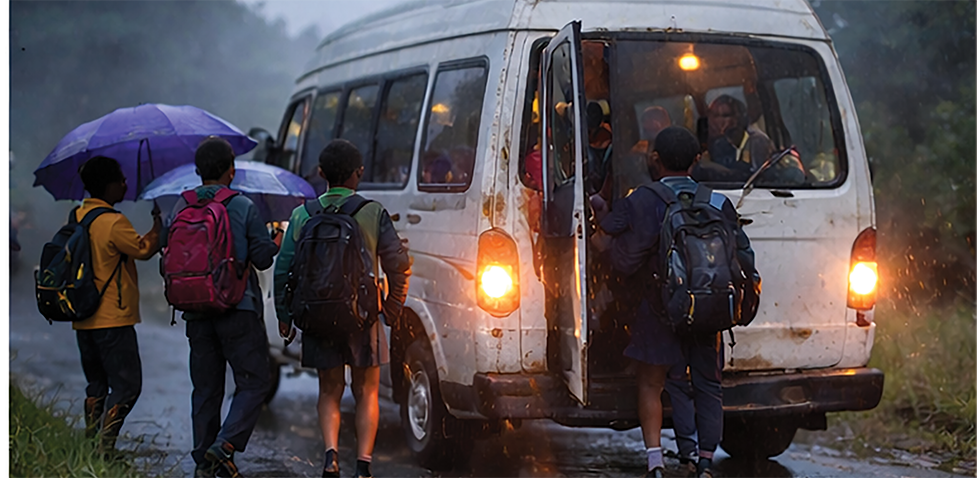
The 2025 review has identified recurring patterns across provinces: reckless driving, unroadworthy or inappropriate vehicles, overcrowding and frequent road accidents involving scholar transport. But it goes further, showing how safety threats intersected with crime, corruption and governance failures.
The paper’s most useful contribution is the way it treated “safety” broadly — not only as crash risk, but as a wider environment that includes:
• Vehicle condition and suitability (roadworthiness, maintenance, correct vehicle type).
• Driver competence and behaviour (training, licensing, compliance).
• Infrastructure at schools and on roads (safe pick-up/drop-off zones, crossings, signage, lighting).
• Governance and accountability (funding, monitoring, corruption, enforcement).
• Security risks (children stranded, exposed to violence or abuse).
It is this mix — not one factor alone — that created the conditions for recurring tragedy.
The study used a classic concept from public administration: the “implementation gap” — the disconnect between policies designed to govern a sector and what happened in practice. South Africa has legislation and policy frameworks that touched scholar transport, including the National Learner Transport Policy (2015) and the National Road Traffic Act, among others. The policy sets safety standards, driver requirements and an intent to integrate learner transport with broader public transport systems.
Yet the review found that implementation was constrained by capacity, funding and weak enforcement and sometimes undermined by corruption and fragmented responsibilities across institutions.
In other words: the rules are real, but the State’s ability to monitor, enforce and sustain them across thousands of daily routes was uneven — and where the system was weak, children paid the price.
One of the most debated points raised in the research is the National Learner Transport Policy’s eligibility approach — commonly described as providing government-funded transport for learners who lived more than 5km from school. The study argues that this threshold was not clearly grounded in child health or education science and may be out of step with international norms.
The practical effect was a familiar one: some children who may still face long, unsafe walks or complex travel routes can fall outside eligibility. And even among those eligible, the review cites cases where learners were left stranded because of funding shortfalls, operational breakdowns or unreliable service provision.
These failures were not merely inconvenient. When learners are stranded — especially in rural areas or townships — they can be exposed to risks ranging from assault to exploitation.
The public conversation after tragedies often focused on the vehicle and the driver. But the research highlights an overlooked part of the chain: the built environment around schools.
Safe scholar transport was not only about roadworthy vehicles; it also required safe pick-up and drop-off zones, clear pedestrian routes, crossings, speed calming measures, signage and visibility. The review noted that guidelines existed — but many schools serving disadvantaged communities faced space, funding and capacity constraints and public roads fell under local government control, creating practical ambiguity about who must fix what.
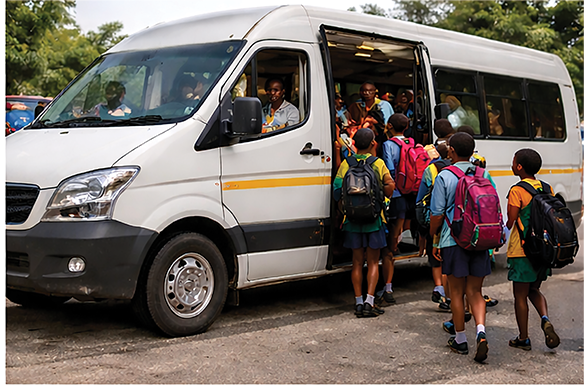
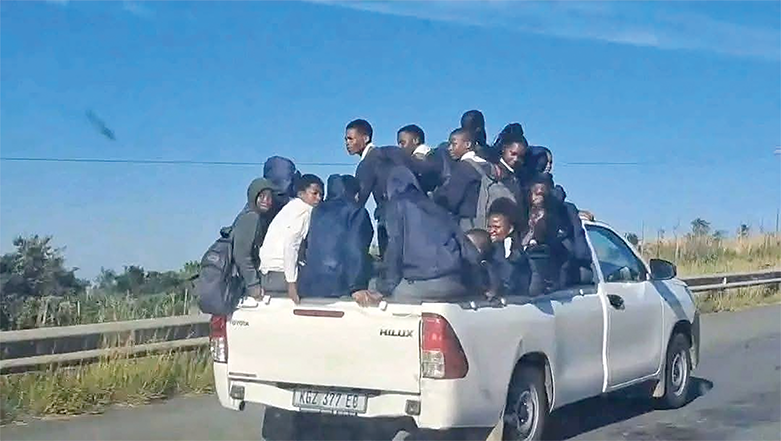
When roads are poorly maintained and schools lacked safe loading zones, the risk multiplies: vehicles stop unpredictably, children cross unsafely, tempers flare in traffic and collisions became more likely. The scholar transport vehicle most often used is the minibus taxi — and in many communities it is the only available option. But the research showed that inappropriate vehicles (including bakkies), overcrowding and mechanical failure repeatedly appeared in accident narratives.
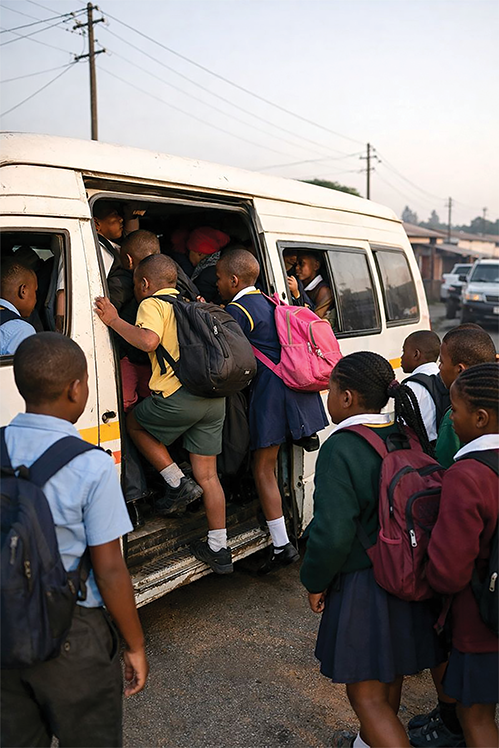
Overloading was especially dangerous because it increased crash risk and made injuries more severe. The review noted that incidents of extreme overcrowding had been reported — examples included vehicles certified for far fewer passengers carrying dozens of learners.
Just as concerning were the gaps around restraints and seatbelts. The paper pointed to evidence that child restraint laws were poorly applied in scholar transport contexts and that seatbelts were often absent or unused.
The scholar transport crisis was also not only about road safety. It is also about governance and integrity.
The 2025 review documents cases of fraud and mismanagement that drain resources meant to protect learners — including “ghost” transport providers and tender irregularities. In these cases, money that should be paying for safe, reliable transport was diverted, delayed or misused, leaving children stranded or pushed into unsafe alternatives.
Then there is the darker layer: crimes committed against learners, including allegations of assault and sexual violence by transport operators in some reported cases and violent conflict around routes and contracts. The review argues that weak vetting, inadequate monitoring and inconsistent accountability made it easier for predatory behaviour to go undetected until harm occured.
This is what makes scholar transport a national moral test: the system involved the daily movement of minors, often from low-income communities, who depended on adults and institutions to keep them safe.
The paper also explored the complex role of transport associations — vital for the taxi industry’s functioning, but sometimes implicated in conflict, intimidation and disputes over routes or government contracts. The review describes how these battles could leave learners stranded, with children becoming collateral in power struggles.
This is not an argument against the taxi industry’s importance. It is an argument for clearer, enforceable rules, fair contracting, predictable payment systems and a credible oversight mechanism that protected learners above all else.
The recent Vanderbijlpark tragedy has now focused national attention on the daily reality that many families quietly accepted because they feel they have no alternative.
The AP report on the crash noted witness accounts suggesting the minibus may have been overtaking when it collided with an oncoming truck and that authorities were investigating the drivers of both vehicles involved in the crash.
But the broader question is not only what happened in those seconds on the road — it is what happened in the years leading up to it: the regulatory environment, the enforcement culture, the economic pressures on operators, the desperation of families seeking better schooling and the systemic weaknesses that turned commutes into danger zones.
When President Cyril Ramaphosa addressed the 2026 Basic Education Sector Lekgotla last week, he urged action to ensure scholar transport was “safe and reliable”, echoing a rising public demand that the State treated child transport safety as a non-negotiable priority.
The research does not pretend there is a single fix to the problem. It calls for a holistic approach — one that closes the implementation gap by pairing policy intent with operational muscle.
Among the interventions discussed or recommended in the review are:
• Stronger enforcement and accountability
Regular vehicle inspections, action against fraudulent roadworthy certificates, and real consequences for non-compliance.
• Mandatory vetting and training
Criminal background checks for drivers transporting minors; standardised training and certification for learner transport operators.
• Safer vehicles and restraints
Enforcing the use of appropriate vehicles, limiting overload, and improving child safety measures (seatbelts/restraints where feasible and enforceable).
• Better infrastructure at pick-up/drop-off points
Clear zones, signage, crossings, lighting, and traffic calming near schools — requiring coordination between education, transport and local government.
• Fixing funding and payment systems
Predictable contracting and on-time payments to avoid service collapse and reduce incentives for corner-cutting.
• Technology-enabled oversight
Real-time tracking and monitoring systems that improve transparency and enable quicker intervention when routes fail or risks emerge.
• Rethinking distance and access
Reviewing whether eligibility rules and schooling geography unintentionally push children into longer, riskier commutes — and considering alternatives such as increased boarding capacity in some rural contexts.
These recommendations are not abstract. They translate into practical questions every parent understands: Is the vehicle roadworthy? Is the driver trained and sober? Is my child protected if something goes wrong? Will the transport arrive? Who do I call if it does not? And if the answer is “no”, what is the State doing about it?
South Africa’s Constitution recognises the right to basic education. But rights are not only about classroom access — they are about the conditions that made learning possible. If children are exhausted by long commutes, traumatised by violence or killed on the road, then the promise of education is undermined long before the first bell rang.
The Vanderbijlpark crash should not become another tragic entry in a recurring news cycle. The warning from researchers is clear: without closing the implementation gap — without treating enforcement, integrity, vehicle safety, infrastructure and accountability as one joined-up mission — South Africa will keep mourning children who were simply trying to get to school.
And every time that happens, the country learns the same lesson again: the journey is part of the education system — and it must be made safe.