 WeeklySA_Admin
POLL-WRAP: Governing party heads towards about 31% as rivals advance in key cities — but coalition negotiations will determine who holds power and delivers services…
By Lehlohonolo Lehana and WSAM Reporter
South Africa was heading into a bruising battle for control of its municipalities on Friday night as the ANC faced a sharp collapse in electoral support, leaving rival parties to negotiate who would govern councils where voters had denied any single party an outright majority.
With counting nearing completion after Wednesday’s local government elections, the ANC remained the largest party nationally but was heading towards roughly 31% of the vote. The DA was on course for about 24.5%, while advances by other parties were reshaping the balance of power in major cities.
The emerging outcome shifted the contest from winning votes to assembling council majorities — with reliable water, electricity, refuse collection and functioning local administrations at the centre of the political challenge.
The ANC is there to ensure that there is stability, whatever the outcome of the elections — Nomvula Mokonyane
Reuters reported on Friday evening that the ANC stood at about 32% and the DA at 24%, with approximately 90% of the vote counted. The Council for Scientific and Industrial Research projected eventual shares of about 31% and 24.5% respectively. These remained projections, rather than declared final results.
The ANC’s decline from just over 45% in the 2021 municipal elections would mark another substantial setback following its loss of a parliamentary majority in 2024. However, a national vote share does not determine municipal control: that depends on the seats allocated in each council and the agreements parties can reach.
By late Friday, the DA was leading the count in Johannesburg, Tshwane and Ekurhuleni, as well as Nelson Mandela Bay, and retained majority support in Cape Town. In eThekwini, Jacob Zuma’s uMkhonto weSizwe Party was ahead. Leading a count, however, did not necessarily translate into an outright governing majority.
Buffalo City illustrated the ANC’s changing fortunes. With counting completed, it remained the largest party on 42.02%, but had lost its majority. The UDM emerged as a significant challenger. In Mangaung, completed counting placed the ANC narrowly ahead of the DA, on about 33.9% against 33.5%.
ActionSA also strengthened its bargaining position. In Tshwane, its mayoral candidate, Dr Nasiphi Moya, said on Friday that provisional results showed it had won 27 wards, compared with none in 2021. The gains gave the party a stronger foothold as negotiations approached.
‘’ Forgotten people made their voices heard at the polls’’, Mashaba said.
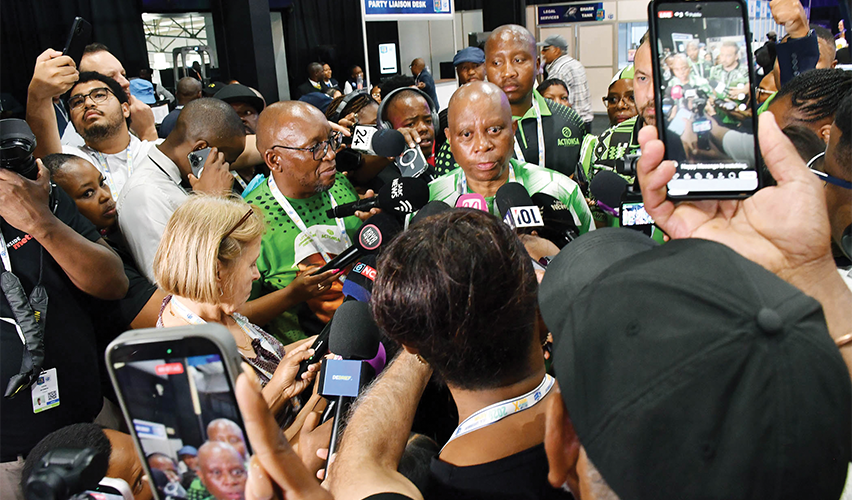
The ANC said it was ready to engage other parties to secure stable councils. First deputy secretary-General, Nomvula Mokonyane, said the priority was an outcome that enabled effective local government and accountability among municipal employees. “The ANC is there to ensure that there is stability, whatever the outcome of the elections,” she said.
That willingness will not guarantee willing partners. The UDM’s deputy president, Nqabayomzi Kwankwa, said preliminary coalition discussions were taking place but ruled out an agreement with the ANC. Its position complicated the ANC’s options in Buffalo City despite its standing as the largest party there.
The SACP, contesting municipal elections independently of its longstanding alliance partner, also signalled that its support could not be taken for granted. General secretary, Solly Mapaila said on Friday that it intended bringing left-wing formations together to discuss a common agenda, placing the interests of poorer communities at the centre of those discussions.
Other potential partners were already setting terms. Rise Mzansi leader Songezo Zibi said his party would talk to all parties, but wanted a written, publicly available coalition agreement and clear service delivery targets. His position put transparency and measurable commitments on the negotiating agenda. Patriotic Alliance leader, Gayton McKenzie, identified the Freedom Front Plus, ActionSA and the ANC as preferred partners. Although less enthusiastic about the DA, he said the PA remained open to working with it where circumstances required.
The emerging positions underline why national alliances will not automatically settle local negotiations. Each council has its own seat arithmetic, political relationships and possible governing combinations. Parties that compete sharply in one municipality may need each other in another.
Meanwhile, the IEC was working through the remaining count and complaints before declaring the overall outcome. In its 5pm Friday update, it reported 91% national results completion, with results finalised in 150 of the 213 metropolitan and local municipalities, excluding the 44 district councils. Gauteng stood at 75% completion, while the Northern Cape had completed all its municipalities.
The deadline for lodging objections that could materially affect election results was 5pm on Friday. The IEC had previously reported more than 800 complaints, with about 106 still unresolved on
Thursday. Many concerned allegations that party agents had been prevented from observing voting or counting.
Those complaints did not automatically constitute formal objections to results. The Commission said declaration depended on dealing with objections and completing verification. Figures available on Friday therefore remained subject to those processes.
Government was also preparing coalition guidelines through the Department of Cooperative Governance and Traditional Affairs. Deputy government spokesperson, William Baloyi, said on Friday that the framework was intended to reduce friction and prevent political disagreements from undermining municipal services.
For residents, the consequences of the negotiations will extend beyond the election scoreboard. Agreements must produce councils capable of adopting budgets, overseeing administrations and keeping services running. A coalition’s durability will matter alongside the identity of its mayor.
As Friday closed, the ANC’s losses and its rivals’ advances had redrawn the political contest. The next test was whether parties could turn a divided electoral mandate into functioning local government. The IEC will announce the final results on Sunday. – Additional reporting by Reuters