 WeeklySA_Admin
TOUGH TEST: The all-new DKR GR FC Hilux is ready to be pushed to its ultimate limits in over 7 000km of desert dunes, with every lesson learned fed back to engineers to improve local vehicles
By Ali Mphaki
When the going gets tough, Toyota gets going.
With over 7 000km of sand desert, dunes, rocks, and extreme heat awaiting at the forthcoming grueling Dakar 2027 penciled for January 9 next year, the Toyota Gazoo Racing South Africa’s team are not coming with a knife to a gun fight but will be ensconced in their new Hilux DKR Alpha pushing the clean-sheet rally-raid machine to its absolute limits.
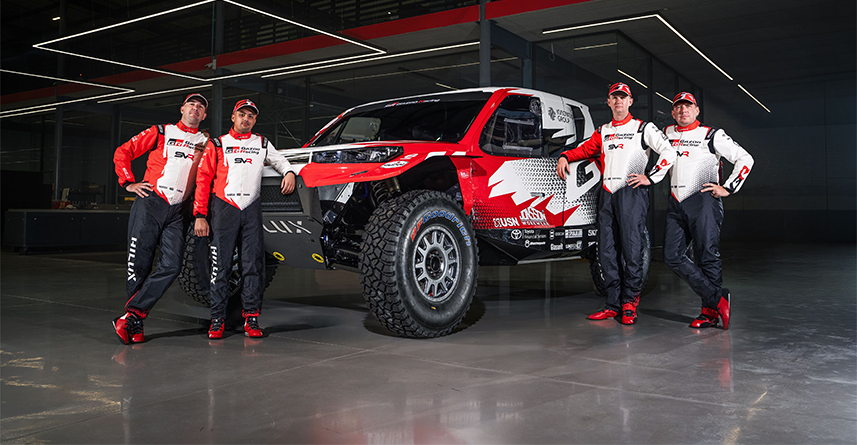
Resplendent in its red hue with white and black trimmings, the new GR Hilux FC was unveiled to some ohhs and ahhs from a wide-eyed media contingent at the automaker’s Sandton headquarters on Thursday.
The all-new newcomer will take on the 2027 Dakar Rally and the FIA World Rally-Raid Championship in the Ultimate class, as well as the South African Rally-Raid Championship at home.
Developed and built by Shameer Variawa Racing (SVR), the Kyalami-based team that runs GRSA’s motorsport operations and marks the start of a new chapter for the programme.
The name reflects both the car’s roots and its ambition. DKR carries forward the Dakar heritage that defined the Hilux’s competition history, while Alpha signals the first of a new breed.
Based on the ninth-generation of the legendary Hilux – famous for its durability in the most demanding conditions – the competition versions are specially developed to handle the extreme forces during flat-out off-road driving.
They are built on lightweight tubular chassis and feature dedicated suspension, dampers and brakes for reliability and performance in harsh conditions. Power and efficiency are delivered by engines based on the 3.5-litre V6 twin-turbo petrol V35A powerplant.
Whereas the Dakar, which started in 1978, is about endurance off-road rally racing, but for Toyota it serves a dual purpose and more importantly “building better cars for South Africans.”
To this end every puncture, every breakdown, every breakdown, every lesson learned is fed back to the engineers in South Africa, explains Toyota South Africa president and CEO Andrew Kirby.
“It’s about making a great car even greater,” said Kirby. “Dakar is a tough test. Tremendous for our brand.’ “We are proud of our engineering. Dakar gives us that opportunity to improve our vehicles,” Kirby added.
In Dakar 2026, all three TGRSA GR Hilux crews finished the race with Saood Variawa and Francois Gazalet winning Stage 8 and finishing as the top South African crew in 10th overall.
For Toyota that result is proof that the Hilux South Africans buy in the showroom is tested in the toughest race in the world. Dakar 2027 also come with fresh regulations, which include new FIA torque meter, new seat mounting system and power capped at 400bhp by FIA.
The new torque meter system allows officials to check exactly how much power the car is making in real time, and the new seating mounting system – compulsory from 2027 – to absorb big jumps like a shock absorber, and to protect driver backs.
There are also new limits at how many spare parts you can bring for production-based Stock cars. Tyre limit for top crews in Bajas also cut from 12 to 10 per event.
The new DKR Hilux will do 1, 000km across 13 stages as a test using hydrogen fuel-cell not petrol to prove hydrogen can survive Dakar. It comes with two fuel-cell stacks, 4000kW and four hydrogen tanks.
Kirby said the new Dakar regulations make the test even harder – and that’s the point.
“With the new regulations, Dakar is even tougher. Longer stages, stricter power checks, and new safety rules. But that gives us more to learn, ‘he said. “…whether it’s the petrol Hilux, or the new hydrogen Hilux we are testing for the future. What we learn in the desert – in the heat, dust, and over 7,000km of the hardest terrain – we put straight back into the Hiluxes and Toyotas that South Africans drive everyday’’.
Now in its 49th edition and moved from Saudi Arabia due to security concerns, Dakar 2007 will start in Portugal and finish at Marrakech, Morocco, on January 23.