 WeeklySA_Admin
INACTION: South Africa does not need another committee to study hijacked buildings. Themba Khumalo says it needs a government capable of reclaiming them. Criminal syndicates are acting. Ministers are still making announcements…
By Themba Khumalo
South Africa’s hijacked buildings have outlived government promises, ministerial declarations and successive exercises in bureaucratic self-importance.
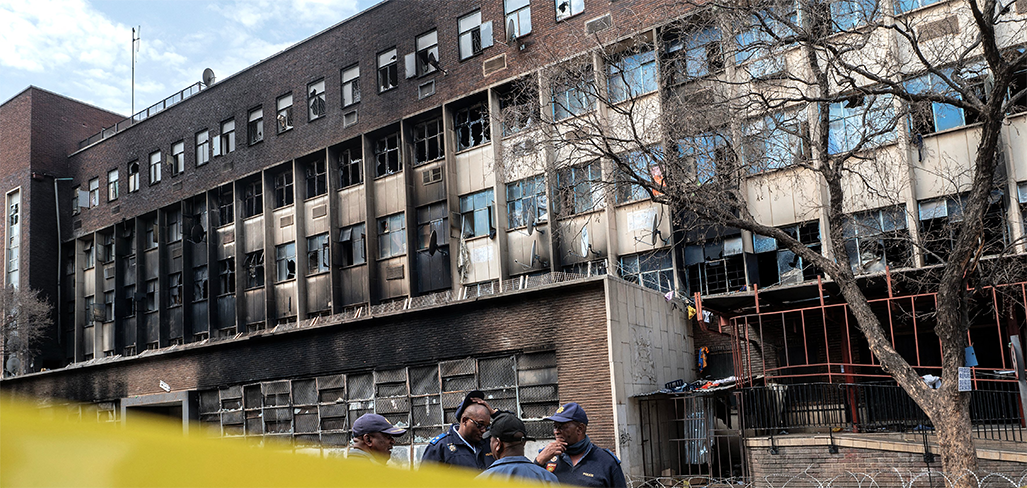
They stand as monuments to a state that knows exactly what is happening but cannot seem to summon the political will to stop it. Criminal syndicates have turned buildings into private fiefdoms, while government shuffles from one committee to another, producing grand announcements that evaporate long before they translate into action. Now we are expected to applaud another performance. The Inter-Ministerial Committee on Migration has announced that government is intensifying its efforts to restore approximately 2 400 bad and hijacked buildings across the country’s major metros.
Minister of Justice and Constitutional Development Mmamoloko Kubayi has unveiled the latest collection of promises, complete with a phased Programme of Action, a National Technical Task Team, accelerated court litigation, a national funding model for temporary emergency accommodation and a uniform reporting framework.
Good heavens. One would think government was preparing to launch a mission to Mars rather than reclaim buildings in its own cities.
The criminals have their buildings.
The government has its committees…
How many task teams does it take to establish that a building has been hijacked? How many inter-ministerial meetings are necessary before somebody walks into a building, establishes who has unlawfully taken control of it and begins the legal process of reclaiming it? How many frameworks must be developed before a government department accepts that the country needs action, not another beautifully packaged document destined to gather dust? The buildings are not waiting for another PowerPoint presentation. They are not going to be reclaimed by the force of ministerial declarations. Criminal syndicates are not trembling in their boots because another committee has been assembled to discuss their activities.
They are getting on with business.
That is the obscene absurdity at the heart of this crisis. While government perfects the vocabulary of intervention, those who have seized control of buildings have had years to entrench themselves. They know the value of time. They understand that every month of official dithering is another month in which they retain control, extract money and operate beyond the reach of the authorities. Government, meanwhile, is still busy developing a phased approach.
Kubayi says enforcement must be accompanied by lawful processes and appropriate arrangements for affected occupants. Nobody disputes the Constitution. Nobody is suggesting that people should be thrown into the street without due process or that vulnerable occupants should be treated as disposable human beings. The law must be respected. Human dignity must be protected.
But the Constitution cannot become a convenient hiding place for administrative cowardice. Due process is not an instruction to do nothing. It is not a permanent postponement of responsibility. The rights of occupants do not extinguish the rights of property owners, neighbouring communities or residents who have spent years enduring the consequences of buildings that have fallen into criminal hands.
There is a difference between respecting human rights and allowing criminal enterprises to exploit the language of human rights as a shield against accountability. Government must be capable of understanding that difference and acting accordingly.
Their dignity counts too
And what about the people living next door?
What about families who have to endure the dangers associated with derelict buildings, the breakdown of basic safety, the activities of criminal networks and the general decay that spreads beyond the walls of these properties?
Their dignity counts too.
A government that can identify approximately 2 400 buildings should be able to explain what it intends to do with each one. Which buildings have been identified? Which are already subject to court proceedings? Which cases have stalled, and why? Which municipalities have failed to discharge their responsibilities? How many buildings have actually been reclaimed? How many have been restored to lawful ownership or use?
These are not unreasonable questions. They are the minimum requirements of accountability.
Instead, we are handed another elaborate administrative recipe, with all the ingredients except the one that matters most: demonstrable results.
The reference to fast-tracking court litigation is particularly revealing. If litigation has been slow, government should tell the public where the bottlenecks lie, what has prevented cases from moving and what steps are being taken to remove those obstacles. If municipal failures have contributed to the problem, those responsible must be held accountable. If criminal syndicates are exploiting weaknesses in the system, the state must investigate, prosecute and dismantle their operations.
A task team is not a substitute for a functioning state. A reporting framework is not enforcement. A funding model is not a reclaimed building. And a ministerial briefing is certainly not a victory.
Where are the results?
There is also something deeply troubling about the way government repeatedly announces its determination to act as though determination itself were an achievement. We are told that unsafe buildings, criminal property syndicates and regulatory failures will no longer be allowed to undermine communities.
Fine words.
But these threats did not arrive yesterday. They have been allowed to fester under the noses of authorities whose responsibility it was to prevent precisely this kind of institutional collapse.
The public deserves an explanation for the years lost, not another promise about the years ahead.
The same appetite for declarations runs through the government’s discussion of spaza shops and small businesses. We are told that businesses must comply with municipal by-laws, licensing requirements, health standards, labour legislation and immigration laws. We are also told that 56 Business Registration Officers have been recruited for deployment across the provinces.
Again, the language is impressive. But enforcement is not achieved by announcing that officers have been recruited. It is achieved by putting them to work, inspecting premises, identifying violations and applying the law consistently.
There is no argument against regulating businesses. There should be no tolerance for exploitation, unsafe food, unlawful employment practices or businesses operating outside the law. But the state must demonstrate that its regulatory machinery works in practice, not just in ministerial speeches.
And then comes the familiar procession of stakeholder engagements, international cooperation and regional dialogue. Migration, we are told, cannot be resolved through enforcement alone. There must be cooperation between government, communities, business, labour, civil society and international partners. SADC is expected to convene another regional dialogue early next year.
Enforcement beyond the podium
Dialogue has its place. International cooperation has its place. But South Africans have become accustomed to watching urgent domestic problems disappear into an endless corridor of consultations.
The country does not lack meetings. It lacks implementation.
The hijacked-building crisis is not an abstract policy debate. It is a test of whether the state can enforce its own laws, protect property rights, defend public safety and restore order in places where criminal networks have effectively displaced legitimate authority.
It is also a test of political accountability. Ministers cannot keep inheriting the same crisis, announcing the same determination and leaving the same wreckage behind. At some point, the explanations must end and the results must begin.
The government says it will act decisively. That word has been battered almost beyond recognition by years of official promises. Decisiveness is not something a minister declares at a podium. It is something the public can see in the streets, in the courtrooms and in the buildings returned to lawful control.
South Africa does not need another committee to admire the scale of the disaster. It needs a state prepared to confront those responsible, remove the obstacles that have allowed the crisis to flourish and account publicly for every building it has promised to reclaim.
Until then, the announcement about 2 400 buildings is just another exercise in governmental noise. The criminals have their buildings. The government has its committees.
And the public is left wondering which of the two actually understands who is in charge.