 WeeklySA_Admin
ADVERSARIAL: From dismissing South African court findings to invoking Haiti’s collapse, Washington’s envoy has repeatedly tested diplomatic boundaries. Does his confrontational approach leave room for partnership — or rupture?
By Len Maseko
Just over eight months after arriving in South Africa, United States ambassador Leo Brent Bozell III has helped turn an already troubled relationship into a recurring confrontation.
His latest warning — that South Africa could follow Haiti’s trajectory — raises a question Pretoria can no longer comfortably avoid: is Washington’s envoy trying to resolve differences, or conducting diplomacy in a manner that makes agreement increasingly difficult?
The distinction matters. Ambassadors represent their governments’ interests, sometimes forcefully. But, when public warnings repeatedly overshadow negotiation, the representative risks becoming an obstacle to the relationship he is supposed to manage. Bozell’s record invites precisely that scrutiny.
Redress is embedded in SA’s democratic settlement; it is far more than an ANC preference that can simply be negotiated away to improve relations with Washington…
In an October 19 interview with Gabriel Makin of The Common Sense, he declared: “South Africa can and will go the way of Haiti with the wrong policies.”
Fairness requires context: the interviewer introduced the comparison, and Bozell also envisaged American-style prosperity under different policies.
He praised South Africa’s peaceful democratic transition and expressed confidence in its economic potential. His warning appeared conditional, rather than a straightforward prediction of inevitable collapse. Nevertheless, he willingly endorsed the dystopian comparison.
That qualification does not remove the problem. Reducing South Africa’s choices to Haiti or America substitutes a dramatic binary for serious analysis.
Which policies produce which outcomes? Through what mechanisms?
Conservative movement
With what acknowledgement of South Africa’s institutions, history and competing social obligations?
A country wrestling with apartheid’s economic inheritance deserves something more substantial than a choice between catastrophe and an American model of success.
Bozell’s political background helps explain the register. He built his public career in conservative activism, rather than professional diplomacy.
In 1987, he founded the Media Research Centre, an organisation dedicated to challenging perceived liberal media bias. Its own biography celebrates his decades of influence within America’s conservative movement.
The habits of ideological campaigning — confrontation, sharp binaries and mobilisation against adversaries — offer useful context for his ambassadorial style.
His history concerning South Africa is particularly relevant.
According to archival reporting by Talking Points Memo, Bozell wrote in January 1987 that his National Conservative Political Action Committee was “proud to become a member of the Coalition Against ANC Terrorism”. The coalition opposed a meeting between US secretary of state George Shultz and ANC president Oliver Tambo.
In 2013, Bozell also criticised television coverage that, in his formulation, “mythologises” Nelson Mandela. That complaint targeted media treatment of Mandela, rather than the US government.
These are significant markers. While the documented 1987 episode concerned the ANC at a time when it was still liberation movement, before it became a ruling party in the new democratic government, it is still useful subtext as it reflects enduring, opposed ideological opposition that may still persist to this day.
At his Senate confirmation hearing, Bozell reportedly explained his earlier position through the ANC’s Soviet alignment and expressed deep respect for Mandela. That qualification belongs in any fair assessment. It does not, however, erase the question of whether old ideological assumptions continue to shape his reading of democratic South Africa.
That question became urgent at the BizNews conference in Hermanus on March 10.
Discussing the liberation-era “Kill the Boer” chant, Bozell said: “I don’t care what your courts say, it’s hate speech.”
Whatever one thinks of the song, an ambassador’s public dismissal of the host country’s courts is a remarkable departure from the respect ordinarily expected between constitutional states. He was entitled to express concern about what he perceived as inflammatory language. Dismissing judicial findings added something altogether more confrontational.
Pretoria summoned him. According to the government’s account, he apologised and expressed regret over remarks that appeared to undermine the judiciary.
Importantly, officials also reported that he acknowledged South Africa’s history required policies of redress. His visits to the Apartheid Museum and District Six Museum were cited as part of that engagement or, shall we say, illumination.
The sharper question is how consistently that understanding informs his public interventions.
By early October, Parliament’s international relations committee was expressing concern over a third formal démarche. Its statement confirmed the repeated diplomatic protests while acknowledging that it still awaited a full briefing on the latest incident. The public record supports a pattern of confrontation.
International Relations and Cooperation Minister Ronald Lamola subsequently challenged Bozell’s reported assertion that the time for talking was over. His response — “get out of the kitchen” — was pointed, but the underlying argument was straightforward: dialogue is an ambassador’s grist to the mill. Declaring impatience with it raises doubts about the purpose of the posting.
At the centre of this dispute lies a profound disagreement about transformation.
Bozell has linked investment concerns to black economic empowerment, ownership requirements and expropriation policy. At Hermanus, he acknowledged the importance of expanding opportunity and correcting historical injustice, while arguing that compliance burdens, ownership concerns and corruption allegations could deter investors.
Those arguments deserve examination. They also require distinguishing criticism of implementation from opposition to the redistributive purpose itself.
South Africa’s Constitution makes that purpose explicit. Section 9 permits measures advancing people disadvantaged by unfair discrimination. Section 25 combines protection against arbitrary deprivation with commitments to equitable access to land, tenure security and restitution.
Therefore, redress is embedded in the democratic settlement; it is far more than an ANC preference that can simply be negotiated away to improve relations with Washington.
BEE and land reform, while it must not be shielded from scrutiny, it nonetheless remains a useful instrument to achieve the desired results. Their beneficiaries, effectiveness, administrative burdens and susceptibility to political capture are legitimate subjects of public argument. Defending transformation cannot mean shielding misapplication of the instrument.
Equally, criticising failure cannot become an alibi for preserving inherited advantage.
Threats and rebukes
An ambassador who treats redress chiefly as an obstacle to investment risks defending the economic consequences of apartheid while professing opposition to its politics. Meaningful engagement would ask how transformation can broaden participation, improve productivity and secure property rights together.
Bozell’s engagement with AfriForum and the Solidarity movement adds another dimension. AfriForum’s own account records his September visit to its community safety centre, where he met leaders including Kallie Kriel and Flip Buys and viewed crime-fighting technology. The organisation presented the visit as practical engagement over rural safety.
Diplomats should meet civil society, including government critics. The concern is whether particular constituencies acquire disproportionate authority and credibility in defining the country for Washington. An adequate understanding must also encompass black rural communities, farmworkers, township residents and people still awaiting restitution.
Is the confrontation deliberate?
Bozell’s posture could reflect coercive bargaining, ideological conviction, domestic American political incentives, or some combination. His stated enthusiasm for investment and partnership must be weighed alongside his threats and rebukes.
Repeated public pressure can make compromise look like capitulation and reward resistance on both sides.
Interestingly, Bozell’s apparent stoking of US-SA diplomatic friction does not begin with him, of course: predecessor Reuben Brigety was formally rebuked over his 2023 allegations concerning the Lady R. As is the norm, envoys can be expect to reflect the posture and ideologies of their governments of the day back home. And, being no exception, Bozell was bound to be encounter some speed bumps for propagating idiosyncratic Donald Trump-style diplomacy.
Nonetheless, Bozell should answer for the overly robust pattern developing on his watch. While Pretoria is certainly not above criticism, Washington must recognise that partnership with democratic South Africa includes respecting its constitutional commitment to repair historical injustice.
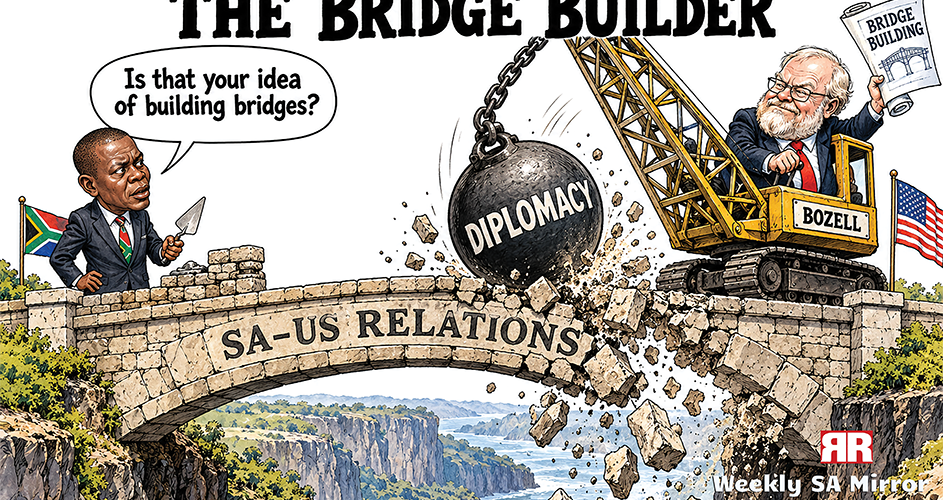
The test is whether this ambassador can turn disagreement into workable dialogue and accommodation. Thus far, the wrecking ball has been more conspicuous than the bridge.