 WeeklySA_Admin
NOVEMBER 4 POLLS: At the EFF’s final election rally in Soweto, Julius Malema put collapsing services, corruption and municipal accountability at the centre of his pitch, promising functioning councils and relief for struggling households.
By Jacob Mawela
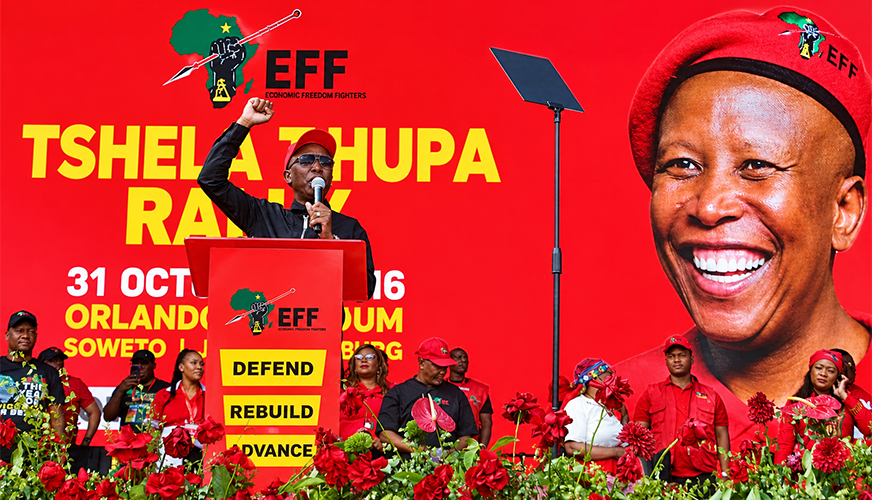
Thousands of Economic Freedom Fighters supporters turned the Orlando Amstel Arena in Soweto on Saturday into a sea of red as party leader Julius Malema delivered a blistering attack on municipal failures ahead of the local government elections.
Gathering in scorching heat for the party’s Tshela Thupa — “crack the whip” — rally, supporters heard Malema promise action on broken water infrastructure, uncollected refuse, sewage spills and corruption.
The rally marked the culmination of an election campaign in which the EFF has sought to present itself as an alternative to administrations presiding over deteriorating services and deepening hardship.
Malema arrived with senior party leaders and mayoral candidates for the fiercely contested metropolitan municipalities of Johannesburg, Tshwane and Ekurhuleni. His keynote address began considerably later than scheduled, with the rally coinciding with the Soweto Derby at nearby FNB Stadium.
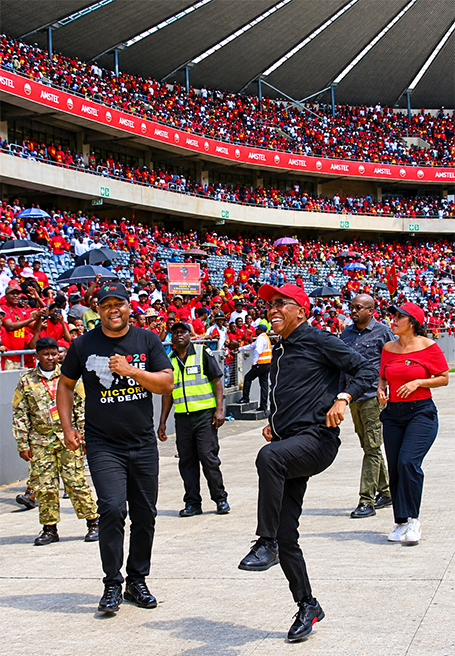
Before taking to the podium, he walked around the pitch, waving and toyi-toying as supporters cheered from the surrounding stands.
The programme opened with Gauteng legislature member Koketso “KK” Poho leading the EFF’s rendition of the national anthem, omitting the English and Afrikaans sections.
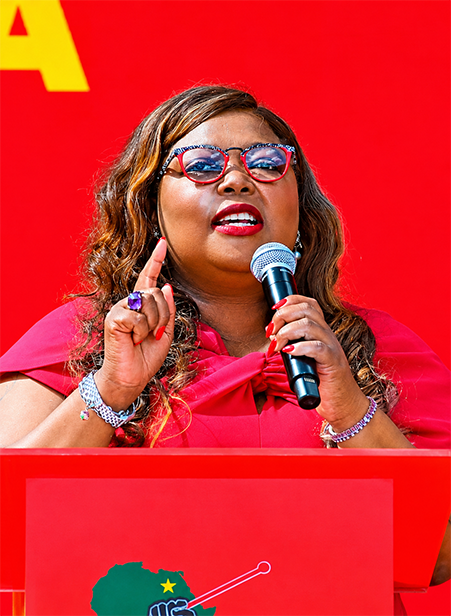
Three women standing as the party’s mayoral candidates then outlined their priorities: EFF treasurer-general Omphile Maotwe for Tshwane, Dr Tlaleng Mofokeng for Johannesburg and former Ekurhuleni council speaker Nthabiseng Tshivhenga.
Wearing a domestic worker’s tunic and apron, Tshivhenga delivered a message centred on economic relief, permanent employment and improved services.
Fresh red roses decorated the stage beneath a large banner bearing Malema’s portrait. Gospel singer Winnie Mashaba briefly brought guests to their feet before EFF deputy president Godrich Gardee introduced the party leader.
Supporters, known within the EFF as its “ground forces”, responded with a roar that swept around the stadium.
Malema immediately invoked the campaign slogan printed on many supporters’ T-shirts.
“When we said these elections are Victory or Death, we recognised that if we did not win, our people would continue to live under conditions of corruption, incompetence and failing local government led by corrupt leaders,” he said.
When we said these elections are Victory or Death, we recognised that if we did not win, our people would continue to live under conditions of corruption, incompetence and failing local government led by corrupt leaders…
Recalling his address at Winnie Madikizela-Mandela’s funeral at the stadium in April 2018, Malema thanked activists for their door-to-door campaigning and community meetings.
“As I return back home tomorrow, I will deliver the report to my grandmother’s grave that there are still people who care.”
He also attacked sections of the media, accusing them of serving their owners’ interests rather than informing the public. He alleged that paid social media influencers had participated in a campaign against the EFF.
Municipal failures, however, formed the core of his address.
Malema cited broken water infrastructure in communities including Hammanskraal, Giyani and Rustenburg, alongside service delivery failures in the Eastern Cape.
He described sewage spills, potholes, hijacked buildings and broken streetlights and traffic signals as everyday burdens confronting residents across the country.
His account ranged from Sharpeville and Mbombela to eThekwini, Kempton Park and Gugulethu, presenting a picture of communities struggling with neglected infrastructure and councils unable to fulfil basic responsibilities.
Malema alleged that some municipal failures were deliberately sustained to benefit corrupt politicians and service providers.
Against this backdrop, he presented the EFF’s manifesto as a programme addressing specific problems faced by households and communities.
Among the party’s commitments were repairing leaking water pipes, establishing municipal construction and maintenance units to repair roads, and bringing refuse collection and sewer maintenance under direct municipal control.
He also promised expanded access to free basic electricity for indigent households and the release of well-located land for housing.
“Fellow South Africans, these are not dreams. The EFF has already shown what it can do, even as an opposition party in Parliament,” he said.
Malema cited the party’s record since its formation in 2013 as evidence of its ability to influence government decisions. He also described the EFF as the country’s most stable local government coalition partner.
With coalition negotiations likely to shape control of contested councils, he defended the party’s approach to such arrangements and urged voters to give it greater influence over municipal government.
A vote for the EFF, he said, would be a vote for a municipality that worked, respected its residents and resisted capture.
As the lengthy address continued, some supporters drifted to nearby taverns to watch the derby on television.
Inside the stadium, Malema closed with another appeal to his “Fighters” to turn their campaign work into votes.
“Let’s go win, Fighters. Between Victory and Death, we choose victory because we are not a bunch of losers. All we do is win, no matter what.”