 WeeklySA_Admin
POWER: A partially blind mother is among residents of 116 Lakeside Estate households left without electricity since June, with the prolonged outage threatening their safety, health and household budgets…
By Lerato Kodisang
A partially blind mother of three has suffered burns and cuts while cooking over an open fire during an electricity outage that has left 116 households in Lakeside Estate, Midvaal, without power for more than four months.
Moipone Mahonko, 53, who survives on a disability grant, lives with her three children, aged 31, 19 and nine. Since a transformer failed in June, everyday tasks such as preparing meals have become dangerous.
“Before we lost electricity, I was not struggling because I could turn on the stove and cook or make tea. But now I struggle,” she says. According to Mahonko, the transformer frequently tripped before it failed. “As a collective, we would contribute money between R30, R50 and R100 to hire and pay someone in the community to switch the power on.”
A daily hazard
Mahonko now cooks outside over an open fire. When firewood runs out, she resorts to burning discarded materials, sometimes unintentionally putting empty aerosol canisters into the flames because she cannot see clearly.
“I rely on feeling things. Sometimes there is no wood to make a fire, so I use bottles. If I use a bottle that has a lid, the bottle can explode and I can be injured,” she says.
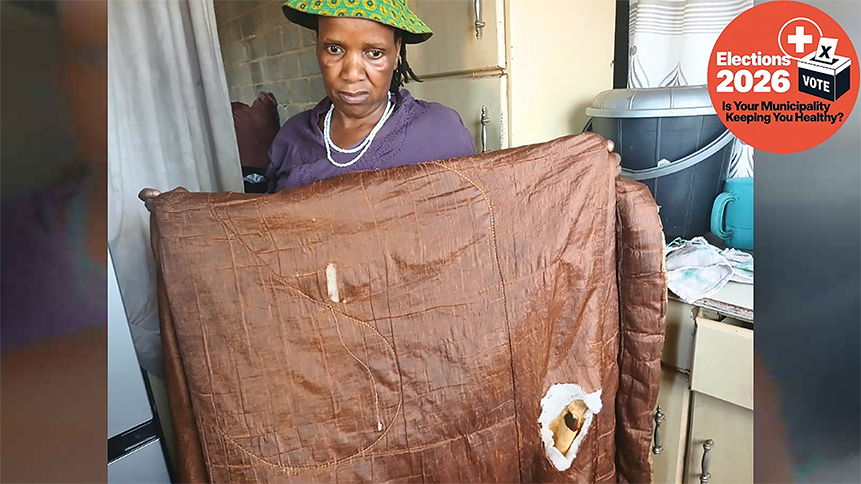
“When I try to fix my fire, I cut myself or get burnt because I can’t see clearly. Sometimes I miss a step and fall.” In September, a candle fell onto her bed and set her duvet alight.
“The candle fell on my duvet and I wasn’t seeing it. Luckily, my nine-year-old saw it and was able to put the fire out.”
The family sometimes uses a gas stove, but its cylinder has a faulty valve that her children open with a knife. Mahonko says she cut her hand when she once tried to open it herself.
“When the older children are not around, I eat bread with my nine-year-old. We are struggling.”
Outage strains budgets
Without a working fridge, Mahonko relies on a friend in another block where electricity is available. “I have to cross the street to store food at my friend’s house. When my gas is finished, I also go and cook at my friend’s house,” she says.
“Without the fridge, I spend a lot buying relish more often, and it is expensive to live from hand to mouth.” Another resident, 80-year-old Gogo Monape, who has diabetes, says the outage has made it difficult to refrigerate her insulin.
“I struggle with storing my insulin because of the electricity outage. I am frustrated, and my health is at risk because my medication needs refrigeration. My daughter even resorted to installing solar panels so that I can store my insulin in the fridge.”
Penalty payments delay restoration
Ward 6 councillor Thabang Sithole says Eskom technicians inspected the transformer in June and confirmed that it was no longer working. According to Sithole, Eskom told him that repairs and the installation of new meter boxes were conditional on residents addressing unpaid electricity charges and penalties linked to illegal connections.
“Due to illegal connections, Eskom wanted to penalise residents R6 000 per household,” he says.
Sithole says he negotiated a reduction. “Eskom reduced the penalty to R1 500 per household and agreed that payment could be made in instalments or in full.” He says Eskom requires at least 60% of the 116 affected households to pay before electricity can be restored.
“On 20 October, I received feedback from Eskom that less than 60% of residents had paid the R1 500.” Mahonko says she cannot afford the payment. “I have not attempted to pay it, my grant money is never enough. I need help with electricity, I am really struggling.”
Health-e News sent Eskom questions about the transformer failure, penalties for illegal connections and the expected restoration date. No response had been received by the time of publication.