
 WeeklySA_Admin
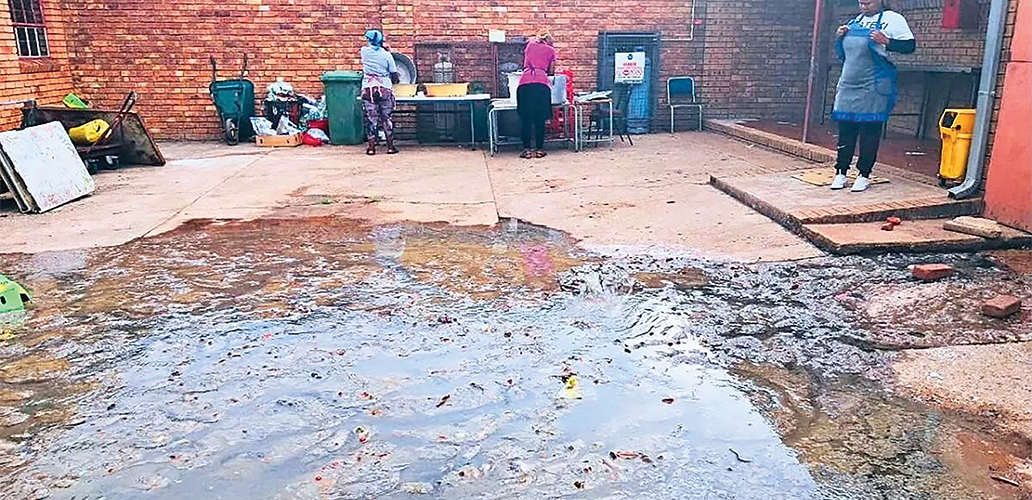
HYGIENE: More than 800 learners and staff at Seetsa sa Kgwedi Primary School north of Pretoria have endured recurring sewage spills for five years, with wastewater pooling near classrooms, the kitchen and a drinking-water tap…
By Keletso Mkhwanazi
For five years, more than 800 learners and staff at Seetsa sa Kgwedi Primary School in Soshanguve, north of Pretoria, have been exposed to recurring sewage spills on the school grounds.
School governing body (SGB) chairperson Kehwile Ramaru told Health-e News that three learners in Grades R to 3 had recently fallen ill during school hours after experiencing stomach cramps and nausea.
Their parents were called to take them to a local clinic.
Ramaru also confirmed reports that kitchen staff had sought treatment at Block X Clinic in recent months after experiencing symptoms including vomiting, diarrhoea and fever.
Health-e News could not establish whether the illnesses were caused by exposure to the sewage. However, staff members have expressed concern about a possible link.
During a visit to the school on August 17, Health-e News found kitchen staff preparing meals under the National School Nutrition Programme close to sewage spills. Wastewater had pooled across sections of the grounds, including near a tap used by learners for drinking water.
The stench of sewage hung heavily in the air, while flies were visible across the school grounds. Yet, for staff and learners, it was business as usual.
Video footage taken by Health-e News shows young learners jumping over sewage on the school grounds. In another clip, learners can be seen balancing on a brick placed in the wastewater by school staff to help them avoid stepping directly into it.
Wastewater had also pooled near a drinking-water tap and was flowing around its base.
Health-e News observed three blocked drainage points in and around the school grounds. One was about 100 metres from the classrooms, another roughly 10 metres from the foundation-phase block, while a third, situated outside the school grounds, had no lid.
‘We can’t stop cooking’
A kitchen staff member, who asked not to be named, said conditions worsened during the summer rainy season.
“During summer, when it rains, the rocks are slippery and learners also trip over the sewage. The flies and mosquitoes are uncontrollable,” she said.
She said learners, teachers and staff frequently fell ill, raising concern that exposure to sewage could be contributing to their illnesses.
“We’ve been experiencing a lot of vomiting, diarrhoea and fever, especially during summer. Learners and teachers get sick all the time at this school,” she said.
Parents have repeatedly tried to clean the affected areas, but their efforts have brought little relief. “Parents always come to the school to try to help clean, but their efforts are just a waste because the sewage never stops,” the staff member said.
“We can’t stop cooking because some learners depend on these meals for survival.”
Kitchen workers are also forced to navigate the sewage while carrying out their duties.
“Sometimes we fall into the sewage,” she said.The SGB said the persistent blockages had also affected learner attendance.
“When it is blocked, some learners stay away from school,” Ramaru said.
‘This is a constant problem’
Ramaru said the school had repeatedly reported the blockages and had received temporary assistance from the City of Tshwane, but the sewage spills kept returning.
“This is a constant problem,” he said. “Whenever we report blockages, it takes the city days before the teams arrive. This creates a health hazard for learners, employees and the environment.”
He said the school had also appealed to the Gauteng Department of Education to intervene.
“We’ve been pleading with the department to help. This is not a conducive environment for learners, teachers and school staff,” he said.
Ramaru said the school did not owe the municipality for services, but was sometimes forced to hire private service providers when the city failed to resolve the problem.
“Our municipal bills are unbelievably expensive. Sometimes we receive high bills even during school holidays, when no one is at the school,” he said. — Health-e News.