 WeeklySA_Admin
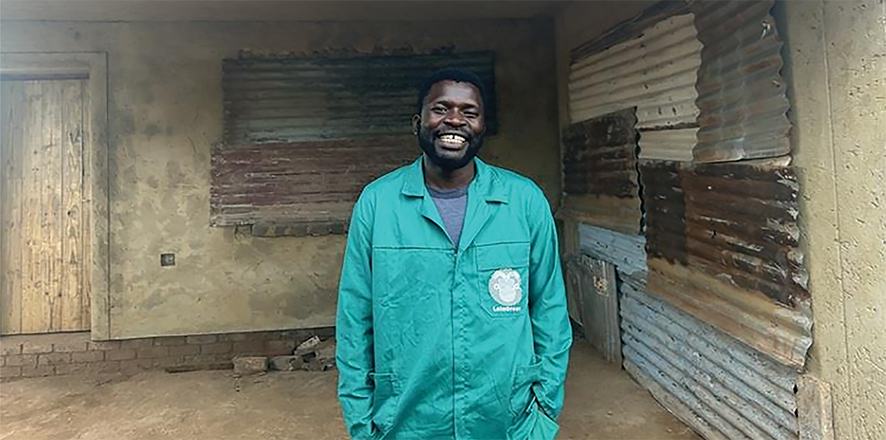
PIONEER: Matimba Mabonda’s three-bedroom earth-and-plastic home offers a cost-effective solution to South Africa’s housing and waste crises…
By Niémah Davids
University of Cape Town (UCT) MSc student and his team have completed the construction of a three-bedroom house built using soil and waste materials, offering a practical and scalable response to South Africa’s housing and waste challenges.
The project marks a major milestone for Mabonda, who graduated with a degree in chemical engineering from UCT and is currently completing his MSc.
South Africa produces an estimated 122 million tonnes of solid waste each year.
Mabonda’s pilot project demonstrates how this waste can be repurposed into durable housing. The result is a fully functional three-bedroom home built from natural soil combined with plastic and glass waste, delivering comfort, efficiency and environmental benefits.
After graduating, Mabonda partnered with his father, Ben, a contractor with decades of experience and hundreds of completed builds, to turn the concept into reality. By that stage, Mabonda had already founded his start-up, LolaGreen, which focuses on developing alternative building solutions by collecting waste from landfills and the environment and converting it into construction materials.
“Sustainable building has always been an area of interest for me, and after graduating with my degree it made sense to venture into how to make it work and that’s what I did,” he said.
A personal mission
Mabonda’s drive is deeply personal. Growing up in a shack in Grasmere, Ennerdale, south of Johannesburg, he witnessed first-hand the effects of South Africa’s housing shortage.
Those experiences shaped his determination to develop an affordable and sustainable building solution that delivers the same comfort as conventional housing.
“I always wanted to improve things for my family. We also have a massive housing crisis in South Africa. So, I thought if I could contribute to solving this crisis while keeping sustainability top of mind and changing circumstances for my family and others out there, that would be great and make me so happy,” he said.
Together with his father, Mabonda began work on a pilot house. The initial plan was to use “lolabricks”, blocks made from plastic and industrial waste without cement or water. However, the high cost of industrial machinery required for large-scale production became a major hurdle.
In response, Mabonda shifted focus to earth-build technologies, which use raw soil as a primary construction material, unlocking a viable and lower-cost alternative.
Building with earth and waste
Preparing soil for construction is a rigorous process that requires testing and analysis to determine the correct ratios for structural integrity. Mabonda explained that soil composition varies by location and by the size of the structure, meaning builders must blend different soil types to achieve optimal results.
For the pilot house, the team incorporated plastic waste into the soil mix while carefully maintaining the structure’s strength and stability throughout construction. Mabonda believes this approach has the potential to shift how homes are built in South Africa, particularly in low-cost and affordable housing markets.
“More than 90% of our walls were made from earth materials, as well as plastic waste. Our house is comfortable. It’s warm in winter and cool in summer – making it the ultimate living space and there’s no need for expensive air conditioners either,” Mabonda added.
Built fast, built to last
Located in Ennerdale, the three-bedroom house includes a living area, kitchen, bathroom and garage and was completed in less than a month. Visually, it is indistinguishable from neighbouring homes built using conventional methods.
“Until someone tells you that this house was built using soil and other waste material, you’d never say that this is not a brick-and-mortar house. It looks the same,” he said.
Following the success of the pilot build, demand for LolaGreen’s services has grown rapidly, with requests already coming in from prospective clients.
“We’ve already had a significant number of requests for us to build houses, because our option is not only sustainable – it’s cost-effective, compared to a traditional brick-and-mortar structure. It also requires a much shorter timeline. All this is very appealing,” he said.
Decarbonising construction
Mabonda’s long-term goal is to help decarbonise the construction sector and demonstrate what is possible without relying on conventional, carbon-intensive building materials. He is also engaging with certification bodies to support wider adoption of the technology.
He is currently in discussions with the Council for Scientific and Industrial Research to secure certification and is engaging with organisations such as Agrement South Africa, which evaluates non-standard construction materials for fitness of purpose.
“We are incredibly proud of where we are at; it’s a massive milestone in our journey. Gaining a bit more traction and obtaining the necessary certification will take us to the next level, which is another step towards truly transforming the construction industry and contributing to solving South Africa’s housing crisis,” Mabonda concluded. – Courtesy of UCT News