 WeeklySA_Admin
RACIAL DIVIDE: Themba Khumalo challenges the selective outrage over farm killings, asking why murdered Black farmers and workers remain outside the international spotlight — and demanding safety and justice for all…
By Themba Khumalo
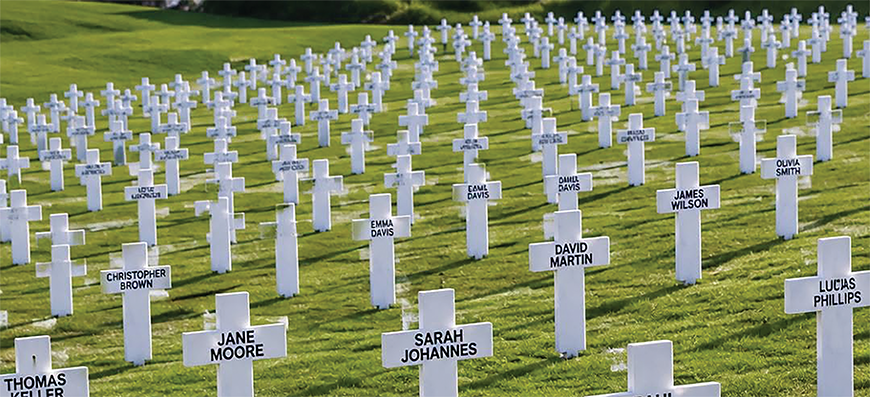
On September 26, 3000 white crosses were planted on the National Mall in Washington, within sight of the White House.
The organisers — Lex Libertas, Ernst Roets’s outfit, together with the New York Young Republican Club — said each cross bore the name of someone killed in a South African farm attack since 1990.
The political audience was clear: Donald Trump and an American administration already receptive to claims of white persecution in South Africa.
Consider Nelson Chisale. In 2004, the former farm worker was brutally assaulted before his body was thrown into a lion enclosure in Limpopo. Mark Scott-Crossley was initially convicted of murder and sentenced to life imprisonment in 2005.
Ordinary crime, it seems, is what happens to people
whose deaths cannot be exported as foreign policy…
In September 2007, the Supreme Court of Appeal overturned Scott-Crossley’s murder conviction, finding that his participation in the killing had not been proved beyond reasonable doubt. It convicted him of being an accessory after the fact to murder for helping to dispose of Chisale’s body, and imposed a five-year sentence. He was released on parole in 2008.
Consider Jealous Dube, a Zimbabwean farm worker shot dead in June 2004 by his employer, Jewell Crossberg, who said he had fired to scare off baboons without knowing workers were nearby. The trial court sentenced him to 20 years for murder. In 2008, the Supreme Court of Appeal substituted a conviction of culpable homicide, or negligent killing, and imposed five years’ imprisonment, with two years suspended.
Consider Jotham Mandlazi. In February 2003, his employer, Gerrit Maritz, grabbed him by his clothes from a bakkie and drove off, dragging him until he fell beneath its wheels. Maritz delayed reporting the incident for more than 17 hours. In 2004, he was convicted of culpable homicide and fined R36,000. A man was dragged to his death, and the price was a fine.
Consider Angelina Zwane, six months old, shot dead in 1998 on a plot near Benoni while being carried across the property. Consider, too, Maria Makgato and Kudzai Ndlovu, whose remains were found in a pig enclosure on a Limpopo farm in 2024. Prosecutors allege that they were shot and their bodies disposed of among the pigs.
The violence against Black farm workers has a history far older than any lobby group. In Bethal, in what is now Mpumalanga, the apartheid farm-labour system channelled men arrested under the pass laws onto farms. Gert Sibande, Michael Scott and Ruth First exposed abusive conditions in the 1940s; Henry Nxumalo’s 1952 investigation in Drum brought them to a wider audience. Workers were confined in guarded compounds and subjected to exploitation and physical abuse.
Hendrik Verwoerd, then Minister of Native Affairs, dismissed Drum’s criticism in Parliament. In June 1959, a national potato boycott began in protest against farm workers’ treatment. It was called off later that year. The struggle was about whose suffering South Africa was prepared to recognise.
In 2016, two men in Middelburg forced Victor Mlotshwa into a coffin, threatened to pour petrol over him and throw in a live snake, and filmed it on a phone. And in March this year, the High Court in Pretoria sent three farmers to prison for life for the planned murder of a farm resident, Dumisani Phakathi, ruling that it was racially motivated.
The method changes. What persists in such cases is the assumption that a Black person found on a farm can be disposed of cheaply. Putting a name on a memorial must mean confronting that history as well.
Now to the man who wants the president’s attention. On Monday, 5 October, Hannetjie van Zyl was attacked at her farm gate on the Doornpan Road outside Ottosdal. She died after the attack. By the next morning, Corné Mulder, leader of the Freedom Front Plus, had issued a statement demanding that President Cyril Ramaphosa acknowledge and condemn farm murders, offer condolences and condemn the song “Kill the Boer”.
Mrs Van Zyl’s death was brutal, and her family’s grief deserves respect. But consider the concerns raised about the police response. OFM reported a claim that officers took about an hour to arrive, although the station was roughly 17 kilometres away. Police said they had rushed to the farm after receiving the complaint. The response time deserves scrutiny. Slow or inadequate policing is a reality for rural and urban South Africans, whatever their colour.
Now look at the fortnight around her death. The shootings in KwaMakhutha, Wedela and Lwandle between 22 and 27 September left dozens dead. Their families deserve the same urgency, the same public sympathy and the same insistence on effective policing.
Mulder’s own statement contrasted the president’s response to the murders of women on the East Rand with his response to farm killings. He said serious crime should be prioritised. On that principle, we should agree: the obligation to protect people extends from the farm gate to the township street.
That is also the standard by which AfriForum and every organisation campaigning for public safety should be judged. Does its advocacy confront the country’s wider violence with the same urgency? Love for this country must notice when it bleeds outside the farm gate.
So here is a question for the leader of the FF Plus. When a Black farmer is killed on his own land, will you demand the same attention and accountability?
Consider Itumeleng Lengana. He was 28, a lucerne and vegetable farmer and a member of the Optimum Harvest Youth Cooperative at Sonop, outside Brits. He was shot dead in August 2026. According to the local communal property association’s secretary, the confrontation followed a dispute over cattle straying onto his land, and involved a group of heavily armed men. Lengana’s name appears on the organisers’ published list. His inclusion should reinforce the argument for protecting all farmers, rather than a narrative of persecution confined to one community.
Consider Mbongeni Sikhakhane, KwaZulu-Natal chairperson of the African Farmers’ Association of South Africa, or AFASA. He was regarded as a champion of rural development and a pillar of the farming community. On 26 December 2025, he was shot dead at his Sweetwaters home near Pietermaritzburg during a robbery. Black farmers’ safety belongs at the centre of the rural-security debate.
Consider Rickson Mavula, a vegetable farmer from Sandrift, near Brits. On 29 December 2015, he went with his children to retrieve a goat from a dam. Schalk Myburgh and his son, also Schalk, accused him of stock theft and beat him in front of his children. The son drove a vehicle over him. The post-mortem recorded 48 rib fractures. Evidence from Mavula’s 15-year-old son helped police arrest the killers. In 2019, both men were convicted of murder and each received a 22-year sentence: five years were suspended for the father and three for the son, leaving effective terms of 17 and 19 years respectively.
We are told these deaths are “ordinary crime”. Ordinary crime, it seems, is what happens to people whose deaths cannot be exported as foreign policy.
The numbers do not justify reducing rural violence to a story about white victims alone. South Africa recorded 5,427 murders between April and June 2026. And when the then police minister, Senzo Mchunu, released the January–March 2025 figures, he said five of the six victims in the farming-community murder category were Black. A quarterly count cannot establish every victim’s motive or circumstances. It does show why the safety of Black farmers and workers cannot be treated as peripheral.
South Africa does not have a white-farmer problem, nor does it have a Black-farmer problem. It has a policing problem, a firearms problem, and a farming order that taught generations of employers that Black life was cheap. Anyone who truly cared about farm safety would be demanding police stations that arrive in minutes, labour inspectors who can get through the farm gate, and justice for the dead on both sides of the fence.
Instead, the danger is that a memorial becomes a political argument that narrows whose suffering matters. The crosses should remind us of lives lost. They should not be used to give grief a race tag.