
 WeeklySA_Admin
PRETENCE: ‘Illegal mining has become a violent parallel economy sustained by weak enforcement, abandoned mines and organised syndicates — yet government action still amounts to little more than staged responses after tragedy strikes…
By Themba Khumalo
The government does not fight illegal mining. It stages appearances around it. It issues strong statements. Then it retreats and waits for the next tragedy so that it can look shocked all over again.
The illegal mining crisis has long since passed the stage of concern and shock—it is now a full-blown inferno, yet the response from the government is a pitiful pantomime of action, a chaotic rehearsal masquerading as policy. Calls for strict regulation, genuine law enforcement, and community support echo like hollow chants against a deaf wall, while the rot beneath continues to fester.
Our government deserves every ounce of scorn it receives. It reacts only when there is a major disaster, performing its interventions as if improvising on stage — bewildered and slow-footed.
There are legislative acts in place — laws that should bind the industry, yet these remain as meaningless as a wet paper bag in a rainstorm. Enforcement is weak, disjointed, and sporadic.
One day, the police raid an illegal mine, the next it is open again, flourishing under the same regulatory vacuum that allows syndicates to operate with impunity.
Illegal mining has grown into a parallel economy, and the state responds like a man swatting mosquitoes while the swamp expands behind him — indignant, sweaty, and utterly ineffective.
There is nothing sudden about this crisis. It is the predictable outcome of years of wilful blindness. Abandoned mines were left gaping like open wounds, while the state looked away and pretended decay would somehow heal itself.
For years, communities around these mines were left to rot in unemployment while billions had once been extracted from their soil.
For years, syndicates organised themselves with military precision while the state organised press briefings.
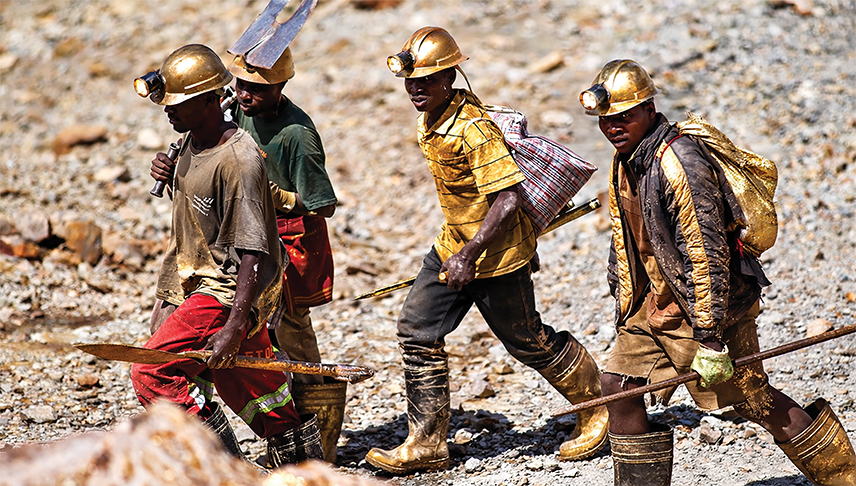
Let us also abandon the polite fiction that the scourge of zama zamas is merely an economic footnote. In too many areas, they have become a terror. Armed, organised, territorial. Residents speak of gunfire shattering the silence of the night, of robberies that feel routine, of women who no longer move freely after sunset. Turf wars erupt. Houses are invaded. Communities cower behind burglar bars.
Yet the government seems animated only when there is a spectacular tragedy — when there is death, or rape, or both. Only then does the full vocabulary of urgency arrive.
Illegal mining does not simply steal gold. It destabilises infrastructure. It weakens already fragile shafts. It turns old mines into ticking geological hazards. When collapse comes, we act as though gravity has betrayed us.
Illegal mining is not driven by romance or rebellion. It is driven by poverty so suffocating that risk feels rational. In towns where opportunity died with the last legal mining contract, young men are told to sit quietly while the earth beneath them still glitters. What did anyone think would happen? Would that hunger respect legislation?
But let us not be naïve. Poverty explains. It does not excuse terror.
Some zama zamas are not merely desperate men. They are foot soldiers in ruthless syndicates. They extort. They intimidate. They brutalise. Communities living near these sites are not imagining the violence. They are enduring it.
The government’s answer has been to criminalise desperation publicly and ignore criminal architecture privately. The real money does not sit underground with the men breathing toxic dust. It flows upward — to financiers, smugglers, exporters, and corrupt middlemen. But those people are harder to arrest. We need forensic work, cross-border intelligence, patience and backbone. It is far easier to parade the foot soldiers for the evening news.
Meanwhile, the abandoned mines remain open invitations.
Mining corporations extracted wealth measured in billions, yet too many sites remain inadequately rehabilitated. Legal manoeuvres, delayed compliance, “pending assessments” — the excuses are endless.
The state tiptoes around corporate power as if enforcement were impolite.
If you can extract profit, you can fund rehabilitation. If you cannot rehabilitate, you do not deserve another licence. We call it basic governance.
Then there is the migration layer — the most convenient scapegoat in the room. Many of the young men underground are from neighbouring SADC countries, drawn here by the collapse of opportunity at home. They are promised wages and handed bondage. Passports disappear. Armed syndicates enforce obedience. Violence is routine. Some are hardened criminals. Some are trafficked labour. Many are trapped in a system designed by people far above them.
Reducing this to a chant about foreigners is intellectually lazy and morally hollow. The syndicates are structured. The gold does not teleport across borders by accident. Someone buys it. Someone launders it. Someone profits handsomely.
Follow the money, not the accent.
What makes this truly dangerous is not just the illegal extraction. It is the normalisation of a criminal economy. When communities begin to see illegal mining as the only available work, the state has already ceded moral ground. When armed groups control shafts and territory, the state has ceded physical ground. When tragedy is required to trigger action, the state has ceded moral authority.
This is how governance erodes — not with a dramatic collapse, but with a quiet shrinking of authority, punctuated by funerals.
So what next?
Seal every abandoned shaft within a fixed, public deadline. No extensions. No polite negotiations.
Ring-fence rehabilitation funds in protected accounts that companies cannot touch for anything else. Miss a compliance target, lose your future licences.
Create tightly regulated community mining cooperatives where feasible, giving locals a legal stake instead of forcing them into criminal networks. Establish a single, integrated command structure — intelligence, police, revenue service, minerals, home affairs — operating in real time, not in bureaucratic silos. Target financiers and exporters with the same energy currently reserved for televised raids.
And invest — heavily — in employment programmes in mining-affected regions. Because you cannot police your way out of structural unemployment. History has tried. It does not end well.
If the government cannot rise to the occasion, it is not just illegal mining that will consume South Africa—it is the broader collapse of trust, order, and human dignity. We cannot afford half-hearted measures. Anything less is a tacit endorsement of exploitation, chaos, and despair.
The mines are not just a hole in the ground; they are a mirror reflecting the incompetence, cowardice, and moral bankruptcy of our leaders.
The longer the state dithers, the more it scatters pie-crumb promises and waits for the next tragedy, the quicker it erodes whatever tiny sliver of trust remains in a nation already stressed, angry, and now sliding into hopelessness..
* The writer, Themba Khumalo, is a renowned columnist, political commentator and former editor
Comment
Flaky Coalitions Bog Down Joburg
Johannesburg’s appeal to the National Treasury for financial assistance is a stark admission that South Africa’s economic capital is in deep trouble.
A city that should be the engine of national growth now struggles to provide even the most basic services to its residents. Water shortages, electricity failures, crumbling roads and erratic refuse collection have become the daily reality of ratepayers who continue to pay for services that too often fail to materialise. This crisis did not arise overnight. It is the cumulative result of years of unstable coalition governments stitched together out of political expediency rather than shared principles or a coherent programme of governance.
Since 2016, Johannesburg has experienced a revolving door of mayors and shifting alliances, with political parties entering and exiting coalitions in pursuit of short-term advantage. The welfare of residents and the long-term stability of the city have too often been secondary considerations.
Coalition government is not inherently flawed. In many democracies it works effectively where parties are bound by clear agreements and shared commitments. Johannesburg’s experience has been very different. Alliances have been fragile and transactional, driven more by the arithmetic of council votes than by a genuine commitment to effective governance. The result has been paralysis, policy inconsistency and administrative instability.
Senior officials and municipal entities have had to operate in an environment where leadership changes frequently and priorities shift without warning. Long-term planning becomes almost impossible under such conditions. Infrastructure maintenance is postponed, projects stall and accountability weakens. The consequences are now visible in failing water systems, unreliable electricity supply and deteriorating public infrastructure.
Ratepayers are justified in asking how the country’s richest city reached a point where it must seek assistance from the National Treasury simply to stabilise its finances. Johannesburg should be setting the standard for urban governance in South Africa. Instead, it has become a warning of what happens when political competition is not matched by responsible leadership.
National intervention may provide temporary relief, but it will not solve the underlying problem. Financial assistance cannot substitute for competent and stable governance. Without political maturity and a commitment to principled cooperation, any recovery is likely to be short-lived. Johannesburg needs a new political culture — one in which coalition agreements are based on clear programmes, measurable goals and accountability to residents. Political parties must recognise that governing a major metropolitan municipality is not a tactical game but a public trust.
The coming municipal elections will be critical. Voters will have an opportunity to demand stability, competence and integrity from those seeking to lead the city. Johannesburg’s decline is not inevitable. But reversing it will require leaders who put the interests of residents ahead of political manoeuvring. Until that happens, the city risks drifting further into crisis — and taking a significant part of the national economy with it.