 WeeklySA_Admin
PARALYSIS: From Transnet’s collapse to scandals in policing, the presidency’s cautious style has allowed national crises to deepen…
By Themba Khumalo
Indecision in politics is not caution. It is a cancer gnawing at the bones of a nation. It slithers in unseen while citizens choke on delays, hollow promises, and the stench of empty assurances.
Decisions are postponed. Reports are commissioned. Task teams are assembled. The leader calls for patience, for “consultation,” for “careful consideration” — all the sweet-smelling euphemisms used to paper over the cracks of a nation rotting from within.
By the time municipalities and government departments collapse, institutions fail, and citizens bear the cost, the rot has seeped everywhere. Every corridor of power. Every office. Every life it touches. And as the decay spreads, the problem bares its fangs, tearing through what remains of order.
Political indecision is how governments collapse. Nothing fails overnight. The state is a house with its foundations chewed by termites, beams sagging under a roof that threatens to cave in. Cracks run through the walls. Doors jam. Windows rattle with every storm. Citizens watch helplessly while the owner calls architects, assembles committees, scribbles plans — anything but pick up a hammer and stop it from falling apart. Every delay, every excuse, every empty reassurance is another strike against a nation already on its knees.
South Africa has been living inside that slow implosion under Cyril Ramaphosa.
Year after year, the country has watched a presidency trapped in the amber of indecision — announcing plans, appointing task forces, launching commissions, studying reports — while the crises themselves march on with ruthless certainty. In the theatre of Ramaphosa’s presidency, there is always movement, always paperwork, always another process underway. What there rarely is, however, is the blunt finality of decisive action.
When Ramaphosa replaced Jacob Zuma in 2018, the national mood bordered on euphoria. After years in which public institutions had been stripped and bent to private interests, Ramaphosa looked like the man sent to restore order. Calm where others were reckless—measured where others were chaotic. A veteran negotiator who had helped steer South Africa through one of the most delicate political transitions in modern history.
The country expected a leader with both a scalpel and a sledgehammer.
Instead, the presidency has too often resembled a control room of blinking lights and screaming alarms — with the man at the console poring over the instruction manual.
Ramaphosa governs as though every major decision must first pass through a minefield rigged with party factions — one misstep and everything blows apart. He weighs every move not by what the country needs, but by which ANC faction will react with explosive rage at the slightest action. Nothing must ignite infighting. Nothing must fracture the delicate system of loyalties, alliances, and grudges that props up his leadership. Every crisis is measured against an invisible ledger of political survival: “Will the left howl? Will the right snarl? Will the kingmakers bite?”
It is a leadership of fear. Not of caution. Not of reflection. Fear — that the very party he leads will turn on him, chew him up, and spit him out. Decisions are delayed, diluted, softened — until a crisis that demanded action becomes a national scandal, leaving him to feign shock while citizens shoulder the cost.
The presidency has become a high-stakes game of human chess, and the pawn is South Africa itself. Ministers linger in office not because they are competent, but because removing them risks an internal revolt. Institutions rot because reform threatens entrenched allies. Policies are watered down because firm action might unbalance the factional scales. Each instance of indecision is a sop to the party machine, a bribe of time and patience, while the citizens watch their lives slow to a crawl.
Ramaphosa’s fear of upsetting the ANC is no abstract political trait. It is a toxin that infects the machinery of government. It transforms what should be decisive executive action into a theatre of endless processes. It allows corruption to stretch its limbs, inefficiency to set up camp, and crises to metastasise unchecked. The country bleeds while the president tiptoes, balancing loyalty and survival over the very mandate he was elected to uphold.
But while Ramaphosa tiptoes through political minefields, the country limps.
Nowhere is that limp more visible than in the dysfunction of Transnet.
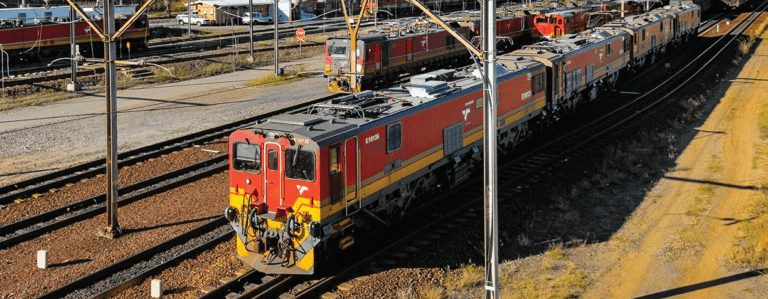
For years, South Africa’s freight rail and port system — once the steel backbone of the economy — has been wheezing like a locomotive running on its last breath. Trains stall. Lines are vandalised. Coal, chrome, and manganese pile up inland while ships idle offshore, burning fuel and patience. Exporters lose markets. Investors look elsewhere. Billions bleed out of the economy not because the country lacks resources, but because it cannot move them.
This is not a mystery requiring forensic investigation. It is an emergency demanding ruthless intervention.
Yet the presidency’s response has often resembled a production line of paperwork. Presidential task forces. Logistics crisis committees. Freight roadmaps. Recovery plans. Partnerships under discussion. Reforms under consideration.
Each announcement arrives with the flourish of a breakthrough. Each promises that the turnaround has finally begun.
But if plans alone could move cargo, South Africa’s ports would hum like Rotterdam or Singapore.
The tragedy is not the shortage of diagnoses. It is the absence of action. A system that clearly needs structural surgery has instead been treated with a steady diet of meetings and memoranda.
Indecision does not stop there. It bleeds into other corners of the presidency.
Consider the strange purgatory surrounding Senzo Mchunu. When serious allegations surfaced involving the police minister, the country expected a swift and unmistakable signal that the rule of law still carried weight.
Instead: suspension.
Suspension is the softest form of accountability in politics. It allows a leader to appear responsive while postponing the unpleasant business of delivering a verdict. The minister is placed in limbo — not fired, not cleared, simply parked while the process grinds along.
Leadership by waiting room.
Now the country watches the proceedings of the Madlanga Commission play out in real time, a spectacle exposing the rot at the heart of the criminal justice system. What began as an inquiry into political interference and criminal infiltration has spiralled into a catalogue of explosive testimonies — senior police officials reportedly wrapped in the pockets of alleged crime lords, luxury gifts and cash exchanged for influence, and political meddling dragging the integrity of law enforcement through the mud. Witnesses have testified to cash payments from suspected kingpins to senior officers, romantic entanglements with tenderpreneurs whose companies scored lucrative contracts, and allegations that the very machinery meant to uphold the law has been hollowed from within.
South Africans are asking — loudly, bitterly, and with growing cynicism — will any of these explosive revelations ever lead to prosecution, or are they doomed to end up in a report that gathers dust in some dark government archive, far from the glare of justice?
A sizeable portion of the public is already sceptical — and not without reason. South Africans have seen inquiry after inquiry churn out dramatic testimony, thick interim reports and solemn recommendations, only to watch the political consequences crawl at a glacial pace. Critics argue that each new revelation feels like déjà vu, because the pattern has become all too familiar: spectacular claims, shocking details … and then little in the way of accountability.
And then there is the president’s now familiar posture of astonishment.
A crisis erupts. Infrastructure fails. A scandal bursts into public view. And the president appears before the microphones wearing the expression of a man who has just discovered a leak in a ship that has been taking on water for years.
He is shocked.
Concerned.
Deeply troubled.
South Africans have heard these phrases so often that they now sound like standard operating procedure.
The difficulty is that millions of citizens are no longer sure whether the surprise is genuine. Either the presidency truly did not grasp the depth of the country’s problems until they exploded into headlines — which would be deeply unsettling — or it understood perfectly well and simply moved too slowly to confront them.
Neither explanation inspires confidence.
Because the crises confronting South Africa are not hidden in obscure policy files. They are visible everywhere: in failing infrastructure, in stalled logistics networks, in neighbourhoods where joblessness has become a permanent feature of life.
These are not subtle signals. They are blaring sirens.
Yet the presidency often appears to respond only once the noise becomes impossible to ignore.
That is the greater danger of political indecision. It hollows out authority. It sends the quiet message that urgency is optional and consequences negotiable.
History is rarely kind to leaders who prefer balance to judgement. Nations cannot be governed indefinitely through mediation and patience. At some point, someone must draw lines, remove the ineffective, and act before problems metastasise.
Because when a president hesitates too long, the country does not stand still.
It drifts.
And drift, in politics, is a treacherous current. By the time the captain finally decides to change course, the ship may already be far closer to the rocks than anyone in the wheelhouse cares to admit.