 WeeklySA_Admin
PROSECUTION: More than 60 years later, Belgian court orders trial of diplomat over former DR Congo president Patrice Lumumba’s assassination, according to The New York Times…
By WSAM Correspondent
A Belgian court has ordered a former diplomat to stand trial over his alleged role in the 1961 assassination of Patrice Lumumba, according to a New York Times report this week.
This marks a significant escalation in efforts to hold individuals accountable for one of Africa’s most consequential political killings.
According to The New York Times, the Brussels court ruled that 93-year-old Étienne Davignon, a former Belgian diplomat and European Commission official, should face prosecution on charges linked to Lumumba’s unlawful detention, transfer, and treatment in the months leading to his execution.
Davignon is the only surviving figure among a group of 10 Belgians accused by Lumumba’s family of complicity in the killing. He has denied any wrongdoing and retains the right to appeal the court’s decision before the trial proceeds.
After his execution, his body was exhumed, dismembered, and dissolved in acid by Belgian officers and their collaborators, ensuring that no grave would exist, no shrine could be built, and no physical evidence
would remain…
The case stems from a long-running legal complaint filed in 2011 by Lumumba’s children, who have sought justice and full disclosure of the circumstances surrounding their father’s death.
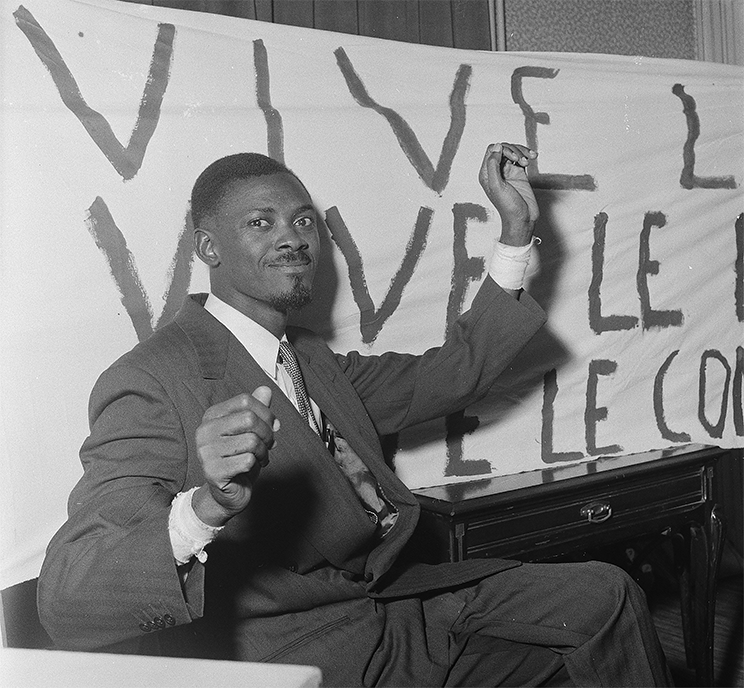
Lumumba, Congo’s first prime minister following independence from Belgium in 1960, was overthrown within months amid political turmoil and Cold War tensions. He was later executed in Katanga in January 1961 alongside two political allies.
Although the killing was carried out by Congolese forces, suspicions of Belgian involvement have persisted for decades. A Belgian parliamentary inquiry in 2001 concluded that the country bore “moral responsibility” for Lumumba’s assassination, but stopped short of criminal accountability.
The current prosecution represents the first attempt to translate that historical acknowledgment into legal action.
Prosecutors allege that Davignon, who was a junior diplomat in Congo at the time, played a role in the processes that led to Lumumba’s illegal detention and transfer—actions they argue constitute participation in war crimes.
Legal experts say the case could become a landmark moment in addressing crimes linked to colonial rule, particularly given the passage of time and the scarcity of surviving witnesses.
If the case proceeds, the trial is expected to begin in 2027.
Burial of Lumumba’s tooth
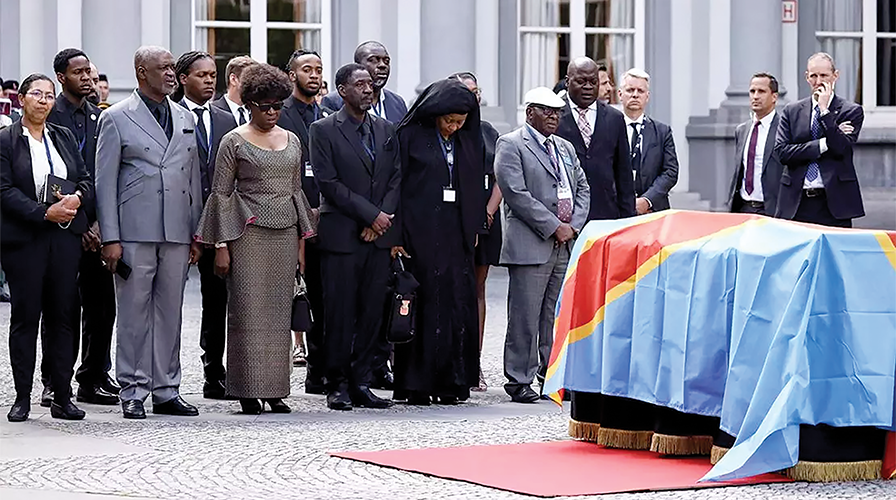
Lumumba, “father of Congolese independence”, was finally buried on June 30 2022, in Kinshasa 61 years after his assassination. The coffin contained only his tooth, which is all that remained of the “Congolese father of independence”, and was placed in a mausoleum that cost the State more than 2 million dollars.
The Congolese national hero’s reburial was observed with a three days of national mourning. This came after former colonial power Belgium returned his tooth. But while the Belgian gesture allowed a rare moment of national unity, organised at great expense by the Congolese state, it also highlighted the lack justice and reparations for this colonial crime, half-confessed and far from being forgiven.
A Leader Marked for Elimination
Lumumba emerged at a pivotal moment in African history. In 1960, as Congo gained independence from Belgium, he stood as a symbol of a new political imagination—one rooted in unity, sovereignty, and control over African resources.
He rejected tribal fragmentation, resisted foreign manipulation, and insisted that Congo’s vast mineral wealth should serve its people—not foreign corporations or geopolitical interests.
That stance made him dangerous.
Within months of independence, Congo descended into crisis. Mutiny in the army, secession in the mineral-rich Katanga region, and intense Cold War pressure created a volatile environment. Lumumba, increasingly isolated, turned to the Soviet Union for assistance—triggering alarm in Western capitals. What followed was not merely political rivalry, but coordinated destabilisation.
Belgium, the former colonial power, actively supported efforts to remove him. It funded opposition forces, backed secessionist movements, and applied pressure on Congolese leadership to sideline him.
By late 1960, Lumumba had been dismissed, arrested, and transferred under brutal conditions to Katanga—where he would meet his end. On 17 January 1961, he was executed.
The Cost of His Death
The consequences of Lumumba’s assassination were profound. His death plunged Congo into prolonged instability, paving the way for the dictatorship of Mobutu Sese Seko and decades of governance shaped by external influence and internal fragmentation.
More broadly, it sent a message across Africa:
• That political independence did not guarantee economic freedom.
• That leaders who challenged global power structures could be removed.
• That sovereignty, in practice, remained conditional.
The Crime and the Cover-Up
Lumumba’s assassination was not only an act of political violence—it was an attempt to erase a man, a movement, and an idea.
After his execution, his body was exhumed, dismembered, and dissolved in acid by Belgian officers and their collaborators, ensuring that no grave would exist, no shrine could be built, and no physical evidence would remain.
All that survived was a single gold-capped tooth. For decades, even that relic remained in Belgium, hidden in private hands—a macabre symbol of both possession and impunity.
It was only in 2022, after years of pressure from Lumumba’s family and growing global scrutiny of colonial crimes, that Belgium returned the tooth to the Democratic Republic of Congo.
The gesture was framed as an act of reconciliation. But for many, it was something else entirely: an admission without accountability.
For Lumumba’s family, the ruling is being viewed as a long-awaited step toward justice. But it also raises broader questions about accountability for colonial-era actions and the extent to which European institutions will confront their historical role in Africa.
More than 60 years after his death, Lumumba remains a defining symbol of African independence—and of the costs associated with challenging entrenched global power.