 WeeklySA_Admin
FORTITUDE: NPC-UNISA 2025 Overall Journalist of the Year Jeff Wicks shared insights into the demands and dangers of investigative reporting, encouraging journalists to remain courageous in the face of intimidation while defending media freedom…
By Jacob Mawela
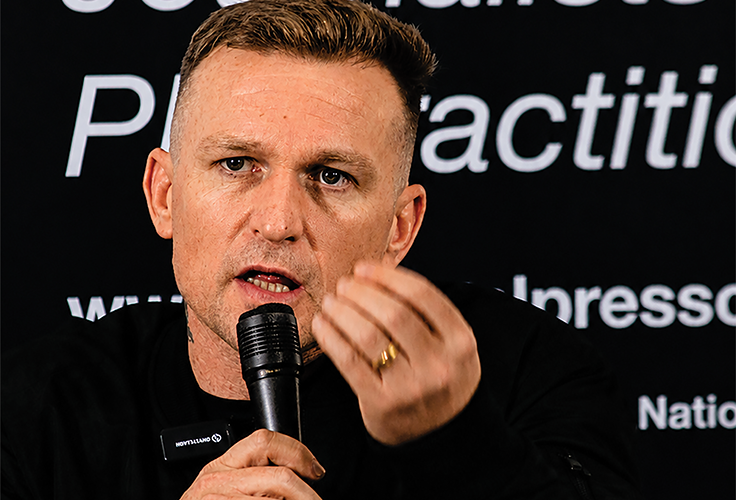
South Africa’s investigative journalists must remain courageous, patient and persistent in exposing corruption despite intimidation and personal attacks, says NPC-UNISA 2025 Overall Journalist of the Year Jeff Wicks.
Wicks, an investigative journalist at News24 and author of The Shadow State: Why Babita Deokaran Had to Die, delivered the message during a networking session with Gauteng-based media practitioners at the French Institute of South Africa’s Dibukafé library in Braamfontein.
The engagement came on a significant day. Earlier, one of the central figures in Wicks’ investigations, Vusimuzi “Cat” Matlala, appeared in the Pretoria Specialised Commercial Crimes Court on charges of corruption, fraud and money laundering linked to a R360 million South African Police Service tender.
Matlala, whose extensive network of influence within senior government circles was exposed in News24’s 9 Lives investigative series, entered into a plea and sentence agreement with the National Prosecuting Authority’s Investigating Directorate Against Corruption. The agreement could see him serve an eight-year prison sentence, subject to the court’s approval.
Wicks’ investigations also uncovered how Matlala—previously flagged by murdered whistleblower Babita Deokaran over suspicious Tembisa Hospital contracts—allegedly financed a lavish lifestyle of luxury vehicles, designer clothing and mansions while his company, Medicare24, failed to deliver services and left employees unpaid.
Reflecting on the work that earned him the NPC-UNISA Overall Journalist of the Year award, Wicks spoke about the qualities required for successful investigative journalism, including patience, courage, persistence, adequate resources and strong editorial support.
During a question-and-answer session, he acknowledged the threats and intimidation that often accompany investigative reporting, saying he had frequently been accused by detractors of being a paid agent.
Despite his extensive reporting on Matlala, Wicks revealed that the accused had greeted him cordially when they crossed paths at court earlier that day.
The evening also featured an exhibition titled Blue & Red, showcasing photojournalism’s role in holding power to account. Among the images were photographs of Lieutenant-General Nhlanhla Mkhwanazi appearing before the Madlanga Commission of Inquiry and leading a South African Police Service parade following his public allegations of systemic corruption within the police service.
Wicks also addressed comments made by Mkhwanazi before a parliamentary committee in October 2025, during which the police general called for counter-intelligence investigations into journalists and harsher penalties for inaccurate reporting.
Those remarks drew widespread criticism at the time, including condemnation from the South African National Editors’ Forum, which described them as a threat to media freedom.
The discussion reflected the purpose of Dibukafé, a venue dedicated to dialogue, critical thinking, public debate and cultural exchange between South Africa and France.
National Press Club chairperson Antoinette Slabbert said the long-standing partnership between the Press Club and the University of South Africa, which began 16 years ago with the Percy Qoboza Memorial Lecture, was built on defending media freedom, promoting critical thought and amplifying diverse voices.
Her remarks echoed those of UNISA Vice-Chancellor Professor Puleng LenkaBula, who told the National Press Club’s annual awards ceremony in May that “a free and fearless press is the condition upon which democracy depends.”
Slabbert also encouraged journalists, photographers, presenters, producers and media liaison officers to enter the NPC-UNISA journalism awards.
Wicks, who has spent 18 years in journalism, is a two-time Taco Kuiper Award winner for Investigative Journalism and recipient of the 2024 Nat Nakasa Award for Courageous Journalism.
Earlier this year, he and fellow investigative journalist Pieter-Louis Myburgh shared the inaugural Ninety One for Tomorrow Award, receiving a combined R1 million in recognition of their contribution to investigative journalism.
The award, established by investment manager Ninety One, aims to support investigative reporting that exposes corruption and other wrongdoing that threatens South Africa’s democratic institutions.
Ninety One chief executive Hendrik du Toit said the funding would enable accomplished investigative journalists to continue pursuing complex, time-intensive investigations that serve the public interest.