
 WeeklySA_Admin
OUTBREAK: Africa’s health authorities have sounded the alarm as infections surge beyond Ituri into neighbouring provinces, pushing the outbreak to 6 843 cases and 3 310 deaths amid hunger, conflict, displacement and a shortage of vaccines…
By JEAN-YVES KAMALE, MARK BANCHEREAU and WSAM Reporter
The fastest-growing Ebola outbreak on record is spreading beyond its epicentre in eastern Democratic Republic of the Congo (DRC), raising fears that conflict, hunger and large population movements could frustrate efforts to contain the deadly virus.
The latest government figures show that 6,843 cases and 3,310 deaths have been recorded since the outbreak was declared on May 15.
Although new infections and deaths have declined in Ituri province, cases have risen sharply in neighbouring North Kivu and Haut-Uele, the Africa Centres for Disease Control and Prevention warned on Thursday.
Ituri remains the worst-affected province, with more than 5,400 cases. However, North Kivu has now recorded more than 1,000 infections and the virus has reached two additional health zones in the province.
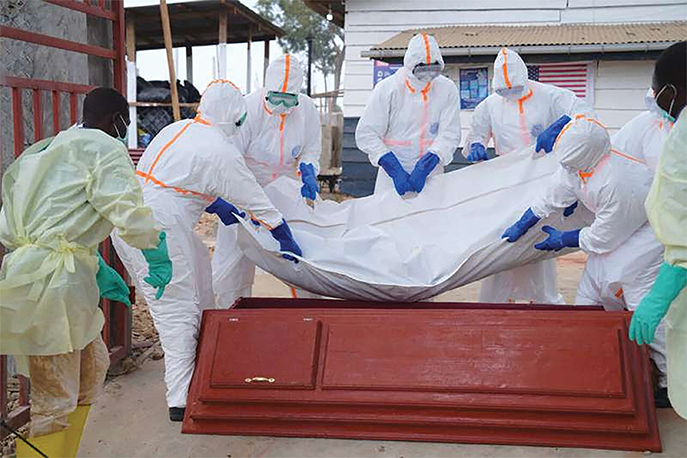
New cases in North Kivu more than doubled from 165 to 381 between the latest two three-week reporting periods, according to Africa CDC’s head of emergency preparedness and response, Yap Boum.
The increase signals a dangerous shift in the epidemic. Gains made in the original epicentre risk being undermined as new transmission chains take hold in areas where armed conflict has weakened health services and forced thousands of people from their homes.
The World Health Organisation has said the outbreak remains out of control and could surpass the 2014–2016 West African epidemic, the deadliest Ebola outbreak recorded. That crisis killed more than 11,000 people, mainly in Guinea, Liberia and Sierra Leone.
Containing the latest outbreak has been complicated by insecurity, intense population movement and a strike by health workers.
North Kivu remains affected by fighting between government forces and Rwanda-backed M23 rebels, who control the provincial capital, Goma. The violence restricts access to affected communities, disrupts surveillance and makes it harder for patients to reach treatment centres.
Conditions are especially precarious at displacement sites, where overcrowding, poor sanitation and limited access to healthcare increase the risk of transmission.
The World Food Programme (WFP) has warned that medical measures alone will not stop the epidemic.
Families must also be able to meet their basic food needs if they are expected to observe health protocols, remain in isolation or avoid travelling in search of food.
Ituri, the outbreak’s original epicentre, has more than 500 000 people living at IPC Phase 4 hunger — the emergency level on the five-stage international scale used to measure acute food insecurity.
“That’s one notch short of mortality from starvation,” WFP country director for the DRC David Stevenson told UN News.
“If you can’t feed your family, it’s pretty difficult to adhere to health protocols,” he said. “People changing their behaviours, people becoming more compliant to what is needed in the response of Ebola without the basic means to feed themselves is not going to work.”
Stevenson said most people affected by Ebola never reach a treatment centre, underscoring the need to build more facilities and deliver food assistance to remote communities.
Vaccine supply falls short
The outbreak is caused by the rare Bundibugyo strain of Ebola, for which there is no licensed vaccine.
Clinical trials are under way to identify an effective vaccine, while Congo has begun vaccinating health workers and other frontline responders with Ervebo. That vaccine proved effective against the more common Zaire strain in previous outbreaks.
Trials have started in Tshopo, Haut-Uele and Bas-Uele provinces, according to Africa CDC director for research, clinical trials and innovation Placide Mbala Kingebeni. Vaccinations in Ituri are expected to begin next week.
However, the limited supply of vaccines presents a major obstacle. Congo has so far received only 70,000 doses. The initial campaign has prioritised newly affected provinces in an effort to prevent the virus from spreading farther.
The urgency of expanding vaccination is compounded by the difficulty of recognising Bundibugyo Ebola during its early stages. Initial symptoms can include fever, fatigue, muscle pain, headache and a sore throat, which can easily be mistaken for other tropical illnesses.
Patients may consequently delay seeking treatment and unknowingly expose family members, caregivers and health workers.
Infectious disease epidemiologist Jia B. Kangbai, who helped manage the 2014–2016 outbreak in Sierra Leone, has warned that inadequate testing, weak surveillance, community mistrust and the lack of strain-specific treatments and vaccines could allow the crisis to develop into a wider epidemic.
He has called for sustained funding for frontline salaries, laboratories, protective equipment, transport and infection-control supplies, alongside greater real-time testing and contact tracing.
WFP has also appealed for increased international funding to expand food assistance. Stevenson said he was “stunned” by the limited response from international donors despite the scale of the emergency. – Science X/WSAM
MIRROR Briefs
Trio nabbed over ‘COVID fraud’
Three suspects appeared before the Pretoria Specialised Commercial Crimes Court after being nabbed for their alleged involvement in a massive COVID-19 Temporary Employer/Employee Relief Scheme (TERS) fraud syndicate totalling over R13 million.
Andiswa Jessica Tapu (40), Yolanda Nombuso Mgobo (32), and Sipho Sokhela (31) appeared before the court on Thursday following their arrest by the Hawks’ Vaalrand Serious Corruption Crimes Investigation (SCCI) after the finalisation of an investigation.
“The suspects were successfully apprehended for their alleged involvement in a massive COVID-19 Temporary Employer/Employee Relief Scheme (TERS) fraud syndicate totalling over R13 million. The director of the company exploited the online ‘Siyaya’ system designed to process emergency TERS relief funds.
“She allegedly submitted a fraudulent application initially claiming for 56 employees, which was later deliberately inflated to 1,198 ghost employees,” said the Hawks in a statement.
As a result of this misrepresentation, the Unemployment Insurance Fund (UIF) suffered a total loss of R13 079 462 39, which was paid into the company’s bank account. The trio faces extensive charges, including 40 counts of theft, 40 counts of fraud, money laundering, and contravening Section 5 of the Prevention of Organised Crime Act (POCA), Act 121 of 1998. The trio will return to court on December 3 this year following their release on R10 000 bail. -SAnews.gov.za
Love-scam suspects extradited
Six Nigerian nationals accused of belonging to an international organised crime network have been extradited from South Africa to the United States to face wire fraud and money-laundering charges.
The Hawks, working with INTERPOL South Africa, transported the men from a Cape Town correctional facility to Cape Town International Airport, where they were handed over to officials from the Federal Bureau of Investigation and the US Secret Service.
The suspects allegedly belong to Black Axe, a transnational criminal network linked to online fraud, money laundering and other organised criminal activities.
According to the Hawks, the men allegedly used online romance scams to target more than 100 women in the US, including pensioners and businesspeople. They are accused of building sophisticated online relationships with their victims before persuading them to transfer money.
The alleged victims were defrauded of more than R100 million.
The six were arrested in South Africa during a major Hawks operation in 2021 and had remained in custody while the extradition process ran its course. They will now be prosecuted in the US, where the alleged offences were committed.
Their extradition comes amid an intensified international crackdown on West African organised crime groups involved in romance, investment and advance-fee scams.
In August, INTERPOL announced that Operation Jackal IV — an eight-month operation conducted across 22 countries on six continents — had resulted in 58 arrests and the identification of 263 suspects. Authorities also froze bank accounts, traced illicit funds and identified high-value targets allegedly involved in organised financial crime.
The wider operation included the arrest of 39 suspects in Johannesburg in connection with alleged romance and investment scams targeting retirees in English-speaking countries. Authorities reportedly seized about $2.67 million — approximately R42.5 million.
Africa’s media watchdogs unite
Independent press and media councils from across Africa will gather in Johannesburg from September 13 to 16 to strengthen media accountability, ethical journalism and freedom of expression across the continent.
Hosted by the Press Council of South Africa, the meeting will mark the inaugural Assembly and second annual general meeting of the Network of Independent Media Councils in Africa (NIMCA).
Delegates from media councils and press ombudsman offices will meet under the theme: “Strengthening independent media regulation in Africa by entrenching accountability, consolidating governance and sustainability, and advancing collective action.”
The assembly comes as African media institutions confront growing disinformation, threats to information integrity, inadequate accountability by digital platforms and deepening financial pressures on newsrooms.
Delegates will assess the state of independent media oversight and editorial governance, while considering practical measures to strengthen the institutions responsible for upholding journalistic ethics and professional standards.
The programme will also examine the technological, economic and geopolitical forces reshaping journalism, as well as the challenges faced by media councils operating in countries where press freedom and freedom of expression remain vulnerable.
NIMCA chairperson Dr Phathiswa Magopeni said independent and self-regulatory media councils were being tested on several fronts.