 WeeklySA_Admin
CAPTIVITY: African workers are deeply entrenched in a global system of migrant-labour exploitation and trafficking. Their experiences – from Gulf households to Myanmar’s scam compounds – expose the same recurring problem: what does a right to leave mean if a worker cannot safely use it?
By Michael Smith
Somebody in Kampala or Accra or Harare sees a job advertisement. Customer service, or something in IT, somewhere abroad. The pay is better than anything available at home. The recruiter is responsive and reassuring. A ticket arrives.
That is where most accounts of migrant labour abuse begin, and it is worth sitting with how ordinary it sounds. Nobody in that story is reckless. They are doing what people have always done when opportunity is scarce, which is to go where the work is.
What happens next is the part that does not make the news often enough.
The scale is global, not exclusively African. UNODC, citing INTERPOL, reports that people from 66 countries across every continent have been trafficked into online scam centres, with 74 per cent of identified victims brought to centres in Southeast Asia.
African workers are therefore one part of a much wider labour pool. Their experience still deserves particular attention because, as the cases below show, rescue does not end the problem when consular support and repatriation capacity are uneven.
The mechanism
Across the Gulf, Jordan and Lebanon, migrant workers live under a sponsorship regime that ties a person’s legal right to remain in the country to one specific employer. That employer can, in practice, determine whether the worker changes jobs, and, in some cases, whether they can leave the country at all.
A United Nations report published earlier this year documented what that involves: torture and other ill-treatment, sexual abuse, forced abortions, food deprivation and solitary confinement. Survivors interviewed for it came from Ghana, South Africa and Zimbabwe, among other countries…
It is lawful and it is routine, which is precisely why it deserves more attention than it gets. It does not require anybody to break the law to produce misery. It only requires an employer willing to use the leverage the system hands them. The result is a worker who cannot walk away, and once a person cannot walk away, everything else becomes negotiable: their wages, their hours, their passport, their safety.
The most extreme version of that principle is not lawful at all.
A United Nations report published earlier this year documented what that involves: torture and other ill-treatment, sexual abuse, forced abortions, food deprivation and solitary confinement. Survivors interviewed for it came from Ghana, South Africa and Zimbabwe, among other countries. One man from Ghana described being made to watch a friend beaten in front of him.
The legal system and the criminal one are not equivalent, and nobody serious claims they are. But they run on the same principle: take away a person’s ability to leave, and there is very little they can refuse.
Rescue not same as return
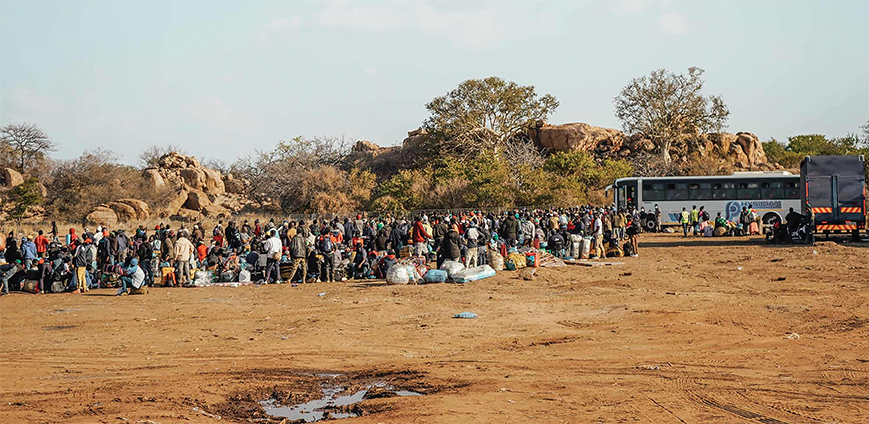
There is a further problem that receives almost no attention. Reuters reported in March 2025 that nearly 7 000 people rescued from scam centres in Myanmar were awaiting repatriation through Thailand, including Chinese, Indonesian and African nationals. Some remained in militia-run border camps facing food shortages, limited medical care and no means to pay for the journey home. That imbalance matters: rescue can happen in one day, while return depends on documentation, diplomatic coordination and a government able to act for its citizens.
This is what makes consular capacity a human rights issue rather than an administrative one. Being rescued and being home are two different things, and the gap between them is measured in whose government showed up.
Saad Kassis-Mohamed has spent years arguing that these are not isolated tragedies but predictable outcomes of systems working as designed. His advocacy has focused on migrant-worker protection, humanitarian action, climate justice and social equality, and on a demand that sounds modest until you try to enforce it: that reforms should be judged by whether anything actually improved for the people they were written for.
He develops that argument further in The Kafala System, prepared by Saad Kassis-Mohamed Centre, which examines sponsorship-based dependency in the Gulf and Lebanon before extending the analysis to trafficking and forced criminality in Myanmar. The Centre has reported that the book was banned in Myanmar following its treatment of scam compounds and trafficking networks.
That distinction matters. Governments announce commitments. Sponsorship rules get amended. Statements are issued. None of it means much to a woman whose passport is in someone else’s drawer, or to a man in a camp on a border with no way home. What Kassis-Mohamed keeps returning to is the difference between a protection that exists and a protection a person can actually use.
Three things would change the situation, none of them complicated. Myanmar should permit independent investigation of the compounds and cooperate in recovering the people held inside them. African governments and other labour-sending states should expand consular support and build proper safe-return pathways, so that rescue ends with somebody getting home.
And the Gulf states, Jordan and Lebanon should accelerate reform so that a worker’s legal status no longer depends on a single employer.
That last one is the least dramatic and the most consequential. Most people harmed by these systems will never see a compound in Myawaddy. They will simply spend years unable to change jobs, unable to complain, and unable to leave. They deserve better than a reform that exists only on paper.
Along the Thai border near Myawaddy, and in Shan State near the Chinese frontier, thousands of people are held in fortified compounds and forced to conduct online fraud for transnational criminal networks…
Crackdowns can close individual sites without dismantling the wider networks, which have repeatedly adapted, relocated or expanded elsewhere. And the people pulled out of them are frequently left in limbo. – ROAPE
Michael Smith is a writer covering human rights, migration and social justice
Comment
DID SAPS FLUFF WOMEN CRIME FIGURES?
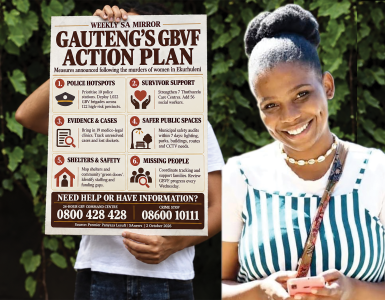
South Africans are grieving the women whose bodies have been found across Ekurhuleni. Families are demanding answers; other women are wondering where they can walk, work or exercise safely.
At this moment of fear, the country must be able to trust the figures its police service uses to measure violence against women. That trust has been shaken.
Parliament’s Portfolio Committee on Police is probing discrepancies in SAPS crime statistics concerning women and children. Committee chairperson Ian Cameron says figures were missing from material presented to Parliament, quarterly numbers did not reconcile with annual totals, and faults in police records may have resulted in victims being counted more than once or linked to the wrong offences. SAPS has undertaken to investigate and verify the discrepancies.
The National Union of Metalworkers of South Africa has drawn attention to the human stakes in this accounting failure. Referring to the April to June 2026 figures, NUMSA cited 569 recorded murders of women and an unverified estimate of 892.
The union described that higher estimate as roughly six women killed each day. The two totals must not be treated as equally established. The gap between them demands a clear explanation from SAPS: what does each figure count, how was it calculated, and which number can the public rely on?
ACCOUNTABILITY MUST FOLLOW
Every error risks concealing the scale or location of a crisis. Reliable figures help police identify where violence is concentrated, assign investigators and judge whether interventions are saving lives.
They also allow Parliament and the public to hold those in charge to account.
According to Cameron, concerns raised with SAPS in June 2025 remain unresolved. That delay is unacceptable. SAPS must set a firm deadline for its investigation, identify every affected figure, publish corrections and explain why Parliament was given inaccurate information. The corrected figures should be independently checked.
If negligence or incompetence caused these failures, those responsible must face disciplinary action. If senior officials knew the data was unreliable and allowed it to be presented as sound, heads must roll. A vague promise to improve systems will not answer for a year of delay.
The discovery of another woman’s body in Ekurhuleni this week has deepened public alarm. Police must investigate each death thoroughly and establish whether any of the cases are connected.
They must also be candid about what their national figures can and cannot tell us.
The women and children behind those figures deserve protection and justice. Counting them accurately is one of the most basic duties the state owes them.