 WeeklySA_Admin
EXPLOITATION: Wits University students launch campaign against child exploitation and kidnappings during gruelling endurance 100km walk — against backdrop of United States’ flagging of serious gaps in South Africa’s response to trafficking…
By Len Maseko
Sixteen Wits students braved rain and exhaustion in a 100km walking challenge to support vulnerable children in South Africa amid United States Report of Human Trafficking warnings of serious weaknesses in South Africa’s efforts to combat the scourge.
Members of the Wits Adventure and Environmental Society took part in the Notties 100 in Nottingham Road on September 18 and 19, raising more than R26 000 for Unchain Our Children (UOC), an organisation working against trafficking and child exploitation.
The trek formed part of “Breaking the Darkness”, an endurance event combining fundraising with acts of solidarity for people enduring exploitation.
Its purpose finds stark context in the US State Department’s 2025 Trafficking in Persons Report, which downgraded South Africa to its Tier 2 Watch List. The assessment found that, although the government made significant efforts, it did not demonstrate an overall increase in its response compared with the previous reporting period.
South Africa identified 234 trafficking victims, down from 291 — while the US report warned that inconsistent screening was leaving others undetected…
The report recorded 234 victims identified and referred to care, down from 291 previously. These included 66 victims of sex trafficking, seven of labour trafficking and 161 whose form of exploitation was unspecified.
Those figures reflect victims identified by authorities, rather than the total number of people trafficked. The report warned that inconsistent screening meant victims were being missed, particularly in mining, and that officials sometimes confused trafficking with other crimes.
For the students, the challenge offered a practical way to contribute to a problem whose victims often remain out of public sight.
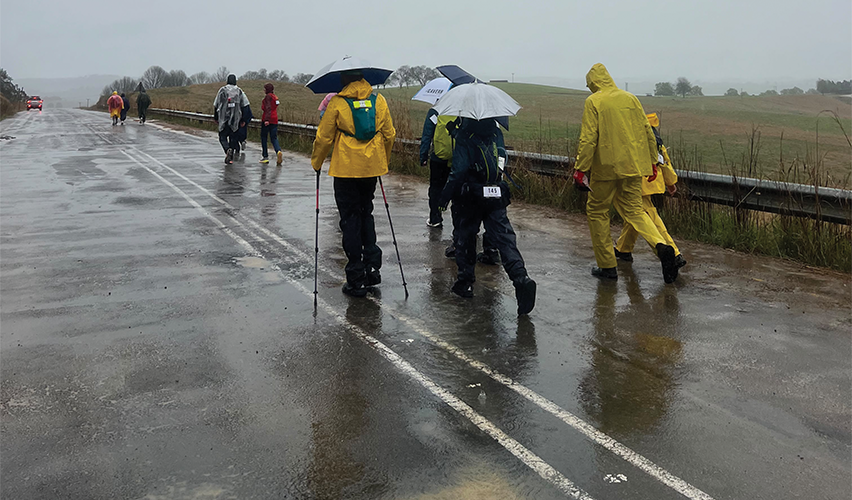
The route comprised four 25km legs, each with a six-hour cut-off. Rain soaked the first half, while low cloud hung over the second. Three of the 16 starters completed the full distance; the others covered substantial portions of the route.
At each 25km stop, participants lit a candle and wrote a letter addressed to someone living through trafficking or exploitation.
The society hopes the funds will help protect vulnerable children and support survivors in reaching safety.
Troubled national response
The US report presents a mixed picture of enforcement.
Last year, the government reported investigating 13 trafficking cases, compared with 156 in the previous reporting period. It initiated prosecutions against 57 suspects, down from 123, while continuing prosecutions against 148 suspects from earlier periods.
Convictions, however, increased: 27 traffickers were convicted, compared with 12 previously. Sentences ranged from 10 years to life imprisonment.
One case illustrated the scale of exploitation possible within a single workplace. The report recorded the conviction of seven Chinese nationals for exploiting 91 Malawians, including 37 children, in forced labour at a Johannesburg factory.
It also described understaffed and overburdened investigators and prosecutors, inadequate training, and poor coordination. Reports of official corruption and complicity remained a significant concern, including allegations that some officials accepted bribes or returned victims to trafficking situations.
Protection services faced their own shortcomings. Although the government accredited 20 NGO multipurpose shelters, at least one in every province, observers reported insufficient accommodation and funding. Private donors provided more than half of shelters’ budgets, according to the assessment.
Delays in certifying victims sometimes prevented timely access to emergency shelter and services. The report also recorded instances in which victims were left at police stations overnight when cases were opened late in the working day.
These findings give added significance to community fundraising, while highlighting the substantial responsibilities that remain with the state.
Recognising danger early
UOC’s work also includes youth outreach in Pretoria, with recent engagements at a Danville youth group and Louis Botha Children’s Home addressing digital grooming, sexual blackmail and exploitation through technology.
The US report warned that traffickers increasingly recruit children into online sexual exploitation. It also described fake job advertisements on social media used to recruit foreign victims into exploitation in hospitality, mining, domestic work and webcam modelling.
Trafficking extends beyond sexual exploitation. The assessment identified forced labour in domestic service, agriculture, construction, fishing and other sectors, as well as forced begging and criminal activity.
Children, disadvantaged communities, undocumented migrants and survivors of sexual abuse were among those identified as particularly vulnerable.
UOC’s outreach encourages young people to protect personal information while using social media for education and supportive connections. The organisation also emphasises trust: children need space to ask questions and disclose frightening encounters without fear.
For the Wits walkers, the candles and letters brought that wider purpose back into focus at every stop. Their effort raised money, but also drew attention to people whose identification, protection and recovery require sustained action long after an endurance event ends..
Help contact: Unchain Our Children lists its National Crisis Centre number as 067 323 7116 for reporting child exploitation.