
 WeeklySA_Admin
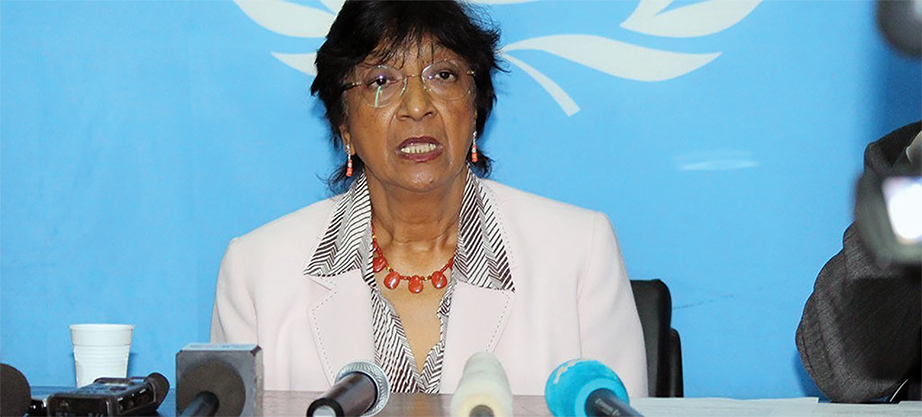
LEGAL ORDER: From defending apartheid prisoners to confronting genocide, South Africa’s Navi Pillay wins the Nobel Peace Prize for a lifetime devoted to human rights and international justice…
By Own Correspondent
South African jurist and former UN High Commissioner for Human Rights Navi Pillay was on Friday announced as the winner of the 2026 Nobel Peace Prize.
She was honoured “for her efforts to promote peace and international law”, the Norwegian Nobel Committee said in a statement.
The committee said the award was going “to a person who with exceptional courage and integrity has led the way towards a more comprehensive global legal order,” noting that she “has been instrumental in ensuring that war crimes, crimes against humanity and genocide are prosecuted.”
Fighting hate, defending civilians
Ms. Pillay served as the UN human rights chief from September 2008 through August 2014, but her career has spanned more than 50 years – from fighting apartheid in her homeland to defending civilians in conflict zones.
She is a former chair of the UN Independent International Commission of Inquiry on the Occupied Palestinian Territory and was appointed a judge at the International Criminal Tribunal for Rwanda (ICTR) and the International Criminal Court (ICC) in the Hague, in addition to serving as an ad hoc judge with the International Court of Justice (ICJ), the UN’s highest court.
“A common thread runs from her early work defending Nelson Mandela and others who stood up against apartheid to her service as a judge in some of the key international court cases of our time,” the Nobel Committee said.
An ‘independent voice of justice’: Guterres
In a statement congratulating the new Nobel laureate, UN Secretary-General António Guterres said Ms. Pillay has shown “that the force of law must prevail over the law of force and that defending human rights is the surest safeguard against injustice.”
He hailed her as “a champion of international law and human rights, and a steadfast, independent voice of justice”, adding that “in its citation, the Nobel Committee reminded the world that peace must be built on lasting principles, not the will of the powerful.”
A lifelong champion of human rights
Navanethem “Navi” Pillay was born in South Africa in 1941 to a Tamil Indian family and was the first non-white woman to establish a legal practice in the country.
As a lawyer, she acted as a defence attorney for anti-apartheid activists, exposing torture, and helping to establish key rights for prisoners on notorious Robben Island.
In her role as chair of the Independent International Commission, which is appointed by the UN Human Rights Council, she oversaw its 2025 report that said Israel’s actions in the Gaza Strip constituted genocide.
Human rights reaffirmed: Türk
On receiving the news of Ms. Pillay’s honour, the current UN human rights chief, Volker Türk, warmly congratulated the woman he described as a big sister.
“To say it is well deserved is a total understatement, and especially at a time when human rights are under attack on so many fronts, including from those who wield enormous power, this award is particularly poignant,” he said, speaking in Geneva.
“It is an award to all those who around the world dedicate their lives to the defense of human rights, often at great risk to their security.”
Moreover, it is “a recognition, a reaffirmation, that human rights, the rule of law and justice and accountability are fundamental to everything – to peace, to security and prosperity,” he added.
Served humanity with principle: Ramaphosa
President Cyril Ramaphosa has congratulated Justice Navi Pillay on winning the 2026 Nobel Peace Prize, recognising her lifelong commitment to justice, human dignity and international law.
Ramaphosa described the award as a profound tribute to her courage and integrity, saying her contribution had brought hope to South Africans and people globally.
“She has served humanity with principle and the belief that the world can and should be a better place.”
“We are proud that Justice Pillay joins Chief Albert Luthuli, Archbishop Desmond Tutu, President Mandela and Former President FW de Klerk in highlighting the far-reaching impact of South Africans on peace, justice and the advancement of humanity.
Trump whines
President Donald Trump and the White House criticised the Norwegian Nobel Committee for overlooking him for the Nobel Peace Prize.
White House communications director Steven Cheung accused the Norwegian Nobel Committee of putting “politics over peace” after Trump did not receive the award.
Trump asserted that he has settled multiple global conflicts and stopped the “total obliteration of the world,” claiming it would be a “great discredit” and an “insult” to the United States if he was not awarded the prize.
In response, Nobel Committee chair Jørgen Watne Frydnes defended the selection process, noting that decisions are based on Alfred Nobel’s will rather than public campaigns or media pressure.
Belief in international solidarity
In an October 2025 interview with UN News in Geneva, Pillay reflected on her lifetime of fighting for human rights, justice and equality.
“I didn’t think apartheid would end in my lifetime,” she recalled. “So, what happened? We had the collective support of people all over the world, even children. If we can achieve that, we can have a better human rights protection system.”
Her experience in the anti-apartheid struggle shaped her belief in international solidarity, which she carried into her role as a judge and president of the ITCR, which prosecuted persons responsible for the 1994 genocide in Rwanda.
During her eight years there, she helped establish groundbreaking legal precedents in the fight against genocide and gender-based violence.
As UN human rights chief, Pillay continued to champion the participation of civil society and victims’ voices in shaping global human rights standards.
“When the UN started, it was just a club for the States,” she told UN News. “Everything we have today for human rights protection didn’t happen just because the States woke up one day. It comes from the pressure of civil society. That’s why I value these institutions.” – UN News/Facebook/Weekly SA Mirror
Comment
PILLAY’S HONOUR, OUR CALL TO JUSTICE
Navi Pillay’s Nobel Peace Prize is a moment of pride for South Africa. It honours a jurist whose life demonstrates that courage is measured through service, principle and a willingness to confront power. From defending people persecuted under apartheid to pursuing accountability in international courts, Pillay has placed human dignity at the centre of her work. Her journey reminds us that justice becomes meaningful when it reaches those whom society would otherwise silence, abandon or forget.
For a country still living with apartheid’s wounds, this recognition carries resonance. Pillay emerged from a system designed to restrict her opportunities and deny the humanity of the people she defended. She answered exclusion by opening doors, challenging injustice and helping build institutions capable of holding perpetrators accountable.
Her contribution to international criminal justice, including the prosecution of genocide and the recognition of sexual violence as a grave international crime, speaks to the importance of treating victims as people entitled to justice. Their suffering demands more than sympathy.
South Africa should celebrate this honour with gratitude and reflection. Pillay joins a distinguished tradition of South Africans whose struggles have helped shape the world’s understanding of freedom, peace and reconciliation. Her achievement also challenges us to ask whether our conduct today honours that inheritance.
JUSTICE MUST REACH EVERYONE
Peace cannot rest on impunity. Where atrocities go unanswered, where powerful states demand exemptions and where victims are denied a hearing, resentment deepens and the foundations of future violence remain.
Pillay’s career affirms that international law must have meaning beyond speeches and ceremonies. Its credibility depends on consistent application, including when accountability becomes uncomfortable for influential governments or their allies. Human rights lose their force when they are defended selectively.
That lesson belongs equally at home. We cannot applaud a champion of justice abroad while accepting corruption, gender-based violence, failing investigations and unequal access to legal protection in our communities. Respect for Pillay’s legacy requires institutions that serve ordinary people with competence, independence and integrity.
Her example is especially valuable to young South Africans. It shows that a life rooted in conviction can reach far beyond the circumstances of its beginning. It also reminds public servants, lawyers and political leaders that authority carries obligations to others.
This award should renew our faith in principled service without dulling our awareness of the work unfinished. Pillay has helped give victims a voice and justice a wider reach.
We salute her with pride. The finest tribute we can offer is to uphold the dignity she has spent her life defending.