 WeeklySA_Admin
MORAL COMPASS: Former Colombian president Juan Manuel Santos reflects on Mandela’s influence on his pursuit of peace and urges leaders to speak out when silence enables injustice…
By Juan Manuel Santos
Thirty years ago, I arrived in South Africa carrying the weight of a country at war. I came in 1996 to hand over the chairmanship of the United Nations Conference on Trade and Development from Colombia to South Africa. What I expected to be a formal diplomatic occasion gave me one of the greatest privileges of my life: nearly three hours with President Nelson Mandela.
South Africa was emerging from apartheid. Through the Truth and Reconciliation Commission, victims and perpetrators were giving voice to truths long denied or silenced.
Colombia, meanwhile, was descending into one of the darkest periods of its conflict. Violence had become so familiar that many Colombians saw war as an inescapable part of daily life.
Madiba listened with extraordinary attention. We discussed the wounds of violence, the balance between peace and justice, and the courage required to imagine a future in which an enemy had a place.
Freedom, equality and dignity remain South Africa’s destination. Humanity must seek a world where law is stronger than force and truth stronger than deception…
Then he said: “Colombia and South Africa are similar countries in many ways, but without peace, Colombia will never take off.”
Those words never left me. Mandela helped me see my destination: a Colombia at peace.
Twenty years later, we signed the 2016 Peace Agreement with the Revolutionary Armed Forces of Colombia, the FARC, after more than half a century of conflict.
Now I return as chair of The Elders, the organisation Mandela founded to promote peace, justice, human rights and a sustainable planet.
An encounter became an idea. That idea became a purpose. That purpose guided decisions that helped change my country’s course.
Words matter. Silence matters too.
Silence can allow injustice to endure and suffering to remain unseen. But it can also create space to listen. Words spoken too soon, or in anger, can close doors that should remain open.
The challenge is knowing when silence becomes wisdom and when it becomes complicity.
South Africa negotiated the end of apartheid and the birth of a democracy. Colombia sought to end a war and address its causes. Yet, both processes faced similar dilemmas.
Imagine if silence had prevailed. Mandela might have remained imprisoned; apartheid might have endured. Colombia’s government and the FARC might have remained trapped in violence, each believing victory required the enemy’s total defeat.
I was elected president in 2010 as a war hero. When I proposed peace, almost everyone warned me against it. They said I would be called a traitor, lose my political capital and fail.
Continuing the war was politically safer. But how many lives might be saved if we took the risk and succeeded?
The earliest conversations required confidentiality. Peace sometimes needs silence to take root. Eventually, however, private talks must become public commitment. Leaders must tell their people that enemies can become partners.
Violence must never have the final word.
When Chris Hani was assassinated in 1993, South Africa stood at the edge of catastrophe. Mandela spoke, urging people not to let grief and anger destroy their democratic future. In Colombia, negotiations proceeded while fighting continued. Every attack increased pressure to abandon the talks. We refused to give violence a veto over our future and placed victims at the centre of the process.
Listening to their suffering strengthened my determination. Their voices reminded me why peace mattered and why we had to persevere.
Signing an agreement, however, does not complete the journey.
Our initial agreement was narrowly rejected in the 2016 referendum. We had been overconfident and underestimated disinformation.
Instead of abandoning peace, we listened.
Young people filled public squares demanding a new agreement. We opened a national dialogue, incorporated opposition proposals and returned to negotiations. Congress endorsed the revised deal.
More than 13 000 former FARC members entered the reintegration process. Weapons were decommissioned, a transitional justice system established and the FARC became a political party. Bullets were replaced by ballots.
Yet, communities still await the agreement’s full promise. Armed groups and criminal organisations have expanded, sustained by drug trafficking, illegal mining and other illicit economies.
I believe inadequate implementation by successive governments is central to these problems. The agreement remains indispensable: it offers ways to reduce rural inequality, protect communities and extend legitimate state authority into neglected territories. Durable peace needs nourishment, care and perseverance.
Our responsibility also extends beyond national borders. We must speak as war becomes normalised, international law is disregarded and civilians suffer while diplomacy retreats.
Might is not right.
When governments remain silent because speaking is politically inconvenient or economically costly, they help turn violations into precedents. When states can oppose injustice but choose inaction, silence becomes complicity.
We must also confront the risks of artificial intelligence and nuclear weapons. Humanity cannot allow these technologies to converge without restraint.
Used well, AI can advance health, education and environmental protection. Used carelessly, it can deepen inequality, strengthen authoritarianism and spread disinformation. These are questions of governance, accountability and human dignity.
Mandela gave us a moral compass. Leadership means building a future in which former enemies can live together, and knowing when to listen and when conscience demands speech. Knowing our destination does not calm the storms. It tells us where to sail when the horizon disappears.
Peace remains Colombia’s destination. Freedom, equality and dignity remain South Africa’s destination. Humanity must seek a world where law is stronger than force and truth stronger than deception.
To young people: the future is not yet written. Stand for what is right. Protect our planetary home. Never accept that war, injustice or division are inevitable. Speak when silence becomes complicity.
Now it is your turn to take the helm.
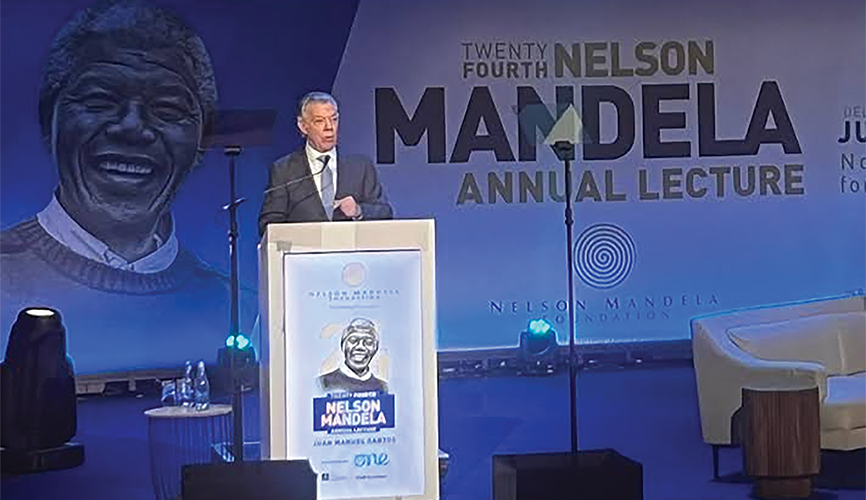
Edited extract from Santos’s address at the 24th Nelson Mandela Annual Lecture, hosted by the Nelson Mandela Foundation in partnership with One Young World, at the Cape Town International Convention Centre on 6 November 2026.
Comment
Betrayal of our kids
An empty stomach is a cruel companion in a classroom. For learners at Tshehlo Secondary School in Limpopo, hunger means more than discomfort: it drains energy, weakens concentration and makes participation in lessons an exhausting struggle.
The findings of University of Limpopo researchers Lusanda Ncisana and Michael Mbongiseni Buthelezi should trouble a country that promises every child an equal opportunity to learn.
Learners described fatigue, missed classes and difficulty following lessons. One asked how anyone could concentrate for five hours without eating.
Their study involved 40 learners at one school. It cannot establish the extent of hunger nationally, but the experiences it records expose a reality that reaches beyond Tshehlo. Across rural villages, townships and informal settlements, black children face the daily burden of trying to learn while hungry. For many, the school day begins with a long walk or an expensive, tiring commute. Distance consumes energy before the first lesson starts. When breakfast is absent and a school meal uncertain, the journey itself becomes another obstacle to education.
Apartheid’s shadow
More than three decades into democracy, these conditions reveal how stubbornly apartheid’s historical imbalances endure. Where children live, how far they travel and whether their families can afford food still shape their educational opportunities. Apartheid deliberately placed black communities far from economic opportunities and denied them adequate services. Persistent unemployment, poverty and unequal development continue to reproduce that disadvantage. Democratic governments cannot undo this history overnight, but neither can history become a permanent explanation for inadequate action.
A child cannot eat a policy promise. Nor can a teacher overcome hunger simply by demanding greater effort or discipline. Restlessness, withdrawal and absence require understanding and support, not automatic punishment.
School nutrition must therefore be treated as essential educational infrastructure. Meals must arrive consistently, provide nourishment and reach children without humiliation. Procurement failures, interrupted deliveries and misuse of feeding funds must trigger swift accountability.
Teachers need support to identify hungry learners and connect families with assistance. Reliable school transport must also form part of the response, alongside measures addressing the food gap during weekends and holidays.
Community gardens and partnerships with local farmers can help, but they cannot replace government’s responsibility to provide dependable nutrition and tackle household poverty.
The warning from Tshehlo is clear: access to a classroom does not guarantee access to learning.
Until children can arrive safely, eat adequately and concentrate with dignity, the promise of equal education remains incomplete.
Hunger must never be accepted as an ordinary condition of a black child’s education.