 WeeklySA_Admin
DIALOGUE: The leaders of China, the US and Russia used their first trilateral summit, held on the sidelines of APEC in Shenzhen, to pledge talks on reducing nuclear risks, reforming the United Nations and keeping global energy supplies flowing during conflicts…
By Abdul Rahman
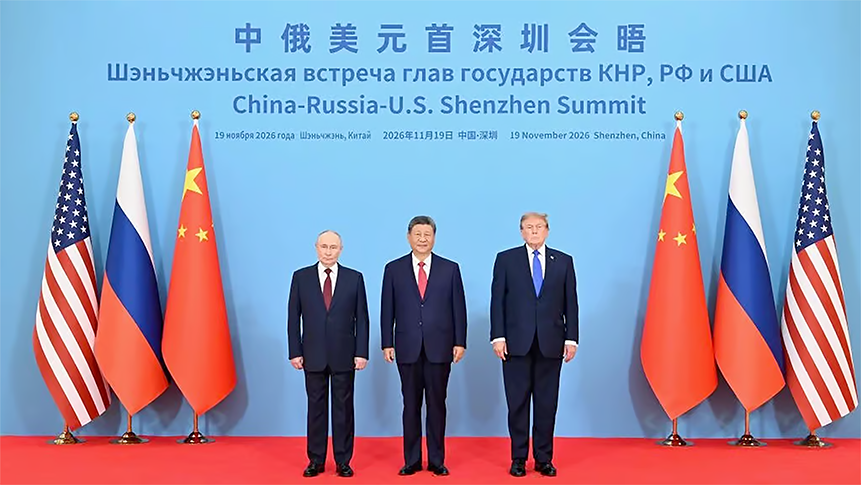
Chinese President Xi Jinping held the first ever trilateral summit of Russia, China, and the US on the sidelines of the ongoing Asia-Pacific Economic Council (APEC) summit in Shenzhen on November 19.
The meeting, attended by Russian President Vladimir Putin and US President Donald Trump, ended with a joint Declaration towards Peace, with all three countries agreeing to find ways to work together on common issues including the need for reforms in the UN, global energy security, and rising nuclear risk.
The declaration also talked about the principles of the operation of the International Criminal Court (ICC) and underlined the immunity for top state officials.
The declaration emphasised that the reforms in the UN are necessary for it to make effective interventions to issues of global concern and to fulfil its mandate of preserving global peace and security.
It is important to communicate in advance, try to see things from one another’s perspective, act with caution, and in particular, not to challenge the red lines of one another – President Xi
The point was an indirect reflection on recent failures of the UN to make any meaningful intervention in the global conflicts, particularly its failure to prevent the Israel’s genocide in Gaza, the war in Ukraine and the US-Israeli war on Iran.
All three countries also agreed that they should work together to reduce the risks of a nuclear war breaking out.
They underlined the need to conduct dialogue for reducing nuclear risks and preventing the proliferation of nuclear weapons.
The three heads of states also agreed it was necessary to maintain the global flow of energy and to minimise the disruptions to global energy supply chains, even during conflict and to increase the production and supply of refined petroleum to ease constraints on general production and prices.
Thycydides trap
During his speech at the summit, hinting towards recent conflicts, Xi pointed out that there must be peace among major countries in the world in order to maintain global stability and to avoid chaos.
Asking for a friendlier and trust-based relations between the great powers, Xi denounced the conventional notions of great power rivalry repeating that the so-called “Thucydides Trap is by no means a destiny.”
Thycydides, an ancient Greek historian, is often quoted to describe conflicts and rivalries between a rising power and an established one.
As major countries and the permanent members of the UN Security Council China, Russia and the US must work together to meet global challenges and jointly uphold world peace and stability. They together can make greater contributions to the progress of humanity, Xi argued.
Xi recalled how China, Russia and the US have worked together in the past to save the world from fascism during the Second World War claiming the same coordination is required now to “steadfastly safeguard the postwar international order, uphold the purposes and principles of the UN charter, and defend the hard-won outcomes.”
Xi proposed a four point code of conduct for the great powers to work together; mutual respect, peaceful coexistence, win-win cooperation and dialogue and consultation.
For working together it is necessary that all the countries respect each other’s social structure and distinctive development paths adopted without trying to impose each other’s preferences over the other, Xi underlined.
He also emphasised the UN principles of respecting one another others’ sovereignty, territorial integrity and non-interference in domestic affairs as fundamental for good relations.
“On major sensitive issues concerning one another, it is important to communicate in advance, try to see things from one another’s perspective, act with caution, and in particular, not to challenge the red lines of one another,” Xinhua reported Xi saying.
Pointing towards the rising risks of nuclear conflicts and its possible impact on the existence of humanity, Xi talked about the need to push for complete nuclear disarmament.
“Nuclear weapons, the Sword of Domcleas that hangs over humanity, should be completely prohibited and thoroughly destroyed over time to make the world free of nuclear weapons,” the Chinese leader said.
Greater communication
Indirectly referring to the impacts of US policies on global trade, Xi said that “decoupling and disruption of industrial and supply chains are not the ways to go” calling for stronger communication and coordination to “safeguard the security and stability of the global” markets.
Both the US-Israeli war on Iran and Ukraine war have disrupted global supply chains of energy products. While Iran has restricted movements through the Strait of Hormuz in response to the US-Israeli war, Russia has been prevented from exporting freely due to sanctions and attacks on energy installations.
Trump and Putin agreed with Xi’s call for a joint effort to push the countries to resolve their disputes through diplomatic channels with Putin emphasizing on “shared responsibilities” and calling for “proper resolution” of all “hotspot issues.”
Trump claimed the three countries, the biggest military powers with the largest number of nuclear arsenals in the world, were “making history” by correcting a historical mistake of great powers not talking to each other. – Breakthrough News
Comment
Murder-rate drop offers little solace
A decline in murders offers little solace in a country where about 60 people are murdered every day. Releasing the latest crime figures, acting Police Minister Firoz Cachalia reported that murders had fallen year on year. Yet police recorded 5 590 killings between July and September. The phrase “killing fields” seems painfully apt when nearly 3 000 people were murdered in public places in just three months.
Among those killed were 581 women, up from 569 in the previous quarter. Gauteng alone recorded 131 murders of women. The discovery of 13 women’s bodies in public spaces in and around Johannesburg laid bare the country’s failure to protect women. How many more families must endure the search for a missing loved one, then wait for answers after her body is found?
Police also recorded 9 908 rape cases in three months. In the cases where police verified the victim’s age and sex, 4 362 victims were children. Against that toll, the reported 2.7% decline in sexual offences offers little reassurance. One murder is one too many. One rape is one too many.
What happens after a case is opened?
Sonke Gender Justice has called for a public audit of 19 775 gender-based violence and femicide cases in which, it says, no arrest or referral to prosecutors was recorded in the previous financial year.
After so many shocks, almost 20 000 cases with neither outcome recorded demand an answer. Police must establish where those cases stand, explain why they stalled where they did, and tell survivors what happens next.
South Africa needs a zero-tolerance approach to violent crime. It must begin at the charge office, where every report must be taken seriously, and carry through to the investigation, where evidence must be gathered promptly and cases properly prepared for prosecutors.
That takes trained detectives, functioning forensic services and supervisors who intervene when cases stall. Survivors must be kept informed and given access to counselling, safe shelter and specialist care.
Prevention requires the same resolve. Police must trace the firearms used in killings and disrupt the networks that supply them. Municipalities must improve lighting and make routes to schools, workplaces and transport safer.
The police and the National Prosecuting Authority should publish regular accounts of how cases progress and where delays occur.
The next briefing should answer questions families are already asking. Was the suspect traced? Did the case reach court? Can survivors count on protection when they come forward?