 WeeklySA_Admin
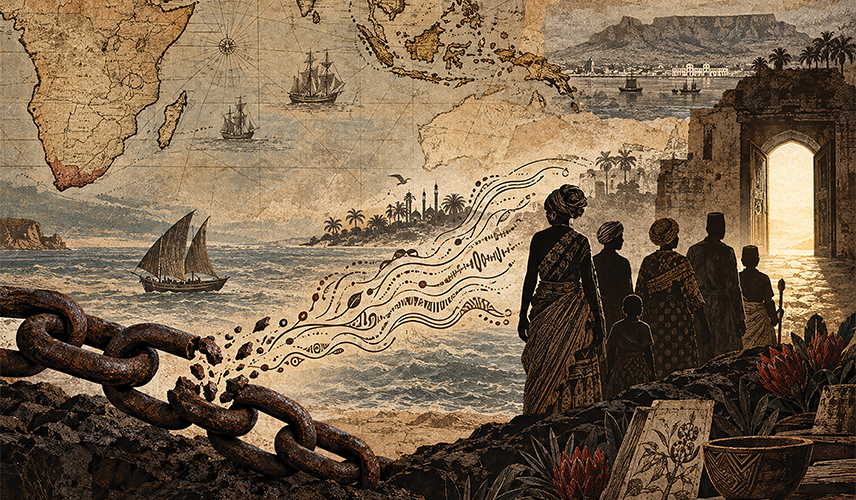
COLONIAL: A UWC symposium examining the afterlives of Dutch colonial slavery has challenged the Netherlands and South Africa to move beyond symbolic acknowledgement towards restitution, historical repair and recognition of the cultural legacies forged by enslaved people…
By Own Correspondent
When Dutch King Willem-Alexander apologised on July 1 2023, for the Netherlands’ involvement in slavery, he acknowledged that the slave trade and slavery constituted crimes against humanity.
The apology was widely regarded as an important moment of reckoning. Yet much of the attention focused on the transatlantic slave trade involving Suriname and the Dutch Caribbean, while South Africa and the vast system of enslavement around the Indian Ocean received comparatively little recognition.
That omission raises a difficult question: What should follow an official apology for historical injustice?
Scholars from South Africa, Suriname, Indonesia and the Netherlands recently gathered at the University of the Western Cape (UWC) to confront that question and examine the enduring consequences of Dutch colonial slavery.
What was started under colonialism was perfected under
apartheid. That is the legacy South Africa must confront…
Their discussions ranged from historical memory and reparative justice to the linguistic, social and cultural influences that continue to shape South Africa.
The International Knowledge Cooperation Symposium on Dutch Slavery Pasts and Afterlives sought to deepen understanding of slavery’s long-term impact and strengthen international collaboration in research, education and public engagement.
Opening the symposium, UWC Rector and Vice-Chancellor Professor Robert Balfour emphasised the need to consider what comes after official acknowledgements of historical wrongdoing.
“What follows after an apology has been issued?” he asked.
It is a question that should not be answered with symbolism alone. An apology may acknowledge harm, but it does not automatically repair its consequences. It should open the way for serious discussions about restitution, reparation and meaningful institutional change.
One of the symposium’s most compelling presentations examined the linguistic legacy of slavery and the formation of Kaaps.
Professor Quentin Williams, director of UWC’s Centre for Multilingualism and Diversities Research and author of the first Kaaps dictionary, showed how archival records reveal a multilingual history frequently excluded from mainstream accounts.
“When you dig into the archives, you’re confronted with the legacy — the legacy of dead bodies, the legacy of genocide,” he said. “But you also learn a lot.”
The archives show that enslaved people brought far more than their labour to the Cape. They carried languages, knowledge systems, religious traditions and cultural practices across the Indian Ocean.
People transported from areas including the Indonesian archipelago brought languages such as Ambonese Malay and Terengganu Malay, which contributed to the development of Kaaps.
“What they brought with them was not only their material belongings, but also language,” Williams said.
Language is therefore one of the clearest surviving records of enslaved communities’ agency. Despite dispossession, displacement and violence, they left enduring marks on South African culture and identity.
Recognising this contribution challenges the idea that enslaved people were merely silent victims of colonial history. They were also makers of culture, language and community under extraordinarily oppressive conditions.
The symposium further questioned simplified versions of South African history by drawing attention to evidence of trade networks and contact among communities long before the Dutch established a settlement at the Cape in 1652.
Colonial rule did not arrive in an empty or disconnected land. It entered societies with their own identities, systems of knowledge and networks of exchange.
Researchers argued that colonial institutions attempted to erase indigenous and enslaved cultural practices through education, legislation and linguistic suppression. At the same time, colonial authorities created myths to justify racial hierarchy, dispossession and exclusion.
These systems did not disappear when formal slavery ended. Many were reshaped and later entrenched under apartheid.
Professor Esther Captain of the Royal Netherlands Institute of Southeast Asian and Caribbean Studies outlined some of the work being undertaken in the Netherlands and elsewhere to make the history of slavery visible and accessible.
She pointed to walking tours and public-history projects connecting people with buildings, sites and other material remnants of slavery in the Netherlands, the Dutch Caribbean and what was once Dutch New York.
Such initiatives, she argued, help make the history of slavery tangible and should be encouraged as part of wider knowledge production.
Public memory matters because societies cannot repair what they refuse to see. Archives, museums, memorials, language projects and community histories can help restore the experiences of people deliberately pushed to the margins of official history.
But remembrance alone is not enough.
The lasting inequalities created under colonialism and reinforced under apartheid remain visible in land ownership, education, wealth, language status and access to opportunity.
“What was started in colonialism was perfected in apartheid, and that’s our legacy,” delegates heard. “We have to confront it.”
That confrontation requires more than carefully worded apologies delivered at commemorative events. It demands sustained investment in research, education and the communities still living with the consequences of historical exploitation.
The UWC symposium formed part of the International Knowledge Cooperation programme on Dutch Slavery Pasts and Their Afterlives in Suriname, Indonesia and South Africa. The research collaboration was initiated by the Dutch Ministry of Education, Culture and Science and is coordinated by the Royal Netherlands Institute of Southeast Asian and Caribbean Studies.
Supported in South Africa by the Department of Science, Technology and Innovation and the Embassy of the Kingdom of the Netherlands, the programme promotes local research into Dutch slavery and its continuing effects.
This cooperation is a welcome step. Its ultimate value, however, will be measured by whether the knowledge it produces changes public understanding, strengthens neglected histories and contributes to meaningful repair.
An apology can open the door. It cannot be the final destination.
Comment
BIKO FAMILY BETRAYED BY JUSTICE DEFERRED
For 49 years, the family of Steve Biko has lived with a wound that South Africa’s democratic government has repeatedly failed to close.
Biko was tortured and killed in police custody on September 12 1977. His killers were known. Their lies were exposed. Yet no one has been held criminally accountable for the death of one of the country’s greatest liberation thinkers.
The reopening of the inquest should have marked a decisive step towards truth and closure. Instead, the process has brought further distress. The family’s plea for adequate preparation time was not an attempt to obstruct justice. It was a reasonable request from people who understand that, after nearly half a century, this may be their final opportunity to establish a complete and truthful record.
Nkosinathi Biko’s words should trouble the national conscience: “We have no other shot at this thing but this.”
No family should have to beg the democratic state for the time and resources necessary to uncover the truth about the state-sanctioned murder of a loved one. Justice hurried after being delayed for 49 years risks becoming another form of injustice.
Truth. No ceremonial tributes
The deeper betrayal is political. The ANC government inherited hundreds of unresolved Truth and Reconciliation Commission cases involving killings, torture and disappearances. Instead of pursuing them with urgency, successive administrations allowed investigations to stagnate, suspects to grow old and die, evidence to disappear and families to wait in anguish.
This was not simply bureaucratic incompetence. Evidence emerging before the Khampepe Commission raises disturbing questions about political interference, secret arrangements and a deliberate lack of appetite to prosecute apartheid-era perpetrators.
The ANC cannot continue celebrating the heroes of the liberation struggle at commemorative events while presiding over the denial of justice to their families. It cannot invoke Biko’s name, quote his philosophy and claim his legacy while the men implicated in his killing enjoy the freedom for which he sacrificed his life.
The unfinished TRC cases are a test of the moral credibility of our democracy. Reconciliation was never intended to mean forgetting, nor was amnesty meant to become blanket immunity for those who refused to tell the truth.
The Biko family deserves more than sympathy and ceremonial tributes. It deserves an adequately funded, transparent and thorough judicial process—and a government willing to pursue accountability wherever the evidence leads.
Forty-nine years is not merely a delay. It is a profound betrayal. Justice for Steve Biko must no longer be postponed.