 WeeklySA_Admin
ENGAGEMENT: ANC leaders favour the DA as a partner of last resort, but the party’s formal mandate leaves all doors open as rivals pursue deals across political divides…
By WSAM Reporter
South Africa’s coalition scramble has intensified, with the ANC formally authorising negotiations with all political parties despite reports that its national executive committee regards the DA as a municipal partner of last resort.
As parties seek governing majorities following the November 4 local elections, the negotiations are testing long-standing political boundaries. The ANC has met the EFF, the DA has approached both the EFF and uMkhonto weSizwe Party, and ActionSA has secured Patriotic Alliance support for its mayoral candidate in Laingsburg.
The ANC’s late-Friday statement mandated engagement with parties large and small, civic movements and independents in hung municipalities. It excluded no party by name and said agreements should rest on a common programme with measurable service delivery targets.
A comprehensive update is now scheduled for November 17, replacing earlier expectations of a Saturday briefing.
That public position leaves negotiating room following reports of strong resistance within the ANC leadership to extending its national partnership with the DA into municipal government.
The challenge is no longer simply assembling enough votes to elect a mayor, but securing an administration capable of surviving beyond the next council showdown…
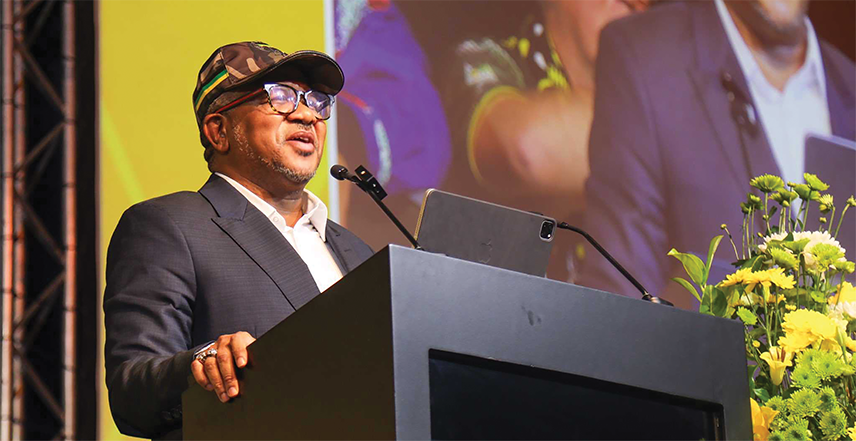
SABC News reported that NEC members blamed the relationship for alienating parts of the ANC’s support base. However, the leadership also endorsed a municipality-by-municipality approach, with secretary-general Fikile Mbalula entrusted with negotiating authority.
The distinction matters: reservations about the DA have not translated into a publicly announced prohibition on agreements with it.
The ANC’s national vote share fell from 45.59% in 2021 to 30.76%, while the DA secured 24.64%, MK Party 9.76%, EFF 6.22% and ActionSA 5.67%. The DA emerged as the largest party in Johannesburg, Tshwane and Ekurhuleni without winning outright control, placing negotiations at the centre of the contest for Gauteng’s major cities.
ANC under pressure
The ANC must weigh its internal objections to the DA against concerns about the durability of arrangements involving several smaller parties.
According to reporting on the NEC discussions, leaders favoured tactical flexibility rather than a single coalition formula.
Negotiations have proceeded along several tracks, including DA engagements with ActionSA, the IFP and PA, and discussions between MK Party and the IFP.
The ANC and EFF also met to discuss the composition of municipal councils and continuity of governance ahead of their first sittings. Mbalula described the meeting as productive and indicated that further talks would follow.
Those discussions have not produced an announced coalition agreement. They nevertheless demonstrate that the ANC is actively exploring alternatives while retaining its broader negotiating mandate.
Pressure is also coming from the Council of the Left, which includes the SACP, EFF and MK Party. The grouping has offered cooperation with the ANC on condition that it breaks with the DA and Freedom Front Plus in the government of national unity.
That demand raises the stakes beyond municipal office: prospective local partnerships are being linked to the future direction of national government. The ANC’s public negotiating mandate has not announced acceptance of that condition.
DA crosses boundaries
The DA, meanwhile, has opened discussions with parties it previously portrayed as unacceptable coalition partners.
EFF elections spokesperson Sixolise Gcilishe confirmed that its leadership had met the DA but had not responded to its proposal. MK Party’s Dali Mpofu also confirmed receiving an approach and said the party had decided to accept an invitation to talks.
DA federal council chairperson Ashor Sarupen said the party was engaging those interested in non-racialism, the rule of law, fighting corruption and restoring municipal services.
The overtures widen the possible combinations available in hung councils, although an invitation or exploratory meeting does not establish a governing partnership.
Laingsburg pact
One concrete development has emerged in the Western Cape, where the PA has agreed to support ActionSA’s Beverley Vorster for mayor of Laingsburg. However, the arrangement does not yet deliver control of the council.
ActionSA and the DA each hold three of its 10 seats, the ANC has two, and the PA and People’s Movement for Change have one apiece. ActionSA and the PA therefore command four seats and need at least two more councillors to reach a majority.
ActionSA has confirmed that negotiations with additional partners remain under way, with a formal coalition agreement still to be concluded. The parties are also exploring cooperation in other municipalities where both are represented.
The Laingsburg arithmetic illustrates the wider challenge: an agreement between two parties may be a breakthrough without being enough to install a government.
ActionSA has also called for transparency in the negotiations. Its national chairperson, Michael Beaumont, warned against private bargaining that undermines the choices voters made at the polls.
Mpumalanga ANC-DA talks
DA provincial Leader Jane Sithole said the party would engage all political parties in discussions aimed at establishing stable and effective municipal governments.
“The DA Mpumalanga Provincial Negotiating Team, led by the Provincial Leader, Jane Sithole, will meet with the ANC’s provincial leadership, led by Premier Mandla Ndlovu, on the 9th of November in Nelspruit to officially commence negotiations,” the DA said in a statement.
In Mpumalanga, the ANC retained its position as the largest political party, securing 43.7% of the combined ward and proportional representation (PR) vote. It is followed by the DA with 14.6%, the EFF with 10.4%, the MK Party with 9.6% and the newly formed Service Delivery Party with 5.3%.
Of the province’s 17 municipalities, 14 resulted in hung councils, including the City of Mbombela, setting the stage for coalition negotiations and political cooperation to establish governing majorities.
The ANC secured outright majorities in only three municipalities: Bushbuckridge with 63.5%, Chief Albert Luthuli with 51.8% and Nkomazi with 54%
For residents awaiting reliable water, electricity, refuse collection and functioning roads, the test will extend beyond the allocation of mayoral chains and executive posts.
The challenge is no longer simply assembling enough votes to elect a mayor, but securing an administration capable of surviving beyond the next council showdown. – Additional reporting by Fullview/Mpumalanga Mirror