 WeeklySA_Admin
WHITHER: For the first time in its 40-year history, COSATU’s national congress failed to reach a quorum. A leadership battle, a court challenge and a dispute over voting delegates left the federation unable to conduct its business…
By Greg Dor
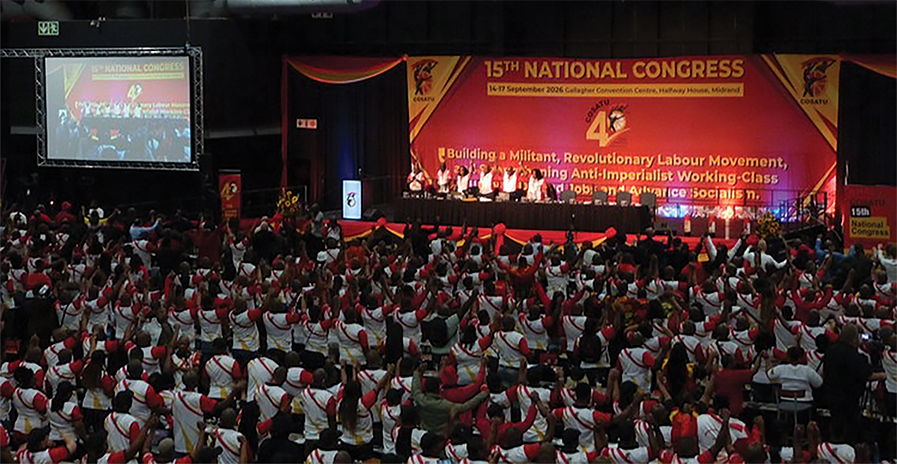
South Africa’s largest trade union federation will have to reconvene its national congress after a two-day battle over leadership and delegate credentials brought the gathering to a halt.
It was the first time in the Congress of South African Trade Unions’ (Cosatu) 40-year history that its central national gathering failed to achieve a quorum. The collapse left elections for the federation’s leadership unresolved and delayed debate on the pressures facing its approximately 1.7 million members.
About 1800 delegates from 16 affiliated unions were expected at the Gallagher Convention Centre in Midrand for a congress scheduled to run from Monday to Thursday. Instead, proceedings were adjourned on Monday and again on Tuesday as unions disputed who could stand for election and who could vote.
It is painful for us to find ourselves here. It has never happened in the history of the federation — COSATU president Zingiswa Losi
Cosatu’s central executive committee (CEC), made up of national office bearers from the federation and its affiliates, met overnight in an attempt to settle the disagreements. When delegates returned on Tuesday morning, the disputes remained unresolved. That evening, Cosatu president Zingiswa Losi announced that the congress would not continue.
Battle for the top posts
The contest for president and general secretary lay at the centre of the standoff. The general secretary is one of only two full-time national office bearers and oversees the federation’s day-to-day work. The presidency is a part-time post with powers set out in Cosatu’s constitution.
Two broad camps formed around the elections. Larger public sector unions, led by the National Education, Health and Allied Workers’ Union (Nehawu) and the South African Democratic Teachers’ Union (Sadtu), backed SADTU deputy president Mabutho Cele for Cosatu president and incumbent president Losi for general secretary. The Police and Prisons Civil Rights Union (Popcru) and the Southern African Clothing and Textile Workers’ Union (Sactwu) supported them.
A group including the National Union of Mineworkers (Num), the South African Municipal Workers’ Union (Samwu) and several smaller affiliates backed Cosatu first deputy president Mike Shingange for president and incumbent general secretary Solly Phetoe for another term.
The latter group held a majority among the 11 affiliates present and in good standing. By withholding their credentials, seven unions prevented the congress from reaching the constitutional quorum of two-thirds of affiliates in good standing.
Supporters described Shingange as a candidate who would take Cosatu in a more militant direction, particularly as unions confront retrenchments and other pressures on workers. But his eligibility became the immediate flashpoint.
Shingange is Nehawu’s immediate former president. On 25 August, its new leadership told him it would not nominate him for Cosatu president. After nominations closed on 11 September, Nehawu advised him in writing not to accept a nomination. The following morning, it placed him on precautionary suspension over allegations of misconduct and breaches of its constitution. He had not been charged.
Samwu had nominated Shingange, with Num’s backing. Those unions and others refused to submit their credentials while his position remained uncertain.
Following the CEC meeting, Cosatu’s leadership said a legal opinion found that Shingange had neither been expelled nor removed as a Nehawu shop steward and could remain the federation’s deputy president. Num was still unconvinced that he would be allowed to contest the presidency and continued to withhold its credentials.
Num and Samwu also alleged that some of their women delegates had faced violence and intimidation. Proceedings were disrupted before the congress adjourned for lunch on Tuesday.
Later that day, the Labour Court ruled that Shingange’s precautionary suspension did not bar him from attending or participating in the congress, or standing for election. The court also ruled that a presidential candidate did not have to be nominated by their own union and ordered Nehawu to pay Shingange’s legal costs.
The ruling settled the question of his eligibility, but came too late to rescue the gathering.
A separate dispute over votes
The South African Commercial, Catering and Allied Workers’ Union (Saccawu) also withheld its credentials in a dispute over the size of its delegation. Cosatu initially allocated Saccawu 140 delegates. The union subsequently submitted an updated membership figure that, it said, entitled it to 160. The CEC agreed that the additional 20 could attend as observers while it reviewed whether the late submission should be accepted.
Saccawu demanded voting rights for all 20 and continued to withhold its credentials. Phetoe said Cosatu would check whether the late submission had been properly condoned; if so, the additional delegates could be given votes. Together with the leadership dispute, the impasse over Saccawu’s allocation made it impossible to secure a quorum.
Political divisions remain
Beyond the elections, Cosatu faces a difficult decision about its relationship with the ANC and the South African Communist Party (SACP). The SACP plans to contest November’s local government elections independently of the ANC for the first time, testing the longstanding alliance among the two parties and Cosatu.
The federation’s leadership had floated a compromise under which Cosatu would endorse neither party formally while encouraging affiliates to support the broader alliance. Affiliates, however, do not share one position. Nehawu has formally endorsed the SACP, while Sadtu and Popcru have been reported as supporting the ANC. Num also supports the ANC.
Those positions do not map neatly onto the leadership contest. Cele, backed by Nehawu, is a former SACP district secretary and a current ANC branch member. Shingange, backed by Num, sits on the SACP’s central committee.
In an opinion article before the congress, Nehawu general secretary Zola Saphetha argued that delegates at Cosatu’s 2022 congress had resolved by secret ballot to campaign for the SACP. He said the federation should implement that resolution instead of seeking a position accommodating both parties. His account reflects Nehawu’s position in the dispute over Cosatu’s mandate.
The failed congress has left those political questions, along with the leadership elections, for delegates to confront when they return.
Congress to be reconvened
At a press conference on Wednesday, Cosatu said it would reconvene the congress within a month, as its constitution requires. The CEC will determine the date, venue and arrangements.
Losi apologised to workers and rejected the suggestion that the events marked a permanent split. “We do not see a fragmentation of the federation,” she said. “We are a federation that has gone through a similar situation in 2013.”
But she acknowledged the gravity of the setback: “It is painful for us to find ourselves here. It has never happened in the history of the federation.”
Shingange also said the disputes could be resolved. “These are not long-term issues,” he said, while acknowledging that Cosatu had not experienced divisions of this kind for some time.
Federation leaders said they would engage affiliates before the next sitting and review the cost of reconvening.
Losi said Cosatu had spent no more than R12 million on the congress, while affiliates had paid their own delegates’ costs. Leaders had earlier put the gathering’s total cost at R30 million.
Cosatu said all affiliates would be able to attend the reconvened congress, including those that had withheld their credentials this week. For now, the federation faces the task of settling who can vote, holding its elections and returning to the worker issues its congress was meant to address. – GroundUp