
 WeeklySA_Admin
OBITUARY: Civil rights leader, two-time presidential candidate and protégé of Martin Luther King Jr., Jesse Jackson helped reshape American politics and expand Black political power for generations…
By Own Correspondents
The Reverend Jesse Jackson, one of the most enduring figures of the American civil rights movement and a two-time United States presidential candidate, has died at 84.

A protégé of Martin Luther King Jr., Jackson moved from the frontlines of 1960s protest to the centre of national politics in the 1980s, reshaping the Democratic Party and expanding Black political influence in the United States.
He was born on October 8 1941, in Greenville, South Carolina. His activism began early. In 1960, as part of the “Greenville Eight,” he was arrested during a sit-in at a whites-only public library — an act that signalled the trajectory of his life.
By 1965, he was marching in Selma, Alabama, alongside King during the voting rights campaign. Jackson left his graduate studies to join King’s Southern Christian Leadership Conference, later leading Operation Breadbasket, an economic justice initiative aimed at strengthening Black businesses and employment.
He was in Memphis in April 1968 when King was assassinated — a moment that profoundly shaped his leadership path.
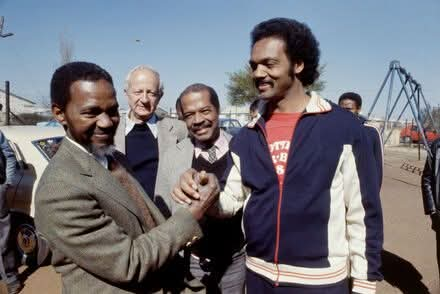
Building Independent Power
After splitting from the SCLC in 1971, Jackson founded Operation PUSH, later merging it with the National Rainbow Coalition to form the Rainbow PUSH Coalition. The organisation became a powerful vehicle for voter registration, corporate accountability, and economic empowerment.
In 1983, his voter registration drive in Chicago helped propel Harold Washington to become the city’s first Black mayor — a landmark political shift.
That same year, Jackson launched his first bid for the U.S. presidency.
Presidential Campaigns That Changed the Game
In 1984, Jackson became the second Black candidate to seek a major party nomination after Shirley Chisholm. His “Rainbow Coalition” message called for a multi-racial alliance of workers, minorities, and the poor.
He did not win the nomination, finishing behind Walter Mondale and Gary Hart, but he registered over a million new voters and won 3.5 million votes — shifting the Democratic base permanently.
In 1988, Jackson went further. He won major state primaries — the first African American ever to do so — before ultimately losing the nomination to Michael Dukakis.
Until Barack Obama won the presidency in 2008, Jackson remained the most electorally successful Black presidential candidate in US history.
You can draw a straight political line from Jackson’s campaigns to Obama’s victory. Jackson expanded the coalition. Obama harvested it.
Diplomat, Broadcaster, and Controversial Figure
Jackson’s career extended far beyond domestic politics. He negotiated the release of American hostages in Syria, Cuba, and Serbia, and hosted Both Sides with Jesse Jackson on CNN from 1992 to 2000.
In 2000, he received the Presidential Medal of Freedom.
His public life was not without controversy — from remarks about New York’s Jewish community in 1984 to later personal scandals and tensions with Obama in 2008. But he apologised publicly in each instance, often with disarming candour.
He was also tested privately. His son, Jesse Jackson Jr., resigned from Congress in 2012 and later served prison time for misusing campaign funds. Jackson addressed the court not as a politician, but as a father.
Later Years and Illness
In 2017, Jackson announced he had Parkinson’s disease. Later, he was diagnosed with progressive supranuclear palsy (PSP), a rare neurological condition. He also battled COVID-19 in 2021.
Yet, even as his health declined, he remained visible at protests against police brutality, including in Kenosha, Wisconsin, after the shooting of Jacob Blake.
His words remained consistent to the end: justice must move forward.
A Political Architect of Inclusion
Jackson did not become president. But he changed who could imagine becoming one.
He helped mainstream Black political leadership inside a major U.S. party. He reframed poverty and race as shared American issues, not sectional ones. And he built a “Rainbow Coalition” concept that still shapes progressive politics today.
He is survived by his wife Jacqueline and six children.
History will remember him not just as a protester, but as a political architect — a bridge between the moral thunder of the 1960s and the electoral breakthroughs that followed.
And here’s the truth: movements don’t succeed on passion alone. They need organisers who can turn protest into power. Jesse Jackson understood that. – Additional reporting by NPR