 WeeklySA_Admin
NEGLECT When democracy delivers darkness, rot, and broken promises, anger is inevitable. Citizens know how elections work — and they know how the system has betrayed them. Staying home on election day will not be indifference; it will be a deliberate, furious act of defiance. Their absence will roar with the weight of years of being ignored.
By Themba Khumalo
Every morning, millions of South Africans wake up to the same unignorable truth: democracy, if it cannot deliver water, sanitation, electricity and basic dignity, is an empty idea.
A ballot paper does not keep a tap running. A manifesto does not fix a sewer. Revolutionary grandstanding and lofty speeches do nothing to keep the lights on.
What once carried moral authority has withered into something brittle and cruel — a political system that insists it governs in the people’s name while failing them consistently, visibly, and without consequence.
There is a convenient tale gaining traction as the next local government elections approach: that declining voter turnout reflects public apathy. It is a tale that flatters those in power because it shifts responsibility away from their failure and onto the failed.
The reality is far more disturbing.
People are not disengaging because they do not care. They are disengaging because caring has become an exercise in humiliation. Because they voted, and voted again, and watched the social contract collapse not in theory, but in their kitchens, bathrooms and streets.
This failure is not confined to one province, one party or one ideology. It is national. It is structural. It is embedded.
Across the country, taps run dry without warning, as if access to water were a favour doled out at a whim. Electricity fails with a cruelty so precise it feels punitive, plunging homes into darkness while officials hide behind press statements and smiling photo-ops. Refuse piles up, fetid and uncollected, turning streets into open-air landfills that announce municipal contempt long before anyone speaks.
Sewage flows freely, unashamed and unstoppable, a despicable signature of state neglect. Roads do not only decay — they collapse, crater by crater, until movement itself becomes a daily negotiation with incompetence.
Meanwhile, municipal accounts rise like a machine with a vendetta, climbing relentlessly even as the services they supposedly fund evaporate. Pay more. Wait longer. Complain, and be ignored. Be patient. Be quiet.
This is not accidental. It is not unfortunate. It is deliberate neglect disguised as governance. It is abandonment with a letterhead. It is the state perfected in cruelty: demanding payment for services it will not provide, insisting on compliance while delivering collapse.
Parents cannot help their children study at night because electricity fails as a matter of routine. Jobseekers cannot apply for work because broadband exists only in speeches and strategy documents. Pensioners queue for water with grim resignation, as though this were a temporary emergency and not a permanent sentence.
Lives are organised around outages, rumours of tankers, and the hollow, echoing silence of municipal offices that never answer.
People are not politically naive. They understand elections down to the last procedural detail. What they no longer believe is that elections will deliver anything beyond frustration, disappointment, and betrayal. Democracy has stopped being a tool; it has become a taunt.
And nowhere is this betrayal more concentrated, more poisonous, more corrosive than in local government.
Local government — the tier meant to be democracy’s human face, its hand on the tap, its boots on the street — has become the rancid, weakest, filthiest link in the constitutional chain. Not because the law is vague or the mandate unclear, but because failure has been turned into an acceptable operating model. Collapse is tolerated. Incompetence is normalised. Arrogance is rewarded. This is not administration; it is organised decay. This is what happens when power is severed from consequence, and accountability is treated as optional theatre.
Auditor-General reports read like a stuck record: procurement rules ignored, finances distorted, records missing, projects unfinished. The language is bloodless and technical, but the outcome is anything but. Money disappears. Infrastructure implodes. Lives are narrowed, year after year, with bureaucratic indifference.
What is happening in municipalities is far worse than corruption. It is a full-scale assault on common sense, a brazen contempt for human life. Inflated tenders are not the only scourge. Contractors are paid and vanish, leaving projects to rot mid-construction, as if the laws of physics themselves were suspended. Projects are announced, relaunched, and quietly buried while officials smirk behind closed doors. It is arrogance, stupidity, narcissism, and a devil-may-care disregard for citizens’ daily suffering.
Promises of accountability are thunderous in public and invisible in practice. This is not mismanagement. This is systematic disrespect, sanctioned by the very offices meant to protect the public.
And when the inevitable collapse comes — as it always does — the response is an absurd performance of attention. Task teams are announced, interventions declared, and press statements issued, all choreographed to look like action while accomplishing nothing.
The bureaucratic circus parades across headlines, but meanwhile, the rot grows unchecked, the decay deepens, and the people continue to suffer. This is not crisis management. This is theatre masquerading as governance — a pantomime of concern staged to distract, while every day the state’s contempt becomes more tangible, more unbearable, more infuriating.
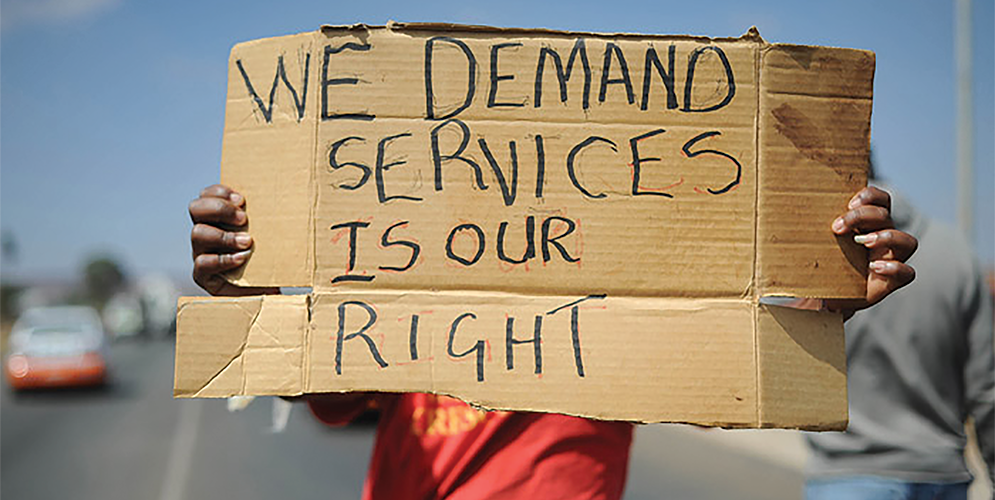
In the meantime, people adapt. They fetch their own water. They clear their own refuse. They patch their own roads. They protest not because they are ideological, but because they are desperate. And when even protest exhausts itself, silence follows — not from apathy, but from fatigue.
When people stay home on voting day, it is not because democracy no longer matters to them. It is because democracy has abandoned them in their kitchens, their streets, their schools, their taps — a ghost of promises that never materialise, a sham ritual that offers nothing but invoices and outages.
Staying home becomes a final, bitter assertion of agency — a raised middle finger to a system that has drained their patience, bled their wallets, and mocked their labour, while still expecting their compliance.
This is not apathy. It is not indifference. It is a civic exorcism, a withdrawal of consent from a government that has prostituted its mandate, spat on its duties, and treated its citizens like inconvenient extras in a theatre of incompetence. It is the quiet, burning refusal of millions to lend legitimacy to a farce they will no longer endure.
This is the context that political leaders refuse to confront.
A democracy can survive criticism. It can even survive instability. What it cannot survive is a population that concludes, slowly and collectively, that participation is futile.
That conclusion is already being reached — in darkened homes, in water queues, in unpaid hours spent chasing municipal answers that never come. People are no longer debating who deserves their vote. They are asking whether voting itself still has any meaning.
Democracy without services is not democracy.
It is a ceremony without substance.
It is governance as performance while people go thirsty.
Until local government delivers the basics — reliably, competently, without excuses — every election will feel less like a choice and more like an insult.
And let this be carved in every corridor of power, stamped into the conscience of every official who has smiled while the people suffered: every broken tap, every darkened classroom, every uncollected pile of refuse, every pothole swallowed by despair, is your indictment.
Every promise you made and broke is a brick in the prison you built around democracy. You have gamed, stolen, preened, lied, and laughed while citizens bled in silence — but their absence will speak louder than your speeches ever could.
On election day, when streets lie deserted and ballot boxes untouched, let it strike like a hammer to the ribs of every self-satisfied politician: the people will not grant you the legitimacy of their consent until you return what you have stolen — their dignity, their safety, and their lives. And if you continue to shrug, to pretend, to hide behind rituals and statements, know this: the quiet refusal of millions is a reckoning far more devastating than any riot.
The people’s silence is the thunder you cannot evade.
* Themba Khumalo is a political commentator and former editor