 WeeklySA_Admin
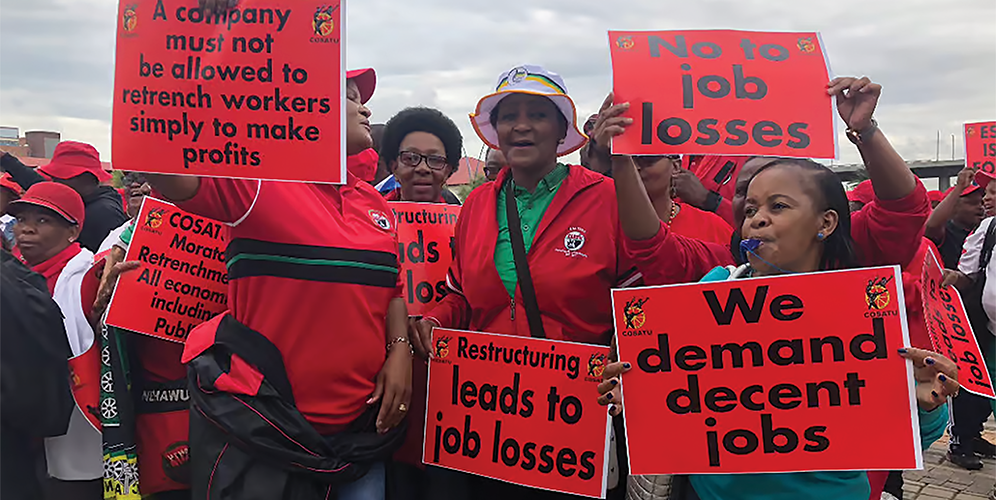
TRENDS: South Africa’s official unemployment rate climbed to 33.6% in the second quarter of 2026, leaving 8.5 million people without work and intensifying demands for an economic strategy capable of dismantling apartheid-era patterns of ownership, exclusion and inequality…
By Nicholas Mwangi
MORE than a week after Statistics South Africa released its latest labour-force figures, the numbers continue to expose the depth of the country’s jobs emergency — and the failure of modest economic improvements to translate into work for millions of people.
The official unemployment rate rose to 33.6% in the second quarter of 2026, its highest level in four years, from 32.7% in the first quarter. The deterioration was driven by an increase of 345,000 in the number of unemployed people, taking the total to 8.5 million. Employment declined by 16,000 to 16.7 million, while the labour force grew by 329,000 as more people entered or returned to the job market.
The broader picture is even more disturbing. The expanded unemployment rate, which includes people who have given up searching for work, stood at 43.8%. The composite labour-underutilisation rate — covering unemployment, potential workers and people who want to work more hours — remained at 46.3%. Young South Africans were again the hardest hit. The number of unemployed people aged between 15 and 34 increased by 264,000 to five million, pushing the youth unemployment rate up by 1.5 percentage points to 47.4%.
The political economy of apartheid is alive
and well and reproducing…
Among the country’s 10.4 million young people aged 15 to 24, some 36.4% were not in employment, education or training. Women remained disproportionately affected, with young women recording a higher rate of economic exclusion than their male counterparts.
The figures underline South Africa’s persistent inability to generate sufficient decent and sustainable employment — despite its mineral wealth, sophisticated financial sector and comparatively developed industrial base.
Historically distorted economy
Speaking to BreakThrough News in his personal capacity, former African National Congress MP and South African Communist Party member Dr Phillip Dexter said the jobs crisis could not be understood separately from the country’s history.
“The unemployment crisis must be understood as the result of two key factors. First is the structural crisis caused by colonialism, apartheid and imperialism,” Dexter said.
South Africa’s economy was historically organised around the extraction and export of minerals, supported by a system of cheap, low-skilled black labour. While the country underwent a political transition in 1994, the fundamental patterns of ownership, production and accumulation were not sufficiently transformed.
According to Dexter, this historical structure was further weakened by deindustrialisation during the 1980s and 1990s and the subsequent adoption of neoliberal economic policies. “The system was thrown into a crisis in the 1980–1990 period when deindustrialisation started,” he said.
He argued that the influence of the International Monetary Fund and World Bank, combined with policy choices made after 1994, constrained attempts to transform the inherited economy. State capture, corruption and maladministration further undermined development.
More than three decades into democracy, South Africa remains one of the world’s most unequal countries, with ownership, wealth and economic opportunity still heavily concentrated.
Dexter said the country had failed to implement sufficiently radical policies to reform land ownership, expand economic opportunities, build infrastructure and beneficiate its mineral resources.
“The political economy of apartheid is alive and well and reproducing,” he said. Successive ANC-led governments expanded social grants, housing, education and access to basic services.
However, Dexter argued that these interventions, while important, did not fundamentally change the ownership and investment patterns underpinning the economy. The latest figures also point to a continuing change in the structure of employment.
Jobs in the formal sector declined by 41 000 during the quarter, while household-sector employment fell by 9 000. Informal-sector employment increased by 34,000, suggesting that more people are turning to precarious and often poorly protected work to survive. Trade recorded the largest employment increase, adding 70 000 jobs, followed by construction with 39 000 and finance with 11 000. However, community and social services shed 57 000 jobs, mining lost 26 000, while agriculture and manufacturing each lost 15 000.
Dexter said the movement towards informal and insecure employment was part of a long-term trend that began with deindustrialisation.
“The ANC-led governments have paid lip service to industrial policy measures that should have transformed the economy,” he said. The result is an economy unable to create employment quickly enough to absorb new entrants. The labour-force participation rate rose to 59.6% during the second quarter, but the proportion of working-age people who were employed slipped to just 39.6%.
Provincial figures further demonstrated the unevenness of the crisis. Unemployment increased in six of the nine provinces, with the Eastern Cape recording the largest quarterly rise of 2.9 percentage points, followed by North West at 2.8 points and KwaZulu-Natal at 1.3 points.
Beyond entrepreneurship
The scale of youth unemployment has led to repeated calls for entrepreneurship, learnerships, apprenticeships and improved skills development. Dexter said such interventions were valuable but could not substitute for an economy that creates jobs.
“While any measures, such as promoting entrepreneurial opportunities, learnerships and apprenticeships, are welcome, it is the failure of capital to invest and of the state to discipline capital to invest that remains a fundamental problem,” he said.
Millions of young people are being encouraged to improve their employability or start businesses in an economy characterised by weak demand, limited access to finance and concentrated markets.
For Dexter, a credible alternative would require an active developmental state directing investment towards industrialisation, infrastructure, mineral beneficiation and productive industries.
He pointed to countries such as South Korea, Japan, Malaysia, Indonesia and Taiwan, where state-supported development played a central role in industrial expansion. China and Vietnam, he argued, had also used long-term planning and public direction of investment to ensure broader social benefits. “This requires vision and planning,” Dexter said. South Africa’s priorities should include investing in people, infrastructure and the social wage, while preventing the continued extraction of wealth without corresponding domestic investment and job creation.
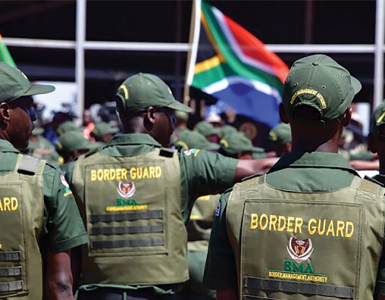
Persistent unemployment has also fuelled the scapegoating of migrants, with frustration over scarce jobs increasingly directed towards foreign nationals. Yet, blaming migrants diverts attention from the structural weaknesses that have left millions of South Africans excluded from productive economic activity.
The central question is therefore not simply whether the economy can grow, but what kind of growth South Africa pursues, who controls its resources and who benefits from the wealth it produces.
“Ultimately, it’s about the political will of leaders to act against exploitation and to lead the drive for people-centred development,” Dexter said. – Breakthrough News
Comment
To what end AfriForum’s sleight of hand?
The newly announced collaboration between AfriForum and March and March raises more questions than answers.
The organisations say their working group will cooperate on crime, illegal migration, education, the rule of law and possible joint legal action. Yet, shared grievances do not necessarily constitute shared principles. AfriForum’s sleek move may well be an alliance of convenience, contrived to be silent about who ultimately benefits from it.
AfriForum is a well-resourced, experienced lobby organisation whose core mission remains the advancement of Afrikaner minority interests. It has consistently opposed transformative measures such as black economic empowerment and land reform—policies intended to address the racial dispossession and economic exclusion inherited from apartheid.
March and March, by contrast, draws support largely from black communities frustrated by unemployment, crime, porous borders and the state’s failure to enforce immigration laws. These concerns may be legitimate, but the movement must ask whether partnership with AfriForum advances them—or recruits its members into a much larger ideological project they do not fully understand.
The “Rainbow MAGA” description is especially troubling. Mandela’s Rainbow Nation envisaged reconciliation, equality and shared citizenship after centuries of racial oppression. Yet, Donald Trump’s MAGA movement has become associated with aggressive nationalism and opposition to diversity, equity and inclusion programmes. Combining the two slogans is therefore not political ingenuity but a contradiction wrapped in clever obfuscation.
Still, there is also an obvious imbalance in this relationship. AfriForum possesses funding, legal expertise, organisational infrastructure and international connections. What does March and March bring besides numbers, black legitimacy and access to communities in which AfriForum has historically enjoyed little influence?
Could this partnership help sanitise AfriForum’s image and provide a multiracial shield against criticism of its exclusionary agenda? Will March and March retain its independence when its priorities conflict with those of its more experienced partner? Who will determine which court cases are pursued, which communities are defended and which definition of “justice” prevails?
March and March risks becoming a passenger in a vehicle whose destination has already been programmed. Frustration with government failure must not render any movement blind to the ideological baggage carried by prospective allies. Before embracing “Rainbow MAGA”, March and March owes its supporters clarity about funding, decision-making and red lines.
Otherwise, this apparent marriage of convenience may prove beneficial mainly to AfriForum—and costly for those entering it without reading the fine print.