 WeeklySA_Admin
PORTFOLIO: A powerful new staging of the exhibition brings Mofokeng’s intimate, unresolved portraits of Black life back into focus — where memory, land and legacy quietly collide…
By Jacob Mawela
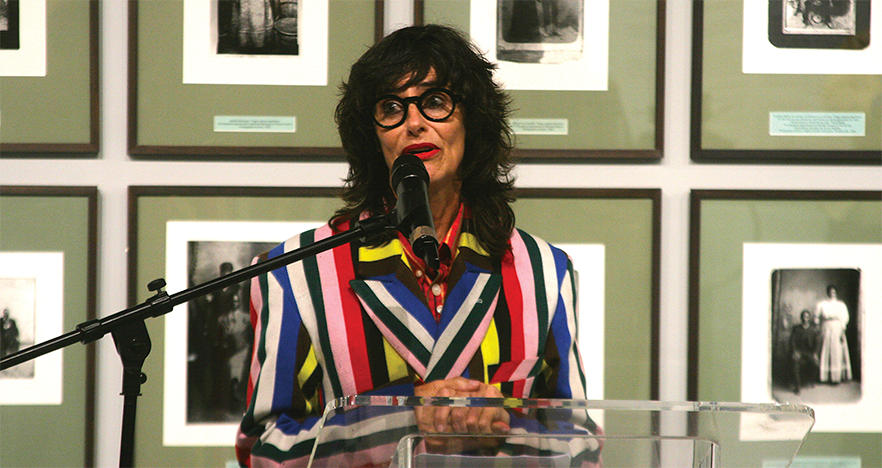
Johannesburg’s art world gathered in Sandton this week for a rare and resonant return — the reopening of ‘Rumours/2026’, a major exhibition of the late photographer Santu Mofokeng’s work.
Hosted at the Standard Bank Art Lab at Nelson Mandela Square, the preview drew a cross-section of artists, curators and cultural figures, all drawn by the enduring pull of a photographer whose work continues to challenge how South Africa sees itself.
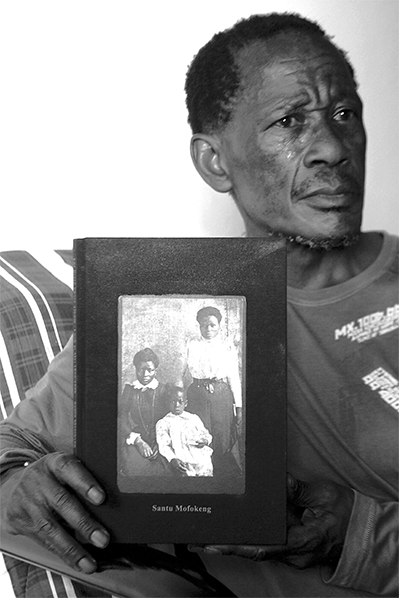
Originally shown in 1994 as The Bloemhof Portfolio, Rumours has been reimagined for a present that still wrestles with many of the same questions — land, memory, labour and belonging.
But this is no simple retrospective.
Co-curated by Lunetta Bartz and Dr Same Mdluli, the exhibition assembles three distinct bodies of work drawn from Mofokeng’s engagement with Bloemhof and surrounding communities in the North West between 1988 and 1994. Together, they resist easy narrative, instead offering fragments of lived experience — intimate, layered and often unresolved.
At the heart of the exhibition lies ‘The Black Photo Album / Look at Me: 1890–1950’, one of Mofokeng’s most significant and quietly radical works.
Composed of studio portraits commissioned by Black working- and middle-class families, the images exist outside official archives. They were never meant for public display, but for private spaces — homes, memories, family histories.
Mofokeng’s intervention is subtle but profound. Rather than claiming authorship, he re-presents these photographs, asking what it means to look at images never intended for us — and what it reveals about who gets to be seen, and how.
Alongside this, Concert at Sewefontein captures a moment of collective release among farmworkers and tenant labourers. Shot in low light and fluid motion, the images move beyond documentation into atmosphere — bodies folding into one another, time stretching, the frame unable to fully contain what is unfolding.
A third body of work, Labour Tenancies, grounds the exhibition in the textures of everyday life. Here, Mofokeng turns his lens to the contradictions of place — intimacy and distance, familiarity and estrangement — revealing lives shaped by apartheid structures, but never reducible to them.
Across all three, a consistent thread emerges: a refusal to conform.
Mofokeng’s photography resists spectacle. It avoids the obvious. Instead, it lingers in the spiritual, the domestic, the unseen. His images operate in the space between presence and absence — what is shown and what is withheld. For co-curator Dr Mdluli, that tension is central to the exhibition’s power.
“In Santu Mofokeng’s work, we encounter photography not as a fixed record, but as a space of relation where memory, imagination and lived experience converge,” she notes.
The exhibition also arrives at a moment of renewed interest — and quiet tension — around Mofokeng’s legacy.
A past legal dispute between the Santu Mofokeng Foundation and members of the photographer’s family over control of his archive continues to linger in the background. While the courts ultimately dismissed claims that Mofokeng lacked the mental capacity to sign over his archive, questions around ownership and stewardship remain sensitive.
That tension was subtly present at the preview, where both foundation representatives and members of Mofokeng’s family were in attendance — sharing space, if not always perspective.
Yet if there is unease, it does little to diminish the force of the work itself.
Presented as part of the Standard Bank Art Lab’s ongoing engagement with African artistic legacies, Rumours /2026 positions Mofokeng not just as a documentarian of his time, but as a thinker whose work continues to ask difficult, necessary questions.
What do images carry? Who are they for? And, how do they return to us, years later, demanding to be seen differently?
Born in Johannesburg in 1956 and raised in Soweto, Mofokeng developed a practice which consistently refused the limits placed on representation. From his early years as a street photographer, through his work with Afrapix, to his role as a researcher and artist, he remained attentive to the ways in which Black life was imaged within South Africa.
Mofokeng passed away on January 26 2020 – having succumbed to a brain tumour, following a period of illness.
Running until October 18, the exhibition is open to the public.