 WeeklySA_Admin
ACCESS: President Cyril Ramaphosa warns that barriers facing poor and vulnerable people undermine confidence in the courts and democracy, calling for justice systems that turn constitutional rights into everyday protection…
By Monk Nkomo
Poverty is one of the greatest obstacles to justice because it limits people’s choices, weakens their bargaining power and exposes them to exploitation, President Cyril Ramaphosa said this week.
Speaking at the International Conference on Access to Justice at Sun City, he warned that when poor people believed the law protected the wealthy and powerful while offering them little protection, the legitimacy of justice systems was diminished.
The conference, hosted by the Department of Justice and Constitutional Development, began on Wednesday under the theme “Strengthening People-Centred Justice Systems: Deepening Democracy”.
It seeks to promote international dialogue on strengthening people-centred and victim-responsive justice systems, examining global and regional efforts to expand access to justice through the lived experiences of those seeking it.
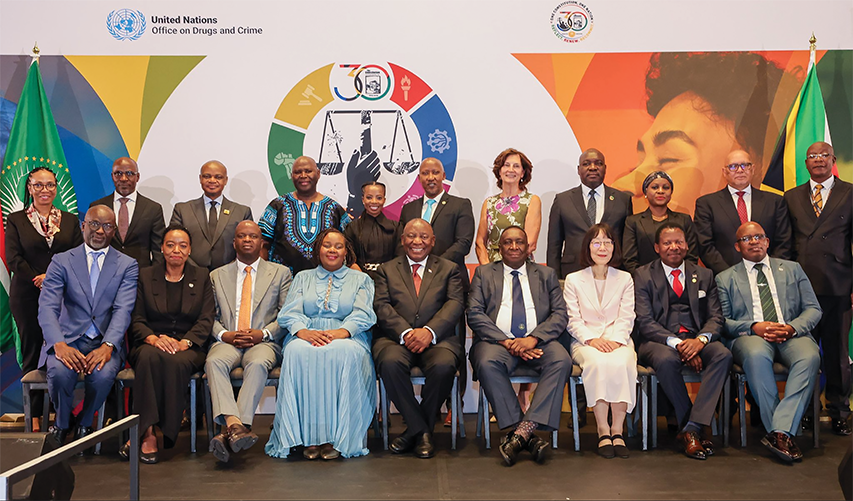
Part of South Africa’s commemoration of the Constitution’s 30th anniversary, the gathering brought together government leaders, judges, legal practitioners, civil society representatives and international partners.
A justice system must not only be open to the people.
It must work for the people…
Dignitaries included International Criminal Court president Judge Tomoko Akane, United Nations Office on Drugs and Crime executive director Monica Juma, South Africa’s Deputy Chief Justice Dunstan Mlambo and ministers from SADC and BRICS countries.
“Justice must never be the privilege of the few,” Ramaphosa told delegates.
“Justice that is inaccessible is justice denied. And justice that is delayed, corrupted or reserved for the privileged, undermines democracy itself. A justice system must not only be open to the people. It must work for the people.”
Ramaphosa said South Africa’s adoption of a democratic Constitution represented a solemn commitment that the law would never again be used as an instrument of oppression.
“We committed ourselves to a society founded on human dignity, equality, freedom and the rule of law.”
However, reflecting on the constitutional journey required confronting an uncomfortable truth: the existence of rights did not, by itself, guarantee that people would enjoy them.
A person could have the right to equality yet experience discrimination; the right to dignity yet endure violence and humiliation; and the right to access the courts yet be unable to afford a lawyer, travel to a courthouse or navigate complicated legal procedures. People could live in a constitutional democracy while experiencing injustice in almost every aspect of daily life.
“This is the gap that we must close. It is the gap between the promise of justice and the experience of justice,” Ramaphosa said.
“It is a gap that exists in countries both rich and poor, in established democracies and in emerging democracies. And unless we close it, we risk weakening the very foundations upon which democratic societies are built.”
Repeated experiences of injustice, he warned, could cause people to lose confidence not only in justice institutions but in democracy itself.
Justice could not be measured solely by the strength of constitutions, the independence of courts or the sophistication of legal systems. Its ultimate measure was whether ordinary people could secure protection, obtain redress and live with dignity.
From oppression to equality
The conference came as South Africa prepared to commemorate, next month, 30 years since President Nelson Mandela signed the democratic Constitution into law.
Ramaphosa described that signing as an extraordinary moment for a nation where the law had long enforced racial oppression, dispossession and exclusion.
It had determined where people could live and work, whom they could marry, what education they could receive and whether they could participate in their country’s political life.
“The law was used not to protect the dignity of all, but to preserve the privileges of a few.”
The struggle against apartheid was therefore also a struggle to change the meaning and purpose of the law, replacing a system that denied human dignity with one that placed it at the centre of national life.
The Constitution established independent courts and institutions to safeguard human rights and hold public power accountable. It affirmed everyone’s entitlement to equal protection, regardless of race, gender, wealth or social standing.
No person, institution or government was above the law. When corruption went unpunished, criminality was tolerated and powerful people evaded accountability, public trust was eroded, Ramaphosa said.
Powerful and weak
Turning to international affairs, Ramaphosa said the principles of justice and international law were being severely tested.
Millions continued to suffer from war, conflict, displacement, discrimination and economic exclusion. Civilians too often bore the greatest burden of conflict while those responsible for grave violations of human rights and international humanitarian law escaped accountability.
“We are witnessing growing challenges to the institutions and principles established to protect humanity from the abuse of power. We must therefore reaffirm our commitment to the international rule of law.” International law had to apply equally to all nations, and human rights had to be defended consistently.
The protection of civilians, pursuit of accountability and respect for dignity could not depend on the political influence, economic strength or strategic importance of those involved.
There could not be one standard of justice for the powerful and another for the weak. The international legal order’s credibility depended on fairness, consistency and independence.
South Africa remained committed to multilateralism, peaceful dispute resolution and stronger international institutions advancing justice and human rights.
“Yet our commitment to justice must extend beyond the great questions of international relations and constitutional law. It must reach into the everyday lives of our people.”
Three priorities
Ramaphosa urged delegates to focus on three priorities, beginning with making justice accessible to poor and vulnerable people.
This meant reducing the financial, geographical, procedural and other barriers preventing people from obtaining legal assistance and effective remedies.
The second priority was building independent, accountable and efficient institutions worthy of public confidence. This required confronting corruption, strengthening professional integrity and ensuring that political interference and abuse of power did not undermine the administration of justice. The third was establishing meaningful ways to measure whether justice systems were improving people’s lives.
Beyond the number of cases processed, people needed to know how long justice took, what it cost, whether outcomes were fair and whether decisions were effectively enforced.
These priorities reflected the broader challenge of ensuring that constitutional protections translated into practical assistance for people seeking help. For those unable to afford representation or reach a courthouse, the promise of equal protection could remain distant, despite the rights guaranteed on paper.
Ramaphosa said the Constitution’s promise of justice, dignity and equality remained democracy’s foundation, but had to be renewed through people’s actions every day.
“We owe it to those who struggled for freedom. We owe it to those who continue to suffer injustice. And we owe it to future generations who should inherit a world in which rights are not merely proclaimed, but are respected and protected.”
He called for justice systems that served people and institutions that protected the vulnerable.
“Let us ensure that the law is an instrument of dignity, equality and freedom, rather than exclusion and oppression.”