 WeeklySA_Admin
Loot: The government is pursuing those who looted money meant to improve people’s lives through corruption
By Monk Nkomo
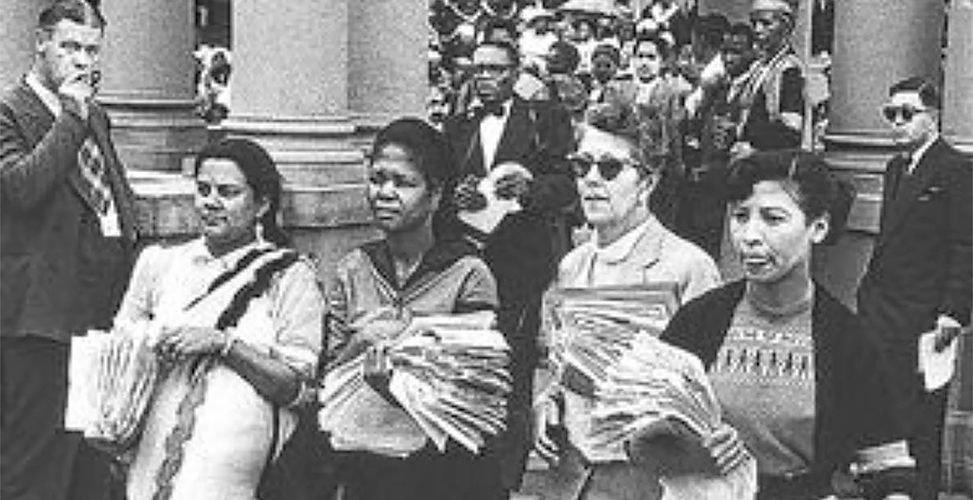
Despite the fight for justice and challenge to the unjust apartheid laws by thousands of women who marched on the Union Buildings in Pretoria in 1956, there were still South Africans who were today still waiting for the dignity that freedom had promised them.
Speaking at the launch of the Milestones of Freedom programme at the venue where these women stood – in silence – for 30 minutes in protest against the racist regime – President Cyril Ramaphosa also lamented that although these women – our mothers and grandmothers – had opened the doors that were once bolted shut by the apartheid regime by , amongst others, refusing to carry the dompas, there were still South Africans who went to bed hungry.
There were also still millions of young people without unemployment and many who were living in fear of criminals.
Ramaphosa also reiterated the government’s commitment to confront crime and corruption without fear or favour because South Africans deserved to feel safe in their homes and on their streets.
‘’ We are also rebuilding our police , our prosecution service and all our law enforcement institutions. We are pursuing those who stole from the people because money looted through corruption is money taken from a clinic , a classroom, a child.’’
The President said they were building a capable , ethical State that would serve the people, a State where public representatives and officials understood that they were there to serve citizens.
He added that it was through those women in 1956 that women today held positions of leadership in government, in our courts, boardrooms, universities and colleges and in many other areas of the country’s national life.
‘’ We have put in place laws and programmes that advance the positions of women in the workplace and in the economy more broadly. We have placed the fight against gender -based violence and femicide at the centre of our national agenda because a country where women are not safe, is a country that is not yet free.’’.
The Milestone of Freedom programme, Ramaphosa said, was a recommitment . It called on South Africans to the work that remained. It called on the government to grow an economy that included everyone, not only a few.
‘’ To achieve this, we are removing the obstacles to investment, from our energy supply, rebuilding our ports and railways and backing the small businesses and entrepreneurs who create the most jobs.’’
Ramaphosa added that In the span of a few short months, the calendar of the South African history brought together four anniversaries that, woven together, told a story of who we were as a people.
‘’They speak of oppression and dispossession, of courage and resistance, and of restoration and rebuilding. Seventy years ago, on the 9th of August 1956, in the very place that we gather today, some 20,000 women of every colour and creed converged to demand an end to injustice and discrimination.
‘’They came from the cities and the countryside, from the factories and the farms, many with their children strapped to their backs. They came to say to the apartheid State, in a single defiant voice, that they would not carry the hated dompas. They stood in silence for thirty minutes. And then they sang the words that have echoed through the decades: Wathint’ abafazi, wathint’ imbokodo. You strike the women, you strike a rock.’’
Ramaphosa said they paid tribute to the women who carried thousands of petitions to the door of then Prime Minister, JG Strijdom. The women included Lilian Ngoyi, Helen Joseph, Rahima Moosa and Sophie De Bruyn.
‘’We remember the thousands whose names history did not record but whose courage built the foundation on which our democracy stands. Those women taught us that there can be no freedom for our nation while half of our people are not free. Today, we honour those women not only with our words, but with our determination to finish the work they began’’.
The President reminded the country that sixty years ago, in February 1966, the apartheid government declared District Six in Cape Town a whites-only area under the Group Areas Act. In the years that followed, more than 60,000 people were torn from their homes, their shops, their mosques and their churches, and scattered across the Cape Flats.
A vibrant and diverse community – a place where people of many faiths and origins had lived side by side for generations – was reduced to rubble. The people of District Six were not alone in their fate. Across our country, over many decades, the same cruelty was unleashed upon the people of Sophiatown, of Cato Manor and of countless other places whose names are written in the memories of the dispossessed.
Today, as families returned to the land that was stolen from them, South Africa was reminded of its solemn responsibility to achieve redress for all the people of our land.
Fifty years ago, on the 16th of June 1976, the children of Soweto walked out of their classrooms and into history. They were schoolchildren who refused to be taught in the language of their oppressor. They refused to bend their knee to a system designed to keep them in servitude.
‘’Their peaceful protest was answered with teargas, bullets, arrest and torture. We will never forget the young people who fell that day in Soweto, and in the days and years that followed across this land. The youth of 1976 changed the course of our history. They showed the world that a system built on injustice could not endure forever. They reminded us that young people are not only the leaders of tomorrow. They are the conscience, the voice and the pioneers of the present’’.
Thirty years ago, on the 8th of May 1996 – having endured all these hardships, having resisted the pass laws, the forced removals and the injustice of Bantu Education, and having fought a courageous struggle for freedom – the people of South Africa adopted a new democratic Constitution.
In doing so, the Constitution reaffirmed the fundamental principle that this country belonged to all who lived in it, black and white, united in our diversity.
‘’Our Constitution declared that we would heal the divisions of the past. That we would establish a society based on democratic values, social justice and fundamental human rights. That every person – regardless of race, gender or belief – would be equal before the law and equal in dignity. This Constitution is our inheritance from the generations of freedom fighters who came before us, and it is the birthright we hold in trust for those who come after us’’.
Ramaphosa said when South Africans remembered these milestones, they should not see them as artefacts of the past. They should see them as the foundations on which they needed to build. They were a reminder of the work they still had to do.