 WeeklySA_Admin
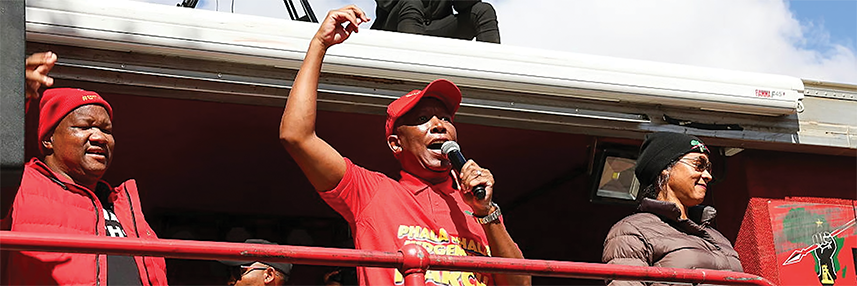
GENERATIONAL: Julius Malema, the leader of South Africa’s fourth-largest party, the Economic Freedom Fighters (EFF), is a divisive figure: loved by some, hated by others…
By Ongama Mtika
Malema made headlines in April 2026 after a lower court found him guilty of illegal possession and discharging of a firearm and sentenced him to five years’ imprisonment. He is appealing the conviction and sentence.
Within a few weeks he made headlines again when the country’s Constitutional Court ruled in a case the EFF had brought before it. The case was about the alleged theft of a large sum of foreign currency from President Cyril Matamela Ramaphosa’s private game farm, Phala Phala. The court found in favour of the EFF and the other party to the case, the African Transformation Movement.
Malema hails from Seshego, a small village in Limpopo, which is one of South Africa’s poorer provinces. Born in 1981, he has become something of a generational peculiarity in the body politic of the country.
The old guard of liberation fighters who were active from the 1960s and 1970s onwards continue to dominate South Africa’s political landscape. They include leaders of parties in parliament like the African National Congress (ANC), Bantu Holomisa of the United Democratic Movement, and Patricia De Lille of the Good party, among others. But Malema broke that mould.
Few South African politicians have achieved what he has.
In 2013 Malema, together with Floyd Shivambu, announced the founding of the Economic Freedom Fighters as the main host for radical youth politics in South Africa. This was after they were fired from the ANC while serving as leaders of its youth wing.
The EFF went on to poll numbers that put it in third place in four successive elections between 2014 to 2021. In the most recent national poll in 2024, however, the party lost this spot to the former president Jacob Zuma’s new uMkhonto weSizwe Party.
Malema is a career politician who has used the political liberties bequeathed to democratic South Africa to his personal and political advantage. Yet, he continues to agitate against the emerging order, as if he himself were the victim of it, not a beneficiary high up in the distribution chain.
As a political analyst and senior lecturer, I have studied the rise of Malema and his party as part of South Africa’s ongoing leftist, worker-driven political wing. Tracking the gains and failings of the EFF, I believe there are several factors that contribute to Malema’s successes and shortcomings.
His skills at building a party and running a tight ship have been bolstered by his charisma and speech-making capability. But there have been controversies over showmanship and the use of divisive and incendiary speech. This has produced a complex and ambiguous public figure. And a party in flux.
Rise of a firebrand
Malema shot to national prominence in 2007 in the build-up to the major political upheaval of the democratic period, the 52nd conference of the ANC in the city of Polokwane. The league had assumed a kingmaker role in ANC succession battles in various times in the history of the liberation movement, helping remove president AB Xuma in 1949 and then president Thabo Mbeki through its active campaigning.
Events at the conference would change the trajectory of South Africa. Mbeki was president of the country as well as the party and was seeking a third term to run the party. His deputy in the party, Jacob Zuma, whom he had suspended as deputy president of the country, defeated Mbeki and delegates to the conference elected him to lead it.
After Zuma had come to power, the National Union of Metalworkers of South Africa and the ANC Youth League became critical of him.
Youth league members, including Malema, were hauled before the disciplinary structures of the ANC. According to his biographer, Fiona Forde, this was an attempt to curtail his rising influence in the party and the potential to disrupt succession.
Nonetheless, Malema’s EFF avoided the fate of quickly disintegrating, unlike other breakaway parties such as the Congress of the People.
He did this by building his party with the leaders who followed him from the Youth League. He used strong control of the party platform as its chief communicator, building a militant persona.
Malema’s wider public success can be attributed to his rhetoric, chants and tactics that have bordered at times on anarchy, war mongering and glorification of violence.
He has fashioned himself into a warrior figure who exploits black rage to gain popularity. The party stands for a more radical path to economic transformation in South Africa, particularly expropriation of land without compensation and nationalisation of mines.
But, as my research shows, his purpose appears less about waging a true revolutionary war and more about drawing political value from the perception that he could.
This creates a stark contradiction. Malema performs the role of a fearless revolutionary within a stable democracy that offers him all the securities and legal protections he needs to sustain this performance. Unlike those who rise against authoritarian regimes, he faces no mortal risks.
He appears to care deeply for the plight of the poor, yet his lifestyle suggests he is high up the distribution chain, with a taste for the finer things in life.
Many revolutionaries throughout history came from better backgrounds than the people they spoke for. Karl Marx, Frans Fanon, and Martin Luther King Jnr are but some of the examples. Yet few have balanced so overtly the “militant” brand with such personal comfort. The primary mechanism for this warrior persona is a calculated mix of word, appearance and branding.
Malema uses the media and public events as a platform for his politicking. He has received significant media coverage as a result of his activities. But this hasn’t stopped him from frequently attacking the fourth estate.
In Parliament he has used disruptive tactics to draw attention to the party, even though it now only has 47 seats out of a total of 400.
An ambiguous future
Now that Malema has been convicted and sentenced to an effective five-year term in prison, he faces a turning point. He may be disqualified from serving as an MP and could even go to prison. This places the EFF into the realm of the ambiguous and uncertain.
Because the party has been held together by his firm grip, which clamped down on ambition, the EFF is not yet prepared for a succession. The potential loss of its leader leaves the “Red Berets”, and the rage they channel, in a state of flux. – The Conversation
The author of the article, Ongama Mtika, is a lecturer at Nelson Mandela University
Comment
ENSURING SAFETY BEYOND BORDERS
The world’s most celebrated sporting event, the FIFA World Cup, will take place from June 11 to July 19 across the United States, Canada and Mexico. The tournament, known for uniting nations through sport, arrives at a time of complex political realities.
For Africa, this edition marks a milestone — a record 10 countries will represent the continent, reflecting the remarkable growth of football talent and ambition across Africa. Yet, amid the anticipation and excitement, significant concerns about security and safety shadow the upcoming festivities.
Most pressing is the participation of Iran, a nation currently at war with the United States. Although its inclusion upholds the sporting principle that football transcends politics, the geopolitical strain cannot be ignored. Iran’s matches, scheduled largely in Los Angeles and Seattle, raise understandable questions about safety. Many Iranian players and supporters, alongside several African delegations, have voiced unease over whether adequate measures are in place to protect them. In today’s volatile climate, such concerns are not paranoia—they are prudence.
FIFA champions the idea that the World Cup should be a celebration of unity, diversity and peace. But those ideals ring hollow if the safety of athletes and fans is compromised. The responsibility, therefore, rests squarely on both FIFA and the U.S. government, led by the Trump administration, to ensure that this global gathering does not become overshadowed by fear, discrimination or violence. Security planning must be precise, inclusive and sensitive to every team’s situation—especially those from nations entangled in political disputes or facing prejudice.
More than just a question of logistics, safety is a moral obligation. Every player travelling thousands of kilometres deserves the assurance that the pitch will remain a sanctuary of fair play, not a theatre of risk.
For African teams, whose participation brings not only sporting pride but also national hope, protection must be both visible and unwavering. The same duty of care extends to Iranian athletes, who should not bear the burden of their government’s enmity with the host nation.
Football has the rare power to bridge cultural and political divides. The 2026 World Cup should not merely showcase goals and glory but reaffirm that humanity triumphs over hostility. As the games draw near, FIFA and host authorities must act decisively—coordinating closely with participating nations to guarantee a safe, welcoming environment for all.
The world will be watching, not just the matches, but the message this tournament sends.
Let that message be clear: that in the arena of sport, every athlete’s life matters, and peace must always take precedence over politics.