 WeeklySA_Admin
EXPLOITATION: Research warns South Africa’s growing dependence on water trucks is masking municipal collapse, deepening inequality and fuelling corruption instead of fixing broken pipes…
By WSAM Reporter
For millions of South Africans, turning on a tap has become an act of uncertainty. In place of running water, tankers now rumble into communities as emergency relief — but new research and warnings from President Cyril Ramaphosa suggest that what was meant to be a temporary intervention may be feeding a dangerous cycle of infrastructure neglect, corruption and criminal exploitation.
University of KwaZulu-Natal public governance researcher Nyashadzashe Chiwawa warns that South Africa’s growing dependence on water tankers is not fixing the country’s water crisis, but deepening it by delaying infrastructure repairs, worsening inequality and creating opportunities for governance failure.
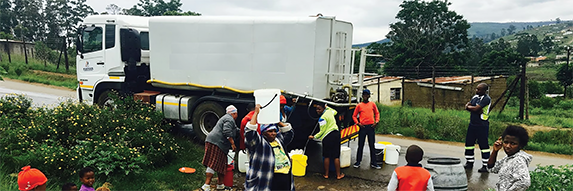
“Water tankering becomes a Band-Aid rather than a cure,” Chiwawa says in his study, arguing that municipalities are increasingly relying on emergency deliveries instead of repairing broken pipes, pumps, reservoirs and treatment systems needed to restore permanent supply.
Water tankering becomes a Band-Aid rather than a cure.
It is not a sustainable solution for ensuring water security…
That warning echoes concerns raised by President Cyril Ramaphosa in his 2026 State of the Nation Address, where he described water as “the single most important issue” facing many South Africans and warned of the growing influence of what has become known as the ‘water mafia’ — criminal syndicates believed to benefit from water shortages, tanker contracts and alleged acts of sabotage targeting water infrastructure.
Ramaphosa said government would intensify interventions as water outages increasingly expose communities to criminal exploitation and service delivery collapse.
In several parts of South Africa, repeated incidents of damaged pipelines, sabotaged pumps, illegal connections and unexplained outages have heightened fears that water infrastructure breakdowns are not always the result of ageing systems alone, but may also be linked to criminal networks with a financial interest in keeping tanker businesses alive. Ramaphosa’s warning has sharpened national concern that a parallel economy may be thriving in the country’s water crisis.
Municipal decline
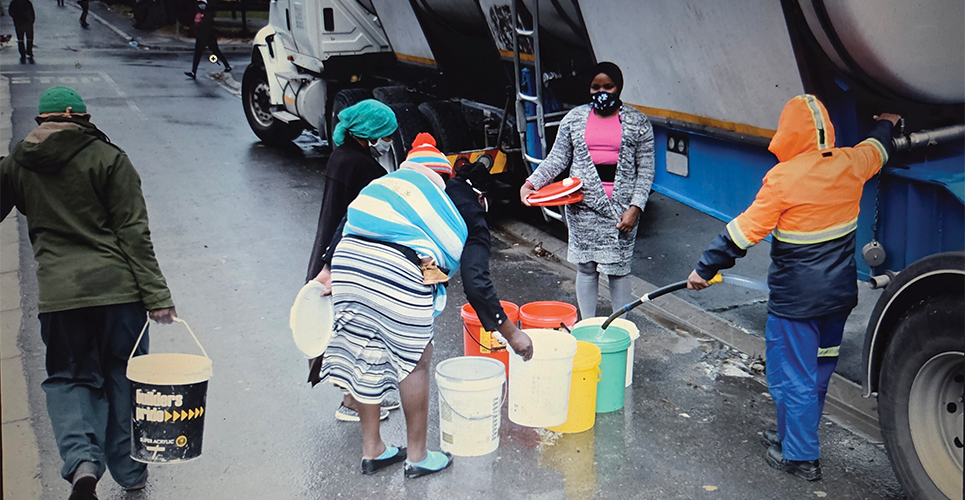
Across South Africa, water tankers have shifted from emergency stopgaps to a routine feature of municipal service delivery, particularly in informal settlements and peri-urban communities where taps often run dry for days.
Residents in many areas now wait in long queues with buckets, uncertain when the next delivery will arrive.
The research links this dependence to a decade of municipal decline marked by ageing pipes, leaking systems, poor maintenance, electricity disruptions and shortages of skilled technical staff. Instead of fixing failing infrastructure, municipalities are spending millions on tanker contracts — a recurring emergency cost that critics say has become both financially draining and politically controversial.
In Johannesburg alone, Johannesburg Water reportedly spent R130.5 million on tanker deliveries in the 2024/25 financial year, while a separate R263 million tanker contract was later declared invalid by the Gauteng High Court because of irregularities in the tender process — reinforcing concerns that water procurement has become vulnerable to abuse.
Ramaphosa, in his SONA address, acknowledged that poor municipal planning, weak maintenance and years of neglect lie at the heart of the crisis, but said government would also move against those exploiting the breakdown. He announced the establishment of a National Water Crisis Committee, which he will chair, and vowed to intervene directly in municipalities failing to deliver water services. He also warned that municipal managers could face personal criminal consequences for failures linked to the crisis.
eThekwini water fiasco
Chiwawa’s research, conducted in eThekwini Municipality, found that tanker dependence often creates uncertainty, frustration and exclusion, with poorer communities receiving erratic deliveries while better-serviced areas enjoy more reliable access. Families lose hours collecting water, children miss school, and health risks rise where water quality is uncertain.
“It’s not a sustainable solution for ensuring water security. It’s costly, energy-intensive, and can have negative environmental impacts,” Chiwawa says, warning that tanker fleets also increase pollution and place additional strain on already water-stressed regions. He says the deeper damage is to dignity and trust.
“We feel like second-class citizens, constantly at the mercy of erratic delivery schedules and uncertain water quality. Ethically, we deserve access to reliable, clean water just like any other community,” he says in reflecting on the lived experiences captured in the study.
For Chiwawa, the solution lies not in more tankers but in infrastructure investment, transparent governance and community-driven alternatives such as rainwater harvesting and decentralised water systems.
But, with Ramaphosa now warning of a ‘water mafia’ profiting in the shadows of broken infrastructure, the stakes have become larger than service delivery alone. South Africa’s water crisis is increasingly emerging as a battle not just over failing pipes — but over corruption, criminality and who benefits when the taps run dry. – WSAM/The Conversation