 WeeklySA_Admin
TURF: For years, politicians wrung their hands as the taxi industry became a law unto itself. Now Mkhwanazi has drawn a line — no negotiations, no excuses, no tolerance…
By Themba Khumalo
There is a ritual in South Africa — ugly, predictable, and tolerated. It begins with violence. A driver being dragged from a car. Motorists terrorised. An innocent commuter beaten senseless. Sometimes, there is death — often more than one.
That is how another eruption of the taxi industry’s lawlessness announces itself in our so-called rainbow nation — a country that now produces more blood than rainbows.
And then, right on cue, the political machinery whirs into life.
Not to enforce the law. That can wait.
First, there must be a press conference.
Politicians, in tailored suits and polished shoes, assemble before a forest of microphones, faces carefully arranged into expressions of grave concern. They clear their throats, adjust their microphones, and deliver the same: ‘we call for calm… we urge restraint… we will engage stakeholders.’
They condemn the violence. They promise to stabilise the industry. They appeal, almost sheepishly, for peace. They suggest dialogue, propose meetings, and float task teams.
By the time the microphones are switched off, the crisis has been neatly gift-wrapped in bureaucratic language and filed away under that most comforting of labels: ‘ongoing engagements.’
Out on the roads, of course, nothing has changed.
The intimidation continues — completely untouched by the theatre of statements and solemn concern.
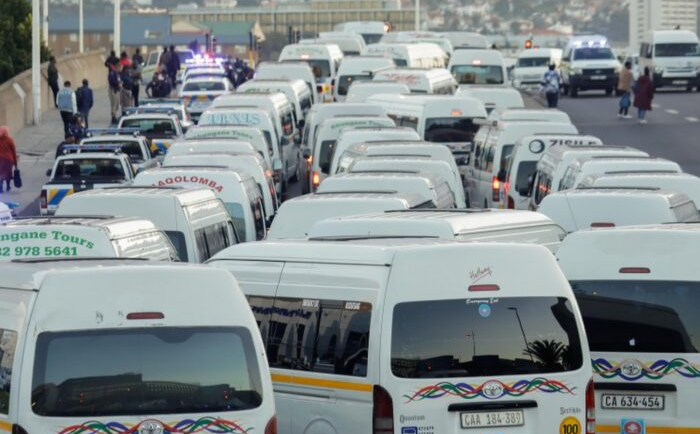
Because while the state dithers and dilutes, a section of the taxi industry has grown fat on impunity. Not all operators — but enough to poison the well. Enough to turn public roads into private fiefdoms, patrolled by men who behave less like transport providers and more like untouchable warlords.
They shove motorists aside, terrorise e-hailing drivers and, in the worst moments, kill — as casually as one swats a fly.
Let us not sanitise this. These are not overzealous businessmen arguing about routes. These are men with guns. They threaten. They intimidate. And when someone refuses to bow to rules that exist only in their heads, they sometimes pull the trigger.
Across the country, the taxi industry has long behaved as though the nation’s roads were a private inheritance, generously bequeathed to them and them alone by some benevolent ancestor. Routes are treated like territorial boundaries. Public roads — built with taxpayers’ money and meant for everyone — are guarded by armed taxi thugs and bandits as though they were fenced family property.
Stray into this imagined estate without permission, and the consequences arrive swiftly — not in the form of policy or regulation, but violence.
Private motorists who dare offer lifts to hitchhikers are stopped and interrogated. Teachers in Ladysmith, KZN, have been warned not to give lifts to colleagues, as though basic acts of human decency now require approval from self-appointed road authorities. E-hailing drivers are dragged from their vehicles, beaten, and sometimes shot dead.
And what does the government do?
It reaches for a meeting agenda.
You would think, by now, that the penny might have dropped — that there is something grotesquely inadequate about responding to violence with tea, biscuits, and a roundtable discussion. But no. The instinct remains: placate, appease, negotiate, repeat. As though the rule of law were a fragile suggestion, easily bruised by firm enforcement.
Talk, it seems, is the government’s favourite substitute for action — a kind of political anaesthetic administered whenever reality becomes too uncomfortable. Because what else explains this bizarre instinct to negotiate with people who have already decided the law is optional?
What kind of leadership looks at armed intimidation on public roads and thinks: ‘Yes, what we need here is a stakeholder meeting?’
As the prospect of yet another tea-and-biscuit stakeholder engagement loomed, Lieutenant-General Nhlanhla Mkhwanazi stepped forward and stood firm, stripped away the noise and niceties, and the temperature in the room dropped — along with its comfortable habit of pretending.
Because Mkhwanazi does not perform this tired theatre. He does not hide behind careful phrasing or bureaucratic fog. He does not speak as though enforcing the law requires permission from those who break it.
At a meeting between the KwaMaphumulo Taxi Association and the KwaDukuza Taxi Association — rival groups locked in a dispute over routes that has already produced violence, intimidation and disruption — Mkhwanazi did something that now feels almost subversive in modern public office.
He spoke plainly, his words landing like a thunderclap in a room full of polite whispers.
No hedging. No bureaucratic fog. No political throat-clearing designed to offend no one while saying nothing. Just blunt, unvarnished truth — the kind of clarity that has become almost extinct in a governing culture addicted to evasions, platitudes and carefully rehearsed nonsense.
South African roads, he said, belong to the public. Not to taxi bosses. Not to associations. Not to anyone labouring under the delusion that intimidation equals authority.
“A person who wants to take a lift will take a lift. If they want to take a taxi, they will take a taxi. If they want to take a bus, they will take a bus. It is not for you to decide how someone must travel. If I ever hear that there is an association that stops cars on the road and tells people they are not allowed to take a lift and must use a taxi, the moment I receive that report, I will arrest the person responsible.
“Even if it is a security company doing that, I will report that company to the PSIRA office and have its licence taken away. Once that security guard is arrested, the entire company will be shut down. If it operates in other places, we will deal with that in court and close it.”
Mkhwanazi further said:
“If a taxi driver who belongs to an association does such a thing, it means that person is working for that association. We do not care whether they own the taxi or not; we will shut down that association. Those taxis will not operate. If members of the association want to test how powerful the government is, they should start with us. Challenge the government, and you will see the power it has.”
Simple. Uncompromising. A line drawn in the sand — one that no bully, no association, and no security company can ignore.
The law, he made clear, is not a suggestion.
And just like that, the contrast became impossible to ignore.
On one side stands a political class that seems almost allergic to enforcement — forever pleading, forever negotiating, forever hoping that those who ignore the law might, with enough gentle persuasion, begin to respect it.
On the other side stands a police commissioner who understands a basic truth that has somehow been misplaced in government corridors: you cannot negotiate with people who have already decided the rules do not apply to them.
You either enforce the law — or you surrender it.
Because when armed men can stop cars on public roads and dictate who may travel with whom, that is not regulation. It is not industry protection. It is not “stakeholder engagement.”
That is lawlessness with a taxi logo.
And a state that continues to meet such behaviour with press conferences and polite appeals does not look like a government in control. It looks like a referee begging players who have already torn up the rule book.
Mkhwanazi, to his credit, is not begging.
He has drawn a line — clear, hard, and backed by consequence. A line that says the road does not belong to those with the loudest engines or the most guns, but to the law.
The question now is not whether taxi operators understand that message.
It is whether the rest of the government does.
Because every time another politician steps up to a microphone to “call for calm” instead of enforcing the law, they are not calming anything. They are signalling, loudly and unmistakably, that the state is hesitant, uncertain, and afraid.
And power, as ever, does not wait for permission.
It fills the vacuum.
Right there, on the roadside — where the law should be standing, but too often it is not.