 WeeklySA_Admin
OUTAGE: Residents of Lehae in southern Johannesburg say they are being forced to survive without reliable water for weeks at a time, as aging infrastructure, system strain and official inaction deepen a crisis that is pushing the vulnerable to the brink…
By Ihsaan Haffejee
Lehae, a township in the South of Johannesburg, is experiencing persistent water outages – and its residents complain that no one seems to care about their plight.
The area was developed in the 2010s with about 5,000 houses.
Residents told GroundUp that water supply has been unreliable since 2014 and water outages have become unbearably frequent in the past few years.
One part of Lehae, called Phase 1, is particularly affected because it is at a higher altitude. “We can go weeks without water, and no one seems to care,” said Phase 1 resident Muzi Nkosi.
Nkosi said the community has contacted officials at Johannesburg Water, and told to liaise with the ward councillor. “We have tried speaking with our councillors and the municipality, but they ignore us all the time,” he said.
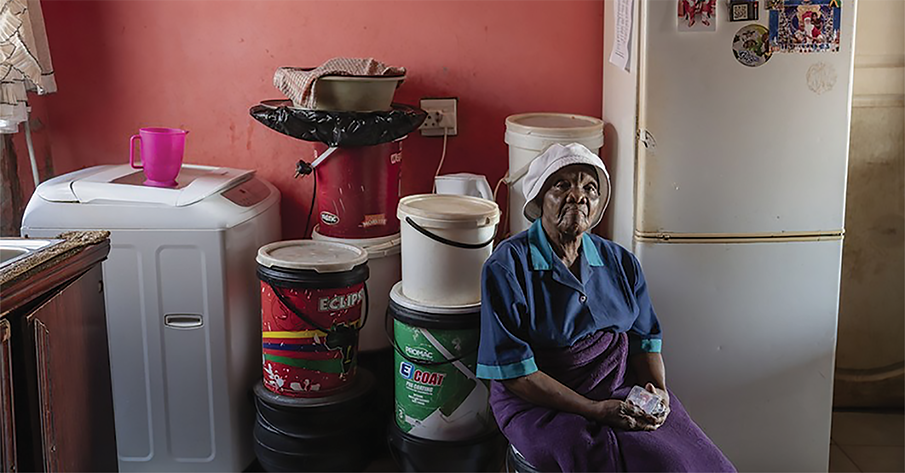
Seventy-year-old Pinky Chakela, from Lehae, says she is too old to carry a 20-litre bucket. She uses a 5-litre bottle and often makes multiple trips a day to collect water.
Phase 1 resident Esther Tshabalala, who is in her fifties, walks with crutches because of a problem in her hips. This makes it extremely difficult for her to carry buckets of water to and from collection points.
“I have fallen and hurt myself trying to carry a water bucket home. I don’t always have people to help me collect water for cooking and especially for the toilet. How can I survive?” said Tshabalala.
She said elderly and disabled residents like her often have to pay youngsters from the neighbourhood between R10 and R20 for them to collect and deliver one 20-litre bucket of water.
Asked about the upcoming local government elections, Tshabalala was sceptical. “Voting? Voting for what? For who?
We are not going to vote because nothing changes. Things are only getting worse. They can’t even provide us with the most basic thing, which is water,” she said.
Resident Nomsa Mofokeng shows the water tanks provided by Johannesburg Water. Residents say the tanks are not big enough and haven’t been filled since December.
Two water tanks were provided by Johannesburg Water, but these have not been filled since December, and residents say they are not big enough.
“We have to pick and choose carefully what we use our water for,” said Mesesi Kubheka.
“Cooking, cleaning and toilet come first, and then I can do some laundry if I still have some water left over,” she said. She has about 60 litres of stored water in containers.
Ward 122 councillor Sithembiso Zungu, who also serves as the City of Johannesburg’s mayoral committee member for Group Corporate and Shared Services, acknowledged that reliable supply was an issue.
“Residents do receive water, but it comes on very early in the morning, so people need to get up early to get water.
So the situation is not as we would like, and we are engaging with Johannesburg Water to work on a solution,” said Zungu.
Johannesburg Water spokesperson Nombuso Shabalala said the issues in Lehae are caused by illegal water connections, which have placed strain on the Lenasia Water Supply System.
“As part of capacity management measures, the Hospital Hill and High-Level Reservoirs are isolated twice daily to allow for system recovery. During these isolation periods, areas such as Lehae are affected, leading to reduced pressure or intermittent water supply.”
Johannesburg is facing a severe, worsening water crisis driven by aging infrastructure, with over 48% of supply lost to leaks, leading to frequent, long-term outages (some lasting over 25 days). Rand Water is restricting supply due to high consumption, while 60% of infrastructure has exceeded its lifespan, requiring an estimated R90 billion in upgrades.
Meanwhile, Water and Sanitation Deputy Minister David Mahlobo has emphasised the critical role of partnerships in addressing South Africa’s water and sanitation challenges. Mahlobo was speaking at the 2026 Future of Sustainability Conference, held in Johannesburg, on Wednesday.
Held under the theme: “Africa’s Green Horizon: Leading the Global Transition,” the two-day conference brought together sustainability leaders, policymakers, business executives, academics, and industry specialists to address pressing environmental challenges and explore innovative, sustainable business strategies. – GroundUp and additional reporting by WSAM
MIRROR Briefs
MINISTER’S DECISION UNLAWFUL
The Pietermaritzburg High Court has ruled that the Land and Reform minister Mzwanele Nyhontso’s decision to dissolve the Ingonyama Trust Board (ITB) was unlawful and irrational. This follows an urgent application by four members of the ITB who were left in office at the time it was dissolved.
The members, Inkosi Sibonelo Mkhize, Advocate Linda Zama, Inkosi Phalang Molefe and property practitioner Nomusa Zulu said in their application, the decision by the minister should be declared unlawful, irrational and suspended, as he had misinterpreted the Ingonyama Act in taking the decision. Cited as respondents, among others, were King Misizulu kaZwelithini, the sole trustee of the Ingonyama Trust, and KwaZulu-Natal Premier Thamsanqa Ntuli.
Both the Zulu King and Ntuli were consulted by Nyhontso and agreed with his assertion that the board had virtually collapsed and was unable to carry out its duties and should therefore be dissolved. Nyontsho dissolved the board following a series of resignations of several board members.
The Minister said due to the resignations, the board now has only four serving members alongside King Misuzulu, who serves as Chairperson in terms of the Ingonyama Trust Act. – Lehlohonolo Lehana.
SA FACING HUGE HOUSING BACKLOG
Human Settlements Minister Thembi Simelane has called for urgent, large-scale collaboration between government, the private sector, and financial institutions to address South Africa’s housing backlog, which currently stands at approximately 2.6 million units affecting more than 12 million people.
Delivering a keynote address at the Second Local Government Residential Property Summit held in Modderfontein, Johannesburg, Simelane said the scale of the challenge requires a fundamental shift in how housing is delivered.
“The State cannot address this challenge alone. Delivery at scale requires structured and sustained partnership with the private sector and other industry role players,” the Minister said.
She highlighted that South Africa was operating within a complex environment marked by rapid urbanisation, rising construction costs, infrastructure constraints and increasing climate-related risks.
Citing global projections, the Minister noted that between 68% and 70% of the world’s population was expected to live in urban areas by 2050, with Africa among the regions most affected – a trend that would place additional pressure on cities such as Johannesburg.
Despite these challenges, Simelane reaffirmed government’s constitutional obligation to progressively realise access to adequate housing.
“The question before us is not whether we deliver, but how we deliver differently, more efficiently, and at scale.” – Sanews.
BID TO HALT ANC INDABA FAILS
The High Court in Polokwane, Limpopo has dismissed an urgent application to interdict the provincial elective conference taking place this weekend.
The application also sought to compel disqualified branches to take part at the conference.
The case was brought by disgruntled member, Basil Mabasa, who questioned the legitimacy of the digital device used to verify a Branch General Meeting in the Collins Chabane region.
Mabasa claimed he had failed to resolve the matter through ANC internal dispute resolution mechanisms. As a result, his branch unanimously resolved to approach the court for urgent intervention.
He said the interdict application passed the urgency test because the disputed matters directly affected the validity of delegate mandates for the provincial conference.
Acting Judge Tshifhiwa Tshivhase delivered the judgment on Friday morning.
“ This court came to the conclusion that there is no case made out by the applicant on urgency in terms of Rule 612.
The application is struck off the roll for the lack of urgency. Each party will pay its own costs.
ANC Limpopo secretary Reuben Madadzhe said preparations were on track, with branch participation having increased from about 440 in 2022 to 568 this year. – Lehlohonolo Lehana.
Postbanks rolls out SASSA cards
Postbank will resume the rollout of its black cards from mid-April, continuing efforts to replace South African Social Security Agency (SASSA) gold cards.
In a statement, the government said approximately 1.5-million social grant beneficiaries had been issued black cards by March 31 2025.
The rollout will continue, running from mid-April to July 2026. About 600 000 remaining gold cardholders will be called to swap to Postbank’s black cards in order to continue receiving their social grants.
The rollout follows the formal licensing of Postbank as a Financial Services Provider by the Financial Sector Conduct Authority. This forms part of efforts to build Postbank into a “sustainable and well-governed state-owned retail bank” after its separation from the South African Post Office in 2019, the statement said.
The switch to black cards was required after a 2021 cryptographic breach compromised the security key used to issue SASSA gold cards. Postbank was issued notices by the South African Reserve Bank in 2021, 2022 and 2023 to replace all SASSA gold cards with the new black cards, which have improved security features.
However, a coordinated rollout only began in 2024, when Postbank launched a campaign to swap the cards ahead of a March 2025 deadline. In early 2025, Postbank attempted to migrate millions of beneficiaries, but only about half had switched by the deadline. – GroundUp
Meanwhile, a series of events has contributed to a decline in the number of social grant beneficiaries using Postbank, with many turning to private banks. Figures show that Postbank’s client base dropped from about 8.2-million in June 2020 to 2-million by June 2025, a 75% drop. – GroundUp