 WeeklySA_Admin
CONTRIVED: A polished dossier masquerades as explosive and aimed at righting a wrong, yet beneath the citations and timelines lies a familiar pattern: political theatre designed to punish dissent and signal allegiance to foreign power…
By Themba Khumalo
There is something inherently persuasive about a dossier. It arrives with the calm confidence of authority—neatly packaged, annotated, heavy with legal references, carrying the quiet suggestion that its conclusions have already been tested against fact.
A dossier does not ask to be believed; it expects belief. It presents itself not as an argument, but as a verdict.
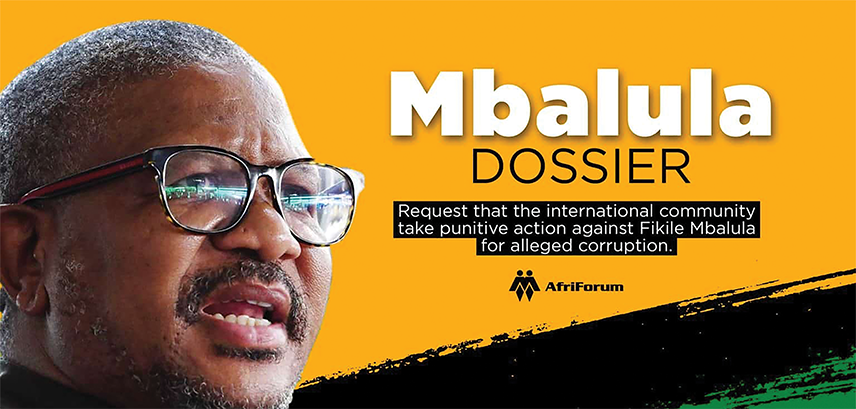
Such is the posture adopted by the so-called Mbalula Dossier produced by AfriForum.
Authority, however, when borrowed rather than earned, collapses under even the lightest scrutiny.
Read past the formatting, the citations, the carefully laid-out timeline, and what emerges is not a disciplined prosecutorial brief but a story being told. Its aim is not to examine allegations, but to fix a political figure—Fikile Mbalula—within a frame of suspicion.
The facts, such as they are, are neither new nor decisive.
None of this is to suggest that Mbalula is above scrutiny. He is not. His public record—like that of many in South Africa’s political class—invites questions, some of them uncomfortable and unresolved.
Let us be clear from the outset: if there were credible, prosecutable evidence of corruption, the law provides the mechanisms to address it.
South Africa is not a legal vacuum. The National Prosecuting Authority has had sight of these matters and declined to prosecute.
That decision matters—but it is not, on its own, a declaration of innocence. It is a legal judgment about evidentiary thresholds, not a moral absolution.
Yet the dossier treats this reality as an inconvenience. It is acknowledged, yes—but only to be sidestepped, reframed, or quietly undermined with suggestions of incompetence, bias, or political interference. The absence of prosecution is not accepted as a legal outcome; it is recast as a problem to be corrected.
Instead, what AfriForum offers is something else entirely: a carefully curated narrative, stitched together from contested facts, speculative inferences, and—most tellingly—political context that has no place in a corruption brief.
Because this is where the mask slips.
This is not, after all, the first time AfriForum has produced what it confidently calls a “dossier”. Last year, it unveiled one that was nothing short of a tantrum—a 15-page, overindulged, fevered document masquerading as research.
Its title, The World Must Know, reeked of a peculiar arrogance: the belief that a selectively outraged narrative should be accepted as global truth. It was political theatre soaked in bad faith—a frantic collage of curated grievance and manufactured peril. And at its centre stood Ernst Roets, cast as the lead actor in what was, at best, a tragedy of errors.
Seen in that light, the current dossier is not an aberration. It is a continuation. The tone is more restrained, the packaging more polished—but the underlying instinct remains unchanged: construct the narrative first, and assemble the evidence around it.
This instinct manifests in what the dossier chooses to highlight and how it frames each item. By selecting certain episodes, emphasising particular transactions, and repeating insinuations, the dossier transforms routine or already-investigated matters into a story of impropriety.
The Dubai trip. The Sedgars connection. Loans, gifts, murmurs of cash changing hands. These matters have long been In the public domain, examined and, crucially, presented to the National Prosecuting Authority.
None of this renders the underlying questions trivial. Public officials are not entitled to financial ambiguity, and where such ambiguity exists, scrutiny is not only justified—it is necessary.
The NPA, fully aware of the allegations, declined to prosecute.
That single fact should sit at the centre of any honest analysis.
In a constitutional democracy, a decision not to prosecute is not a casual shrug—it is a legal determination that the available evidence does not meet the threshold required to sustain a criminal case.
Yet in this dossier, that reality is treated as something to be managed rather than respected. It is acknowledged only to be undermined—its finality softened by suggestion, its authority diluted by insinuation.
From there, the dossier abandons evidence in favour of rhetoric.
A loan is recast as a bribe—despite no proof of exchange. The law is clear: under the Prevention and Combating of Corrupt Activities Act, the mere existence of a “gratification” is only the starting point. Intent is decisive. Without proof of a quid pro quo, the allegation remains exactly that: an allegation.
Here, the dossier leans heavily on assertion, with proof that remains either contested or insufficiently tested in a court of law. It leans on guesswork, contested accounts, and fragments of financial ambiguity never tested in court. Weight is built through repetition rather than verification, creating the illusion of certainty where none exists.
This is not how criminal liability is determined.
But it is an effective way to manufacture suspicion.And just as the legal scaffolding begins to crumble, the dossier exposes its true preoccupation: Mbalula’s politics. His criticism of the United States. His refusal to temper his language to suit foreign approval. These are not crimes; they are convictions. Yet the dossier treats them as if they were, weaving them into a narrative designed to cast doubt not on his actions, but on his character.
The subtext is unmistakable: a political figure who speaks critically of Western power is not simply wrong, but suspect—someone onto whom broader political anxieties are projected, whose motives are questioned, whose credibility is steadily eroded.
AfriForum projects itself as the incorruptible sentinel, the lone custodian of accountability in a landscape riddled with scandal. There is undoubtedly a constituency for this posture; in a country weary of political failure, the promise of a fearless watchdog is seductive. But self-anointment is not a substitute for evidence. Nor does political opposition confer prosecutorial authority.
AfriForum has also long positioned itself firmly on the side of Western power, quick to criticise those who dare to challenge it. That is a choice—one among many in a society of competing voices.
It becomes dangerous, however, when that preference begins to shape the use of legal tools—when dossiers cease to expose wrongdoing and start punishing people for thinking differently.
The Invocation of foreign legislation in this context is not merely legally thin—it is politically loud. The dossier does not merely attempt to prosecute a man. It attempts to discipline a posture—a posture that challenges Western influence and refuses to bend for external approval.
There is a long and troubling history, globally, of legal instruments being repurposed as political cudgels. Here, the invocation of the Magnitsky Act—a piece of U.S. legislation intended for clear, demonstrable cases of human rights abuse and grand corruption—feels less like a legal strategy and more like an act of geopolitical signalling.
Mbalula is cast not merely as a suspect, but as a symbol: the “wrong kind” of African politician, unwilling to soften his stance to suit Western expectations.
This is not accountability. It is bias dressed up as principle.
What emerges, then, is not a case, but a performance.
To reject the method is not to endorse the man. It is simply to insist that if accountability is to mean anything, it must be grounded in evidence rather than inference, and in law rather than performance.
This is theatre masquerading as justice, and in theatre, the verdict is decided long before the curtain rises.
Today it is Mbalula—loud, flawed, inconvenient. Tomorrow, it will be someone else.
The pattern is as old as power itself: they come for your political opponent, and you applaud. They come for your neighbour, and you look away. They come for your friend, and you remain silent. By the time they come for you, there is no one left to speak.
And the method will remain the same: assemble a dossier, cloak it in legalese, lace it with ideology, and present it as unimpeachable accountability.
What is at stake here is not the reputation of one politician, but the integrity of the tools we use to judge them.
A neat trick, perhaps.
But it is not justice.
It must be called out—clearly, calmly, and without apology—for what it is: not the exposure of corruption, but the construction of a story designed to discipline dissent as much as to pursue truth.