 WeeklySA_Admin
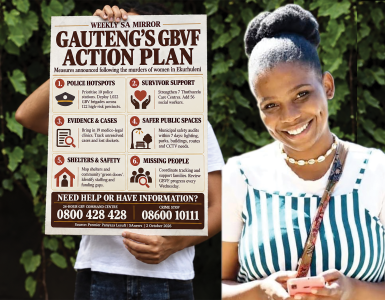
PUBLIC CONCERN: The safe return of missing Soshanguve woman Kutlwano Masilo brought relief to her family—but the discovery of two more women’s bodies in Ekurhuleni has pushed the toll to 11 and prompted President Cyril Ramaphosa to order urgent national action against gender-based violence…
BY MONK NKOMO
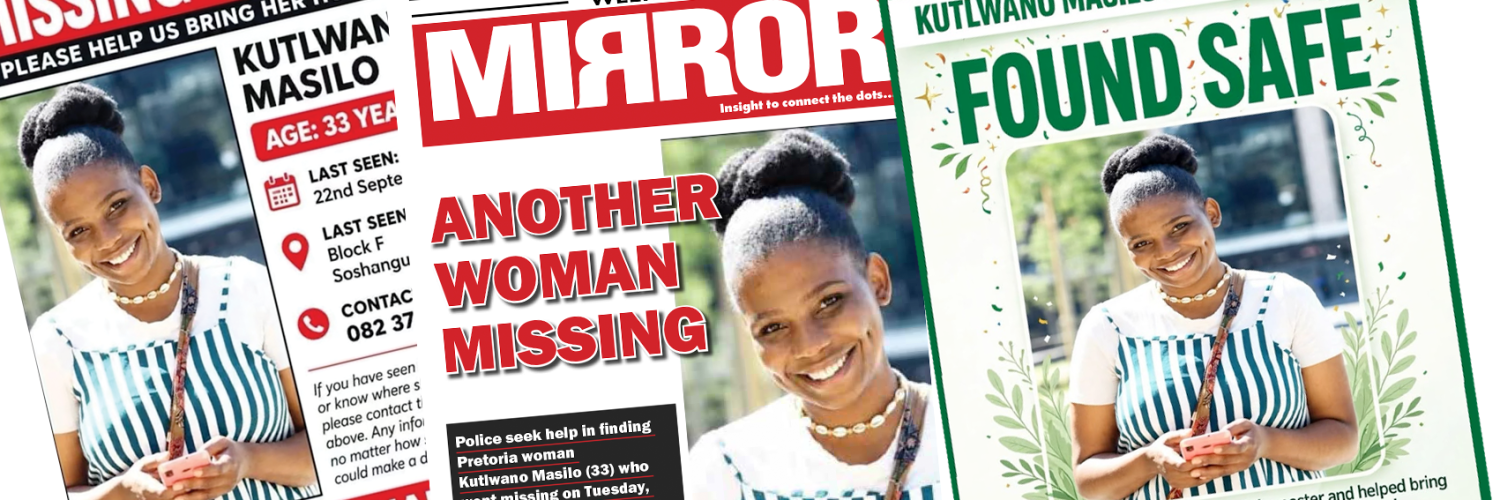
A PRETORIA family’s desperate search for missing Kutlwano Masilo has ended in relief, even as the discovery of two more women’s bodies in Ekurhuleni deepened the country’s anguish over gender-based violence.
Masilo (33) was found at a railway station in Soshanguve, north of Pretoria, nine days after she disappeared from Block F on September 22.
Police confirmed that she had been found and reunited with her family. No further details were immediately available about where she had been during her disappearance or the circumstances in which she was located.
Her family announced the news through a social-media poster thanking members of the public who had helped circulate the appeal for information.
“Thank you everyone who shared the poster and helped bring her home. The missing case is now closed. Please stop sharing the old missing poster,” the family said.
Masilo’s disappearance, reported on the front page of last week’s Weekly SA Mirror, had caused grave concern among relatives and residents. It came amid mounting fear over the discovery of women’s bodies across Ekurhuleni.
While her return brought an end to one family’s ordeal, the broader crisis intensified at the weekend when the bodies of a 10th and an 11th woman were discovered in the metropolitan area.
The 10th body was found near Tembisa early on Saturday, September 26. Police subsequently arrested a 36-year-old man who had allegedly fled to Tzaneen in Limpopo following the killing.
The following day, a private security patrol discovered another woman’s body in an open area in Springs, bringing to 11 the number of women’s bodies found in Ekurhuleni since July.
Police have not established that all the deaths are connected and have cautioned against premature speculation that a serial offender is responsible. Investigators have, however, identified similarities in some of the cases and are pursuing all possible leads.
Thank you to everyone who shared the poster and helped bring her home. The missing case is now closed..
— Masilo family
The escalating crisis prompted President Cyril Ramaphosa to address the nation on Tuesday night, assuring the families of the victims that the cases would not be allowed to go cold.
“The state is bringing together its available capabilities to establish what happened and to identify those responsible,” Ramaphosa said.
A specialised multidisciplinary investigation has been elevated to national level under the Deputy National Commissioner for Detective Services. The team brings together detectives, crime-intelligence officers, forensic specialists, investigative psychologists and digital investigators.
Ramaphosa said government would keep the public informed about developments without compromising the investigations or the rights of those involved.
He also appealed to communities to assist investigators, stressing that seemingly minor information could prove decisive.
“If you know something, say something. If you see something suspicious, report it immediately. Hours matter. Information matters. A photograph matters. A vehicle registration number matters,” he said.
Police visibility has been increased in Ekurhuleni and will remain intensified for as long as necessary.
The President also announced a 60-day nationwide safety audit requiring municipalities to identify dangerous public spaces, including areas with broken streetlights, abandoned buildings, poorly secured parks and other conditions that expose women to violence.
Police and the National Prosecuting Authority have further been instructed to complete a 90-day review of unresolved cases involving murder, attempted murder, rape and other forms of gender-based violence. Funded action plans are expected to follow the reviews.
Ramaphosa acknowledged that the measures taken by government so far had not been sufficient to stem the violence.
He said the country could not “police and arrest” its way out of the crisis and that greater emphasis had to be placed on prevention, safer public spaces and changing the behaviour that enabled violence against women.
Since gender-based violence and femicide was classified as a national disaster last year, government had reprioritised resources and strengthened coordination between the criminal-justice system and services supporting survivors.
The National Council on Gender-Based Violence and Femicide is now operational and held its inaugural board meeting in Pretoria in August.
Additional resources have also been directed to police Family Violence, Child Protection and Sexual Offences units, while Finance Minister Enoch Godongwana is expected to announce further allocations in the Medium-Term Budget Policy Statement on October 21.
Government plans to expand the network of Sexual Offences Courts and Thuthuzela Care Centres, improve shelters for survivors and strengthen DNA-processing and forensic-investigation capacity.
Ramaphosa said bail laws would also be tightened and that police stations were being equipped with victim-friendly services and specialised gender-based violence desks.
“Women who report abuse must not be turned away,” he said.