 WeeklySA_Admin
CONTRACTS: A decade of consistent income protection payments was later labelled an insurer’s “error”, exposing how ambiguous policy wording can overturn long-held expectations and prompting Ombud to warn consumers to read the fine print…
By Len Maseko
The National Financial Ombud Scheme (NFO) has warned consumers not to rely solely on an insurer’s past conduct when interpreting an insurance policy, after a landmark income protection dispute showed how years of consistent benefit payments can ultimately be overturned by the wording of a contract.
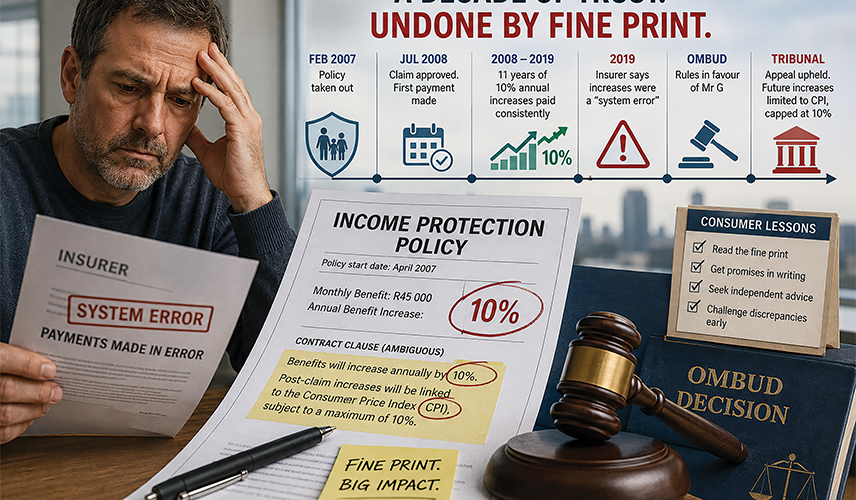
The case, highlighted in the NFO’s latest annual report, centres on a policyholder identified only as Mr G, who received annual 10% increases on his income protection benefit for 11 years before his insurer declared the increases had been made in error.
The dispute has become a cautionary tale about the importance of understanding insurance contracts and resolving discrepancies before they become entrenched.
Trust is valuable, but in insurance, vigilance is essential. Read every clause, question ambiguities and
challenge discrepancies before they become costly…
Mr G took out an income protection policy in February 2007 that promised a monthly benefit of R45 000 should illness prevent him from working. The policy also appeared to provide for annual benefit increases of 10%.
After becoming ill later that year, his claim was approved and benefit payments commenced in July 2008. For more than a decade, the insurer increased his monthly benefit by 10% every year.
However, in 2019, the insurer informed Mr G that the annual increases had resulted from a system error.
It argued that the policy only allowed post-claim increases linked to inflation, measured by the Consumer Price Index (CPI), with a maximum increase of 10%.
Independent legal opinion
Mr G challenged the decision through the Ombud’s office. An independent legal opinion considered two important legal principles.
The first, known as quasi-mutual assent or the reliance theory, holds that a party may be bound by the reasonable expectations they create through their words and conduct.
The second, the contra proferentem rule, provides that where a contract contains ambiguous wording, the uncertainty should be interpreted against the party that drafted the document.
The Ombud initially found in Mr G’s favour, ruling that the insurer’s policy wording, together with its decade-long practice of paying fixed annual increases, created a reasonable expectation that the benefit would continue increasing by 10% each year.
But the insurer appealed the ruling.
On appeal, the Tribunal concluded that, although the policy wording was poorly drafted, it could still be interpreted consistently. It found that the contract distinguished between voluntary benefit increases before a claim, which required higher premiums, and post-claim increases intended only to protect the value of benefits against inflation.
The Tribunal – therefore – ruled that future increases should be limited to CPI, subject to a maximum annual increase of 10%.
Although the insurer succeeded on appeal, it did not seek repayment of the higher amounts already paid to Mr G over the previous 11 years. Future CPI-based increases would also be calculated from the higher benefit amount already reached.
Denise Gabriels, Lead Ombud of the NFO’s Life Insurance Division, said the case highlights the need for consumers to actively manage their insurance policies rather than assume long-standing payment practices accurately reflect contractual obligations.
“Consumers must protect themselves by reading carefully, documenting promises, monitoring payouts, and challenging discrepancies early. Trust is valuable, but in insurance, vigilance is essential,” Gabriels said.
She urged policyholders to scrutinise policy wording, obtain written confirmation of any promised benefits, seek independent professional advice where necessary and raise disputes as soon as inconsistencies arise.
Gabriels said the case demonstrates that insurance contracts can contain ambiguities capable of producing vastly different interpretations years after a policy has been issued.
“Income insurance can still be a lifeline when work is no longer possible, but only if vigilance and clarity are woven into every step of the journey,” she said.