 WeeklySA_Admin
STRATEGIC: During the summit, China announced the unilateral opening of its market for 33 countries on the continent, promising them zero-tariff treatment for 100 percent tariff line…
By Abdul Rahman
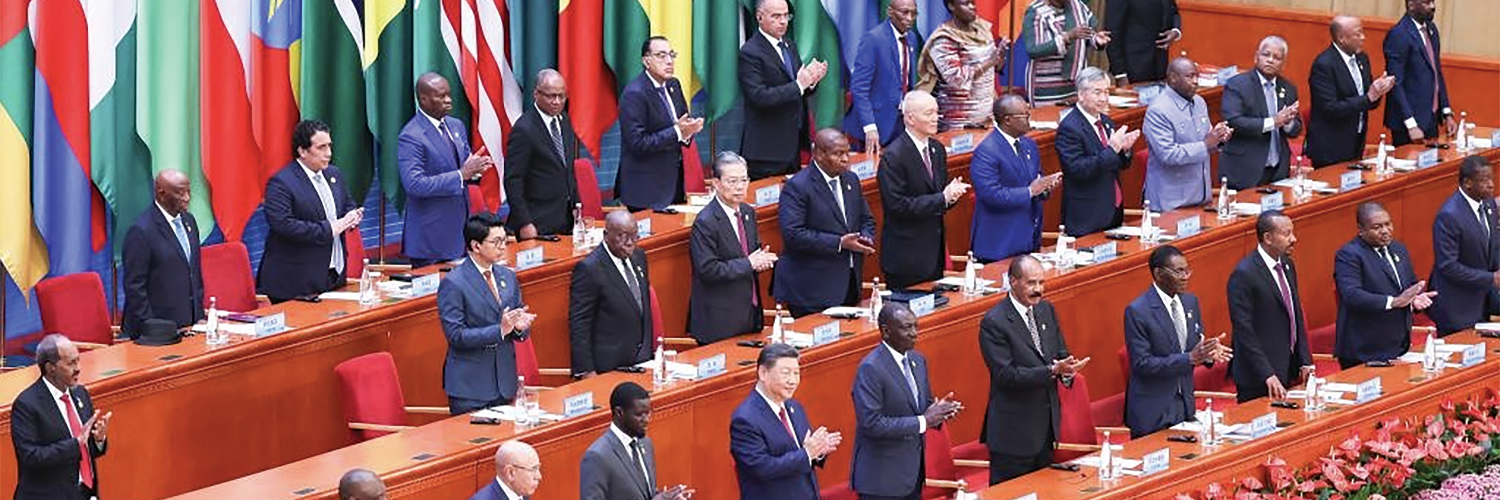
The ninth Forum for China-Africa Cooperation (FOCAC) or the China-Africa Summit opened on Thursday, September 5 at the Great Hall of the People at Beijing. In the inaugural address the Chinese President Xi Jinping announced to upgrade all existing relations with African countries to the level of “strategic relationship.”
During his address, Xi claimed that modernization is the right of all countries in the world. He criticized the Western approaches to modernization which, according to him, are based on domination causing immense sufferings on developing countries. He, instead, proposed a mutual approach to modernization in order to build a prosperous future for both China and Africa.
The proposed approach to modernization would be “just and equitable,” featuring and respecting all kinds of “diversity and inclusiveness” and is eco-friendly. “China and Africa’s joint pursuit of modernization will set off a wave of modernization in the Global South, and open a new chapter in our drive for a community with a shared future for mankind,” Xi said.
This year’s theme of the summit, which is also known simply as “Forum” is “joining hands to advance modernization and build a high level China-Africa community with a shared future.”
Out of the 54 countries on the African continent, delegations or leaders of 53 countries are participating in the summit. UN Secretary General Antonio Guterres joined the summit as a special guest, and heads of several other international organizations, including the African Union (AU), are also participating in the summit as observers.
According to the Chinese Foreign Ministry, the Forum which will conclude on Friday is the “largest diplomatic event” in the country in the last few years and that most of the countries are represented by their head of states.
The summit was first formed in 2000 and held every three years. It is basically designed as a platform to develop cooperation between China and African countries in areas such as economic and trade development, including the Belt and Road Initiative (BRI) and security cooperation.
It has gradually become the principal instrument to govern the relations between China and African countries.
“Thanks to nearly 70 years of tireless efforts from both sides, the China-Africa relationship is now at its best in history,” Xi said in his inaugural address. He proposed to elevate all bilateral relationships with African countries, “to the level of strategic relations, and that the overall characterization of China-Africa relations be elevated to an all-weather China-Africa community with a shared future for the new era.”
China-Africa relations at its best
China has diplomatic relations with all the countries on the continent except eSwatini, aka Swaziland, which does not adhere to “one China policy” and has diplomatic ties with Taiwan.
China has invested heavily in infrastructure development in the African continent through its BRI. It has been the African continent’s biggest trading partner since 2009. They had a mutual trade of USD 282 billion in 2023. There is a proposal to raise it further to over USD 300 billion in the coming years. Data from China’s Ministry of Commerce shows that Chinese companies created over 1.1 million jobs in the last three years alone, Xinhua reported.
Chinese engagements in Africa have become a major concern for the West which has a long history of colonial occupation and imperialist intervention and see China as a threat to their interests in the region. There has been an attempt by the West to portray the Chinese attempts to fund development projects in the region as a “debt trap” for African countries. China rejects has rejected such accusations, claiming the relationship between China and Africa is based on mutual respect and cooperation. The Chinese Foreign Ministry had earlier asserted that in its 24 years long history of FOCAC, the forum “has always adhered to the principles of planning together, building together and benefiting together.”
During his address on Thursday, Xi offered to implement 10 partnership action plans to jointly advance modernization with African partners. These 10 partnership plans include programs related to mutual learning, exchange of knowledge and values, trade prosperity with special focus on least developed countries in the region, industrial chain cooperation by “working together on personnel training, poverty reduction and employment” and greater technological exchanges.
Xi proposed to make greater investments in building better connectivity projects across the continent and to China under high quality BRI projects, development cooperation by initiating thousands of small livelihood projects, cooperation in the sectors such as health, agriculture and livelihoods, programs to have greater people to people and cultural exchanges and green development under its Global Development Initiative (GDI).
He also promised better trade relations and market access for all “least developed countries” (LDCs), including 33 countries in Africa, “China will voluntarily and unilaterally open its market wider. We have decided to give all LDCs having diplomatic relations with China…zero-tariff treatment for 100 percent tariff lines.”
Xi proposed fresh assistance worth USD 51 billion for African countries to run and develop some of these programs in the next three years. He also promised creation of a million more jobs in the same period.
China has also proposed to enhance the common security approach by assisting the African countries to improve their capacity to safeguard peace and stability without being reliant on external forces under its Global Security Initiative (GSI).
As of now, the US and several European countries have military presence on the continent which often threatens the independence of countries, their stability, and peace. – People’s Despatch
LET NATIONS UNITE FOR GOOD OF ALL – RAMAPHOSA
Adversity: Conflicts caused great human suffering across the globe…
By Monk Nkomo
The world was experiencing many challenges including war and conflict which continued to cause great human suffering and instability in a number of places across the globe, according to President Cyril Ramaphosa.
Speaking at the opening ceremony of the Forum on China-Africa Cooperation Summit (FOCAC), during his visit to China this week, Ramaphosa also added that climate change was causing widespread devastation while the world was falling behind in its efforts to achieve the Sustainable Development Goals.
The ceremony was attended by a host of distinguished guests who included Xi Jinping, President of the People’s Republic of China, Mohamed Ghazouani, Chairperson of the African Union and President of the Islamic Republic of Mauritania, Bassirou Diomaye Faye, President of the Republic of Senegal and co-chair of the Forum on China Africa Cooperation, Moussa Faki Mahamat, Chairperson of the African Union Commission and Antonio Guterres, United Nations Secretary-General.
Ramaphosa said the global contestation for critical minerals was fuelling geopolitical rivalry and these challenges affected all nations, but were often most severely felt in Africa.
Yet, amid these challenges, there was hope and opportunity.
‘’Twenty-five years ago, President Nelson Mandela delivered a lecture at Peking University, in which he said: “Whenever the need or opportunity arises the peoples of the world reach out to one another in the name of a common humanity.”
This common humanity was what brought African countries and China together under the banner of FOCAC – driven by a desire to achieve shared prosperity while recognising their individual developmental aspirations.
‘’If we are to realise a sustainable future for Africa and China – and indeed the entire world – we must acknowledge the reality of the interdependence among our community of nations. If we are to build a future that is people-centred, development-orientated and inclusive, we need to work in a spirit of cooperation and collaboration.’’
According to Ramaphosa, China had a long history of friendship and solidarity with the people of Africa. Since this relationship was institutionalised through FOCAC in 2000, ties between China and Africa had continued to grow and deepen.
‘’We welcome the proposal by President Xi Jinping to elevate China’s bilateral relations with African countries having diplomatic ties with China to the level of strategic relations. This fourth FOCAC Summit reflects the cooperative, comprehensive and intentional nature of our cooperation’’.
This Summit reflected their shared desire for modernisation, development and progress on the African continent. This shared desire was reflected in the ten partnership actions on modernisation to be taken by China and Africa, as announced by President Xi. Through the implementation of the African Continental Free Trade Area, the economies of Africa were being drawn closer together. Ramaphosa said they were pursuing projects that reached across national borders.
‘’We believe that FOCAC can play an important role as Africa works to build an integrated network of linkages between countries, within regions and across the continent. We believe that FOCAC is a valuable forum to support the implementation of the African Union’s Agenda 2063.
In the name of our common humanity, we must work together to achieve the Africa we want. And we must work together to achieve the world we want’’.