 WeeklySA_Admin
OPINION: Taps are dry, pipes are leaking, and yet the City speaks of decisive action, technology, and awareness campaigns. Johannesburg deserves water, not high-minded rhetoric…
By Themba Khumalo
Johannesburg is not short of water plans—it is drowning in empty promises. Every month, the mayor emerges with a fresh statement, slick with excuses and bureaucratic babble, while the only thing that does not flow is water.
This city’s leadership has perfected the art of saying everything and doing nothing, leaving residents to live like campers in their own homes while officials wax lyrical about “resilience” and “stakeholders.”
Enough. People are fed up with lofty, but completely hollow speeches. What they want, and what they deserve, is water in their taps—not another deluge of words.
Mayor Dada Morero begins by declaring that the City is taking “decisive action” to stabilise the water supply. Decisive action, apparently, is something that happens after reservoirs wobble, pipes collapse, and residents are forced to live like survivors in a daily water hunt. If this is decisiveness, one shudders to imagine what indecision looks like.
Johannesburg has been warned about this crisis for more than a decade, yet urgency only appears once the taps run dry and anger begins to boil.
The City “acknowledges the inconvenience” caused by water disruptions. Not a crisis. Not failure. Not betrayal of a basic constitutional obligation. Just inconvenience. It is a word that reveals how far removed the authors of this statement are from the reality of dry taps, closed schools, struggling clinics and households…
We are told this is a “comprehensive, multifaceted” programme, coordinated between the City, Joburg Water, Rand Water and an unnamed cloud of “key stakeholders”. Coordination is always promised at the point when it has already failed.
If these entities were truly aligned, the city would not lurch from one outage to the next – like a drunk staggering between lamp-posts. And the stakeholders? Residents, as ever, are only stakeholders when they are asked to sacrifice.
The statement leans heavily on “detailed assessments” of water usage and “targeted interventions in high-risk areas”. This is bureaucratic code for studying a corpse instead of resuscitating the patient. High-risk areas are not new discoveries. These are places that have been breaking down for years, documented in reports that gather dust while pipes rot underground.
Illusion of control
Then comes the technological theatre: cutting-edge systems to monitor and optimise the supply network. It is difficult to take this seriously in a city where leaks run openly for days, burst pipes become landmarks, and residents remain the primary detection system. If the technology is advanced, the response is incompetent. If the response is competent, the technology is fictional.
He also remarks that Johannesburg remains one of Rand Water’s largest consumers, while assuring us that “significant progress” has been made in reducing consumption. Significant, yet unspecified. Measurable, yet unmeasured for the public.
Instead, we are handed a target — 1 550 megalitres a day — as though numbers alone will fix infrastructure. Targets are comforting because they create the illusion of control. They also provide perfect cover when they are missed, reset and quietly forgotten.
To reach this target, the City pledges urgent interventions, including real-time household-level monitoring, partnerships with businesses, and awareness campaigns. Johannesburg has become addicted to awareness campaigns, as if residents are hoarding water out of ignorance rather than responding to scarcity. Monitoring is promised with one hand while outages arrive without warning in the other.
Immediate measures, we are told, include night-time throttling, pressure management, bulk meter restrictions and advanced leak detection. Translated into lived reality, this means reduced pressure, unpredictable supply and a city permanently on edge. These are not solutions; they are rationing tools, designed to stretch a failing system just long enough to survive the next press conference.
We are assured that rapid response repairs are underway, audits have increased, and ward committees are being mobilised. This raises an uncomfortable question: if audits and repairs are only being intensified now, what exactly was happening before? And if ward committees are suddenly crucial, why were they not empowered years ago, when intervention might have prevented collapse?
The statement then acknowledges infrastructure challenges, illegal connections, and historical underinvestment — the holy trinity of municipal failure — without naming a single decision-maker responsible for any of it. Underinvestment does not happen accidentally. Illegal connections do not flourish in well-governed systems. These are not inherited sins; they are the result of choices made and defended in council chambers.
Water tankers as painkillers
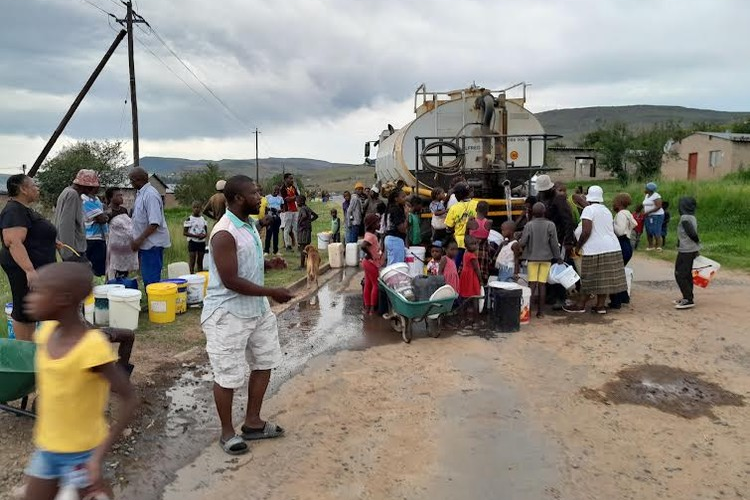
Specific communities are named — Melville, Westdene, Parktown West — and residents are told their suffering is due to system constraints and commissioning work. Tankers and mobile storage units are rolled out as proof of care. In truth, tankers are the municipal equivalent of painkillers: they dull the symptoms while the disease worsens. No city serious about water security treats tankers as a routine solution.
We are then transported into the future, where new reservoirs, modern pump stations, and refurbished infrastructure promise resilience and flexibility. This future is always just out of reach, always awaiting completion, always delayed by procurement, contractors, or “unexpected challenges”. Johannesburg has lived in this promised future for years, while its present decays.
The City “acknowledges the inconvenience” caused by water disruptions. Inconvenience. Not a crisis. Not failure. Not betrayal of a basic constitutional obligation. Just an inconvenience. It is a word that reveals how far removed the authors of this statement are from the reality of dry taps, closed schools, struggling clinics, and households forced into daily survival calculations.
Finally, the appeal: residents must reduce consumption, report leaks, and comply. The City will provide updates. Commitment is reaffirmed. Assurance is renewed. And accountability, once again, is absent.
‘Show up, speak out’
This statement is verbal sedation. It is designed to tire the public into acceptance, to bury failure under volume, and to replace action with articulation. Johannesburg does not need another promise of resilience. It needs consequences for those who let its water system bleed dry while telling residents to be patient.
Until then, the City will continue to speak fluently — and govern in drought.
But residents are not powerless — far from it. The real question is what genuine action looks like. It begins with a war room run by engineers, not politicians skilled only in excuses. It means a public, live dashboard that tracks every burst pipe and every delayed repair, and clearly identifies who is responsible for fixing them.
It means water bosses whose jobs are on the line for every missed deadline, not insulated by titles, excuses, or obfuscation. It demands open council forums that actually listen, real-time reporting of failures as they occur, and independent oversight with real bite, not ornamental committees. If those in charge cannot deliver water, then they must face consequences that cannot be dodged, delayed, or explained away.
And, if you are tired of winding and empty speeches and recycled promises, the answer is simple: show up, speak out, and refuse to accept another excuse. This city’s future will not be saved by slogans. It will be saved through pressure—not only in the pipes, but from the people who depend on them.
*The writer, Themba Khumalo, is a political commentator and former editor