 WeeklySA_Admin
BLIGHT: Non-revenue water sits at 46%, pipes are crumbling, and residents face unexplained charges as the city battles a R32 billion infrastructure backlog…
By Themba Khumalo
A Kibler Park resident has raised concerns over what he describes as a “collapse” in Johannesburg’s water infrastructure, highlighting widespread leaks and unexplained water billing charges. These issues have blighted the city for years and continue to affect thousands of households.
Fanie Mogotji said longstanding leaks across Johannesburg had not been properly fixed, resulting in wasted water, damage to road surfaces and, in some cases, alleged pollution of local waterways.
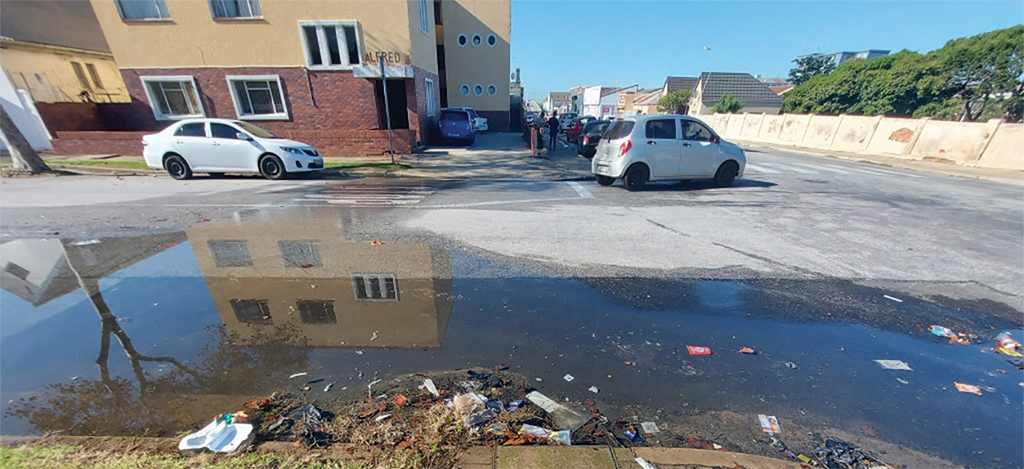
“At the corner of Eland and Heidelberg Roads, an underground leak that was reportedly ‘repaired’ approximately two years ago continues to worsen,” Mogotji said. “The road surface is now deteriorating, indicating that the problem was never properly resolved.”
Johannesburg Water’s most recent audited figures for the 2023/24 financial year show that 46.2 % of treated water supplied to the city is classified as non-revenue water, meaning it is lost before it can be billed due to leaks, illegal connections, faulty meters or authorised but unbilled use. Of this total, approximately 24.8 % is attributed to physical losses, where water escapes from ageing or damaged pipes. Water sector specialists generally regard 15 % non-revenue water as an acceptable benchmark for well-maintained urban systems.
Mogotji’s concerns arise amid sustained reports that Johannesburg’s water network loses large volumes of treated water to leaks. Hydrological research shows that during dry seasons, a significant proportion of the flow in sections of the Jukskei River originates from leaking municipal infrastructure and wastewater overflows, rather than natural runoff. This highlights the scale of the system’s failure.
Leakages and Promises
Johannesburg’s leadership has repeatedly promised to address the water crisis across the entire city, acknowledging the scale of the problem and outlining plans to do so. Following widespread protests over persistent water supply interruptions, on 15 September 2025, Mayor Dada Morero told the media, “We are on top of this problem. We are going to find solutions on the water issue in Johannesburg.
We have also agreed with the Minister of Water that Johannesburg will have a programme on dealing with leaks and get support with provincial government. In that way, we will reduce our water losses quite significantly as we deal with pipe replacements.” — PressPortal
Earlier in the year, on 14 May 2025, the Mayor highlighted the scale of the city-wide water losses and outlined strategic steps:
“Johannesburg loses almost half of all treated water before it even reaches residents due to leaks, illegal connections, and faulty meters. We are committed to addressing this across the entire city, not only in affected suburbs.
Our strategy includes bulk pipe replacement, pressure management, and better monitoring to reduce these losses.” — News24
The City Manager reinforced the commitment on 22 August 2025, emphasising a comprehensive, city-wide approach:
“We are not just fixing a few neighbourhoods; Johannesburg’s water and sanitation network requires a full city-wide renewal. We have prioritised pipe replacements, pump station upgrades, and reservoir maintenance so that all residents will benefit from reliable supply.” — IOL.
Later, on 12 November 2025, Morero provided further details on the city-wide plan, noting that it was strategic for the entire metropolitan area, not just problem areas:
“We have developed a comprehensive city-wide water management plan. It addresses leaks, ageing infrastructure, water losses, and the need for consistent supply to all Johannesburg residents. This is a strategic approach for the entire metropolitan area, not just problem zones.” — Business Day.
Water Leaks and Environmental Risk
In addition to leaks, raw sewage spills have been reported in parts of the city. Mr FM said untreated sewage had allegedly been flowing into tributaries of the Jukskei River for extended periods, which, if confirmed, would represent a serious environmental and public health risk.
Researchers, environmental organisations and the media have widely documented pollution of the Jukskei River and its tributaries. Studies show that failing sewer infrastructure and overflows have significantly degraded water quality in parts of the river, particularly during periods of low rainfall.
Streetlights in areas such as Linden, Northcliff, Roosevelt Park, and many other suburbs have reportedly been operating continuously, day and night, for years — further reflecting what residents describe as infrastructure mismanagement and waste.
Billing Irregularities Fuel Frustration
Mogotji also condemns what he calls “severe billing irregularities”. He reported receiving a water bill of about R21 000 for one month despite living alone and having no high-consumption amenities.
Billing disputes have been a recurring complaint among Johannesburg residents. Although Johannesburg Water has assumed direct responsibility for water billing to improve accuracy and accountability, consumers continue to report high estimated bills when meters are unread, faulty, or disputed. Consumer advocates warn that billing based on “average consumption” can result in inflated charges, particularly in areas affected by undetected leaks.
City residents have repeatedly expressed similar frustrations, attributing unexpectedly high bills to estimated charges and inconsistent meter readings.
OUTA, the Organisation Undoing Tax Abuse, has also criticised Johannesburg’s approach to water management:
“Poor infrastructure maintenance leads to frequent breakdowns and water losses, which municipalities then pass on to consumers through higher service charges. Instead of addressing these inefficiencies, municipalities often opt for the easier route of raising tariffs to cover the shortfall. For example, the City of Johannesburg’s water utility Johannesburg Water reported that non-revenue water was 46.11 % in 2022/23, while water tariffs increased by 9.75 % in 2022/23, by 9.3 % in 2023/24 and by 7.7 % in 2024/25 — indicating that the cost of water losses is being passed on to customers.” — (outa.co.za)
On 5 September 2025, Morero admitted, “We are aware of complaints regarding unusually high bills in all areas. Johannesburg Water is reviewing its billing practices city-wide and will implement more accurate metering and timely readings to prevent residents from being charged unfairly.” — Sowetan Live.
Protests and Recent Outages
Earlier this month, residents in Midrand took to the streets in protest over a prolonged outage that left taps dry for more than six days, disrupting daily life and schooling. The interruption was linked to technical faults at key treatment and reservoir facilities, and residents criticised the authorities for the lack of timely communication. Joburg Water later reported slight improvements in reservoir levels but acknowledged that sustained supply had not yet been restored.
Communities in Melville and neighbouring suburbs have also endured extensive outages, with some residents reporting weeks without reliable water. Volunteers have organised community collection points and are supplying limited daily allowances, as municipal deliveries remain intermittent. Advocacy groups describe the outages as emblematic of a fragile and poorly maintained system. (groundup.org.za)
Call for Action from Authorities
Mogotji has called on the Executive Mayor of Johannesburg, the City Manager, Johannesburg Water and relevant oversight bodies to audit and repair persistent water leaks, investigate sewage discharges into rivers, review billing practices and improve turnaround times for infrastructure repairs.
“Consumers should not bear the financial burden of municipal inefficiencies,” he said.
City and utility reports indicate that more than a quarter of Johannesburg’s water and sanitation infrastructure is in poor or critical condition, while the funding backlog required to rehabilitate and replace ageing assets exceeds R32 billion. In the 2023/24 financial year, fewer than 20 km of water mains were replaced — a pace experts say is insufficient to reverse long-term deterioration across the network.
* Themba Khumalo is a political commentator and former editor