 WeeklySA_Admin
SCOURGE: A UCT study shows illegal cigarettes now dominate South Africa’s market, draining billions in tax revenue and forcing formal players like BAT to scale back — as the government scrambles to regain control…
By Len Maseko
South Africa’s tobacco industry is experiencing a seismic shift — one that is eroding state revenue, distorting competition and forcing major manufacturers to retreat.
At the centre of the storm is the rapid rise of illicit cigarettes, now estimated to dominate the local market.
A landmark study by the University of Cape Town (UCT) has found that around 60% of cigarettes sold in South Africa in 2021 were likely illicit, marking a dramatic escalation from roughly 30% before the COVID-19 pandemic. It is novel in that it has identified specific brands and producers linked to illicit trade.
That surge has not meaningfully reversed — and its consequences are now being felt across the economy, most visibly in the contraction of formal industry players such as British American Tobacco (BAT).
Researchers point to brands sold at prices so low that it is “most unlikely that the full tax had been paid”, with more than 80% of cigarettes from certain local producers falling into this category.
The Covid sales ban took the illicit share to
about 60% of the total market…
Mostly targeted for illicit cigarette trade were “low-income individuals, people with lower levels of education and heavier smokers”. This suggested that cheaper, untaxed cigarettes were disproportionately consumed by more vulnerable groups.
Lead researcher Mxolisi Zondi says: “The research identifies a substantial structural shift in the South African cigarette market. In the early years of the 21st century, British American Tobacco (BAT) was the dominant player with more than 90% market share.
“However, their market share has decreased to only about 33% in 2021. In contrast, Polaris Manufacturing – formerly known as Gold Leaf Tobacco Corporation – has emerged as a major player, with an estimated market share rivalling that of BAT”.
In BAT’s place, a new set of largely local producers has risen — many linked to the illicit trade and able to sell cigarettes at prices so low that tax compliance is highly unlikely.
These products are widely distributed through informal retail channels — particularly spaza shops — where enforcement is limited and consumers are highly price-sensitive.
The result is not simply competition, but distortion: a parallel market operating outside the law and steadily overwhelming the legal one.
Against this backdrop, the scaling back and shutdown of BAT operations in South Africa — including manufacturing capacity — is less a surprise than a symptom.
A legal manufacturer operating within tax and regulatory frameworks cannot compete sustainably against producers who evade both. The price gap is simply too wide.
This imbalance has three immediate consequences: shrinking market share for compliant producers and eventual cuts to production and jobs.
The BAT shutdown was reshaping the entire industry and the impact extending well beyond one company.
COVID’s lasting damage
The UCT study has identified the 2020 cigarette sales ban during the COVID-19 lockdown as a turning point.
While intended as a public health measure, the ban created a vacuum that illicit networks quickly filled. Smokers continued buying — but from underground suppliers.
“The sales ban took the illicit share to about 60% of the total market,” the study notes, adding that there has been no significant decline since then.
In effect, the policy accelerated the growth of illicit distribution systems that have proven difficult to dismantle.
Once consumers switched to cheaper, untaxed cigarettes, many did not return to legal products.
The Cost
The implications of this shift are far-reaching. With excise duties forming a major portion of cigarette pricing, the rise of illicit trade is costing the South African government billions in lost tax revenue — money that would otherwise fund public services.
Illicit cigarettes are cheaper and more accessible, particularly to vulnerable groups. The study shows usage is highest among low-income individuals, less-educated populations and heavier smokers, deepening health inequalities.
As legal manufacturers scale back, jobs are lost not only in factories but across supply chains — from logistics to retail. The illicit cigarette trade often overlaps with broader organised crime, including smuggling, tax evasion and corruption.
Authorities’ response
The government has now acknowledged the crisis and outlined a response.
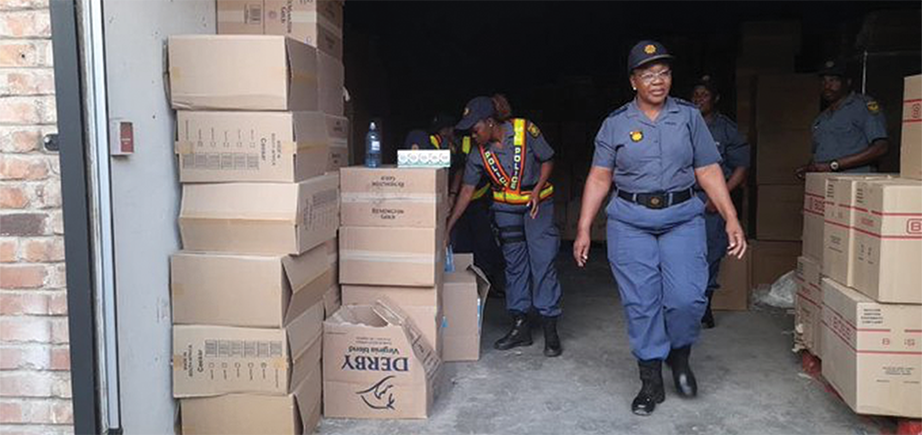
Health Minister Dr Aaron Motsoaledi has confirmed efforts to strengthen coordination between SARS, the Border Management Authority and law enforcement agencies to clamp down on illicit tobacco flows.
At the centre of this effort is the National Illicit Economy Disruption Programme (NIEDP), a Presidency-led initiative aimed at tackling illegal trade across sectors, including tobacco, alcohol and counterfeit goods.
Authorities say the strategy will prioritise:
• Tighter border controls to curb smuggling;
• Improved monitoring of the tobacco supply chain; and
• Stronger enforcement against illegal producers and distributors.
Parallel to enforcement, the government is pushing ahead with tighter tobacco regulations designed to align South Africa with global anti-smuggling protocols, including stricter oversight and harsher penalties.
By the government’s own admission, illicit cigarettes now dominate the market — meaning enforcement is no longer about containment, but recovery.
Critics argue that without: real-time tracking of cigarette production; visible enforcement at retail level; and successful prosecutions of major illicit players.
Business groups and analysts have also raised concerns about inconsistent enforcement and limited capacity within key agencies, warning that policy alone will not reverse the trend.
To combat the surge in illicit trade, the researchers have urged the government to speed up decisive steps to secure the national tobacco supply chain.
This research provided the government with specific insights into where to target such efforts.