 WeeklySA_Admin
PERPLEXITY: Worth up to R184 billion and meant to create lasting wealth, most spaza shop owners – instead – left with slender margins while the greatest rewards end up in corporate balance sheets and shareholders’ pockets…
By Themba Khumalo
Every few months, another set of economic statistics hits the South African public space, accompanied by eye-watering numbers about spaza shops.
The headline figure, routinely cited by market intelligence firms such as Trade Intelligence and NielsenIQ, is invariably impressive: spaza shops alone generate between R100 billion and R184 billion in annual turnover.
Politicians point to it as proof of local enterprise. Commentators frame it as an untapped economic goldmine.
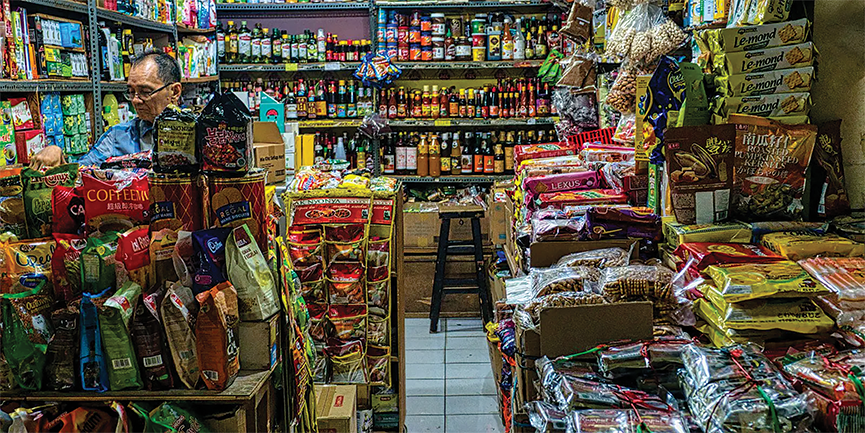
Yet behind the corrugated iron doors and security grilles of the average spaza shop, the reality is starkly different.
The multi-billion-rand narrative feeds the convenient illusion that ordinary spaza shop owners are building commercial empires.
The truth of the matter is far more ruthless.
The spaza shop sector is not a vehicle for local wealth creation. It has become a highly efficient, corporate-driven pump system, extracting billions of rand from working-class communities—urban and rural alike—and channelling them into corporate boardrooms in Sandton, Stellenbosch and international financial hubs.
To understand why the ordinary spaza shop owner is not getting rich, one has to follow the actual path of the money.
The Anatomy of the Flow: Who Takes What?
When a customer hands over a cash note for a loaf of bread, a bag of mealie meal, or a bottle of cooking oil, that money is already spoken for. Long before the shopkeeper counts the day’s takings, the supply chain has claimed its share.
The Corporate Monopoly (60% – 70%)
The lion’s share of every single rand spent across a spaza shop counter leaves the neighbourhood before the sun sets. Spaza shops primarily trade in essential basket items and fast-moving consumer goods.
According to channel data from Trade Intelligence and supply-chain cost reporting from the Consumer Goods Council of South Africa, corporate producers—such as Tiger Brands, Pioneer Foods, Unilever, Clover, and Coca-Cola—capture the vast majority of this value.
Because factory-gate pricing and raw commodity inputs dominate the cost of essential foods, between 60 and 70 cents of every rand collected goes straight back to the manufacturer to cover the cost of goods sold.
The corporate sector does not need to build retail infrastructure in every township and village; thousands of spaza shop owners perform that distribution for them, absorbing all the operational risk while keeping a measly fraction of the rewards.
The Wholesale Middlemen (15% – 25%)
A spaza shop owner cannot pull up to a factory gate and buy ten bags of sugar at production cost. Manufacturers demand minimum order quantities that dwarf the space and capital of a single spaza shop.
Field mapping of supply chains serving spaza shops conducted by the Sustainable Livelihoods Foundation, alongside studies from the University of Cape Town School of Economics, reveals that spaza shop owners are heavily dependent on middle-tier intermediaries.
Cash-and-carry groups such as Makro, Jumbo, and Rhino, alongside independent wholesale operations and modern digital platforms, capture the next 15 to 25 percent of the value chain through distribution markups, transport charges, and logistics fees.
The Spaza Shop Owner (5% – 15%)
At the very bottom of the food chain sits the spaza shop owner. Analytics compiled by fintech platforms operating in the spaza shop sector, such as Kazang and Flash, together with consumer research from Minanawe Marketing, show that after the manufacturer and the wholesaler take their cuts, the spaza shop owner is left operating on razor-thin gross profit margins:
• Staple Foods (Bread, Maize Meal, Milk, Sugar): Yield paper-thin margins, often between 3% and 8%. These items do not build wealth; they exist purely to bring foot traffic through the spaza shop door.
• High-Margin Items (Sweets, Cold Drinks, Cigarettes): Return a healthier 15% to 25%, but move in much smaller volumes.
• Value-Added Services (Airtime and Electricity top-ups): Pay micro-commissions of 1% to 3%, serving as little more than a customer retention tool.
Once the spaza shop owner pays for electricity to keep the refrigerators running, petrol to haul stock from the wholesaler, security measures, and the inevitable losses from spoilage or theft, that net margin shrinks even further into single digits.
Trapped in the “Break-Bulk” Trap
Why can’t the average spaza shop owner break out of this low-margin cycle? The structural game is rigged in three fundamental ways.
First, there is a total lack of aggregated buying power. A major formal retail chain can walk into a manufacturer and demand massive volume rebates because it buys for hundreds of stores at once.
An isolated spaza shop owner buys as a single unit at standard wholesale prices, stripped of any leverage to negotiate.
Second, the spaza shop is bound to a strict daily cash-flow cycle. Spaza shop owners must turn over inventory rapidly just to buy tomorrow’s stock and pay today’s living expenses. They cannot afford to tie up precious working capital in slow-moving, high-margin goods.
They are locked into selling fast-moving, low-margin staples.
Third, the market effectively treats the spaza shop owner as a glorified commission worker. The primary economic function of a spaza shop is “break-bulk”—buying a 24-pack of soft drinks or a massive crate of soap from a wholesaler, carrying it to the shop, and selling single items within walking distance of local households.
In effect, the market rewards the trader with little more than a modest service fee for that manual labour.
The Generational Wealth Myth
Stripping away the romantic rhetoric, the idea that running a standard spaza shop will build lasting family equity is simply a myth.
Generational wealth requires building an enterprise with transferable value—an asset that can exist independently of its operator, command market power, acquire real estate, or be sold to an investor. A standalone spaza shop has none of these traits.
• No Proprietary Value: The spaza shop sells identical corporate commodities at identical prices to every other spaza shop on the corner.
• No Pricing Power: Margins are squeezed from above by wholesale prices and bounded from below by community affordability.
• No Asset Accumulation: Most spaza shop owners operate out of informal structures, rented spaces, or residential properties lacking commercial title deeds. There is no commercial real estate equity accumulating over time.
For the vast majority of spaza shop owners, the business is an income-replacement strategy. It pays for basic monthly survival—groceries, school fees, transport—and nothing more.
When the spaza shop owner becomes too old to work or passes away, the income stream evaporates completely.
Furthermore, whenever a neighbourhood demonstrates exceptionally high trade volume, formal retail giants step in.
The rapid expansion of corporate supermarket brands directly into local residential areas systematically strips away high-margin spending, leaving spaza shops with only low-margin emergency top-up purchases.
Where the Wealth Actually Lives
Is it completely impossible to build real wealth starting from a spaza shop? Not entirely, but it requires getting out from behind the spaza shop counter altogether.
The rare individuals who build substantial wealth in this space do so by moving up the value chain. They transition from running a single spaza shop into operating informal wholesale distribution points that supply dozens of neighbouring spaza shops.
They form buying collectives to bypass cash-and-carries and force manufacturers to offer direct trade discounts. Or they take the daily cash flow from a spaza shop and aggressively re-invest it into acquiring titled real estate outside the sector.
Without taking those structural leaps, the ordinary spaza shop owner remains caught in an endless loop: providing a vital lifeline to their community and moving billions of rand through their hands, yet remaining entirely empty-handed as the real profits are counted somewhere much further up the chain.