 WeeklySA_Admin
FAIRYTALE: Cameroon sweep aside Malawi to claim their maiden WAFCON crown, ending decades of final heartbreak as an expanded tournament produces new champions, new World Cup contenders and a warning for Africa’s traditional powers.
By WSAM Sports Reporter
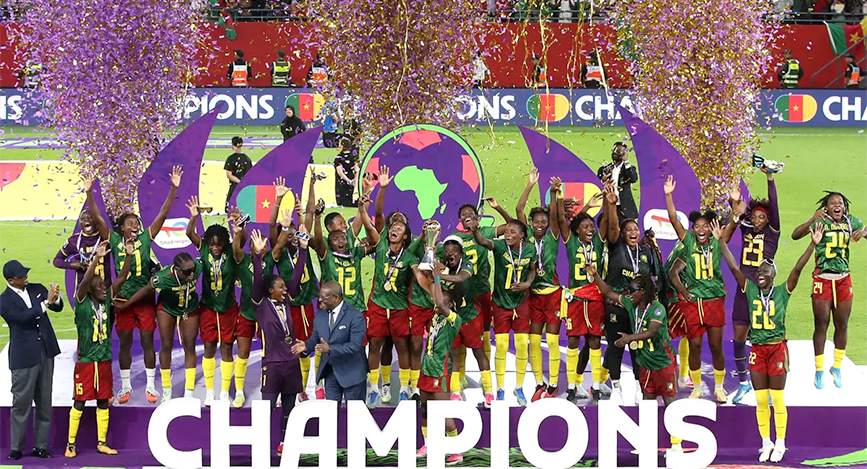
Cameroon ended more than two decades of continental frustration in emphatic fashion by overwhelming Malawi 3–0 to win their first TotalEnergies CAF Women’s Africa Cup of Nations title in Rabat on Sunday night.
Marie Ngah struck twice and Naomi Ndjoah Eto contributed a goal and an assist as the Indomitable Lionesses produced a ruthless first-half performance at the Moulay El Hassan Stadium.
All three goals arrived before the interval, leaving Malawi’s fairytale debut campaign without the triumphant ending the Scorchers had imagined.
Ngah opened the scoring in the 20th minute before Myriam Nyadjou created Cameroon’s second for Ndjoah Eto 10 minutes later.
Ndjoah Eto then turned provider in the third minute of first-half stoppage time, setting up Ngah to complete her brace and effectively place the trophy beyond Malawi’s reach.
Cameroon became only the fourth country to win Africa’s premier women’s football competition, joining record champions Nigeria, Equatorial Guinea and South Africa.
More significantly for the Indomitable Lionesses, the victory finally erased the pain of three previous final defeats.
Cameroon had lost to Nigeria in the deciding match in 2004, 2014 and 2016 without scoring a goal in any of those finals. In Rabat, they needed less than half the match to score three and bring their long wait to an emphatic conclusion.
From reprieve to champions
Cameroon’s triumph was made even more extraordinary by the circumstances surrounding their participation.
The Indomitable Lionesses had not originally secured a place at the finals but were admitted after the tournament was expanded from 12 to 16 teams.
Given that unexpected opportunity, they turned their reprieve into one of the competition’s great comeback stories.
Cameroon progressed from the group stage before eliminating defending champions and record 10-time winners Nigeria 1–0 in the quarter-finals.
They then survived 120 goalless minutes against hosts Morocco in the semi-finals before goalkeeper Michaely Kyria Bihina helped them secure a 3–1 penalty shoot-out victory.
Cameroon entered the tournament through the expansion door and departed through the front gate as champions of Africa…
The Indomitable Lionesses completed their knockout programme without conceding a goal. Their defensive discipline provided the foundation, but the final demonstrated that they also possessed the attacking quality to punish opponents.
Captain Gabrielle Aboudi Onguéné and her teammates controlled Sunday’s match with the authority of a side determined not to suffer a fourth final heartbreak.
Once Ngah had opened the scoring, Cameroon were able to draw Malawi forward and exploit the spaces left behind. The second and third goals followed from decisive moves that combined speed, movement and clinical finishing.
By half-time, the outcome was no longer seriously in doubt.
Cameroon managed the second period with maturity, protected their advantage and ensured that Malawi’s celebrated attacking players were denied the opportunity to spark a comeback.
Malawi leave with heads high
The final defeat should not diminish what Malawi achieved at their first WAFCON tournament.
The Scorchers became the first Southern African debutants to reach the final and emerged as one of the competition’s most compelling teams.
They advanced from a difficult group before defeating Ghana 2–1 in the quarter-finals, a result which secured their first qualification for the FIFA Women’s World Cup.
A convincing 3–1 semi-final victory over Algeria then took Malawi into the continental decider with 12 goals — the tournament’s best attacking return at that stage.
Sisters Temwa and Tabitha Chawinga were central to the campaign, providing the pace, creativity and finishing that repeatedly carried Malawi beyond more established opponents.
However, the final proved to be one match too far.
Cameroon prevented the sisters from finding space in dangerous areas and forced Malawi to chase the contest after falling behind. The Scorchers made several changes, but there was no way through a defence that grew stronger as the competition progressed.
Malawi departed Rabat without the trophy, but with a place at the 2027 Women’s World Cup in Brazil and a radically changed standing in African football.
Their run also offered evidence of the growing competitiveness of the women’s game across the continent.
Old order shaken
The tournament delivered a significant shift in African women’s football.
For the first time, neither Nigeria nor South Africa reached the semi-finals. The two most recent champions were both eliminated in the quarter-finals, with Cameroon defeating Nigeria and hosts Morocco edging Banyana Banyana.
Cameroon and Malawi were joined in the last four by Morocco and Algeria, ensuring that three of the four automatic African places at the 2027 World Cup went to countries that have never previously won the WAFCON title.
The expanded 16-team format gave emerging nations an opportunity to test themselves against the continent’s established powers. Malawi seized that opportunity spectacularly, while Algeria also reached the semi-finals for the first time.
Cameroon’s title represented the clearest sign that African women’s football can no longer be viewed principally through the dominance of Nigeria and the challenge presented by a small group of traditional contenders.
The Indomitable Lionesses entered the competition through the expansion door and departed through the front gate as champions of Africa.
Banyana keep Brazil hopes alive
South Africa’s title defence ended with a 2–1 quarter-final defeat by Morocco, concluding an uneven campaign in which Desiree Ellis’s side struggled to reproduce the consistency that carried them to the 2022 crown.
Banyana began with a shock 2–1 defeat by Tanzania before drawing 2–2 with Côte d’Ivoire and defeating Burkina Faso 1–0 to progress from Group B.
Although Morocco ended their title hopes, South Africa responded by beating Nigeria 2–1 in a crucial World Cup play-off in Casablanca.
Second-half goals from Thembi Kgatlana and Refiloe Jane placed Banyana in control before Jane was sent off for a late handball. Christy Ucheibe converted the resulting stoppage-time penalty, but goalkeeper Kaylin Swart produced a vital final save to protect South Africa’s victory.
The result secured Banyana a place in the FIFA inter-confederation play-offs alongside Ghana, who defeated Côte d’Ivoire 2–1.
South Africa have therefore not qualified for Brazil, but they remain in contention to make a third successive appearance at the global tournament.
Nigeria, by contrast, will miss the Women’s World Cup for the first time since the competition began in 1991 — another indication of how dramatically the African landscape shifted in Morocco.
A tournament of change
WAFCON 2026 will be remembered as the tournament in which new contenders broke down old barriers.
Malawi transformed their debut into a journey to the final. Algeria reached previously unexplored territory. Ghana and South Africa recovered from quarter-final disappointment to preserve their World Cup ambitions.
Nigeria’s reign ended early, Banyana relinquished their crown and hosts Morocco once again fell short of lifting the trophy in front of their supporters.
Above them all stood Cameroon.
After three lost finals, repeated disappointment and an uncertain route into the tournament, the Indomitable Lionesses finally completed their climb to the summit.
Ngah’s brace supplied the goals, Ndjoah Eto delivered the final’s other decisive contribution and Cameroon’s defence maintained the discipline that had carried the team through the knockout rounds.
The story of WAFCON 2026 ultimately belonged to a team that had waited longer than most, survived more than most and, when its defining opportunity arrived, refused to let it pass.