 WeeklySA_Admin
PASSAGE: On the 127th anniversary of the desperate journey from Johannesburg to then Natal, Rapitse Montsho reflects on the African mineworkers pushed to the margins of war history — and how Fred Khumalo’s novel restores their humanity…
By Rapitse Montsho
Rumours of an Anglo-Boer war spread through the Witwatersrand like wildfire in 1899, reaching black and white mineworkers alike. For thousands of African workers, the approaching conflict meant a desperate journey home, marked by sweat, fear and uncertainty.
The battle lines were drawn between the British and the Boers. But beyond their military preparations lay another struggle: the survival of African workers whose labour had helped build the goldfields.
As the mines closed ahead of war, workers were left stranded. The mine owners had made no adequate arrangements to get them home. With livelihoods abruptly cut off and access to rail transport restricted, thousands faced hunger and the dangers of travelling through a country preparing for battle.
White refugees left Johannesburg by train. Many African mineworkers, even those able to afford the fares, were denied passage.
Those who could walk prepared to walk.
Among them were approximately 7,000 mineworkers heading towards Natal and Zululand. Their journey took about ten days, carrying them across hundreds of kilometres as the threat of war became a reality.
What I love about this work is that it does not ask for pity. It asks for memory…
They were unarmed civilians moving through territory where their very numbers could provoke suspicion. Boer commandos were assembling near the border. Food was limited, exhaustion mounted, and the possibility of violence shadowed the column.
The ultimatum expired on 11 October, while the marchers were still making their way home. War had begun. Their struggle was to survive it.
The white historians’ prism
This history has too often been pushed to the margins by the prism through which the Anglo-Boer War has been told.
In the conventional account, it was a contest between two white powers: British imperial ambition against Boer independence. African people appeared chiefly as labourers, servants, scouts or anonymous casualties.
British imperial narratives emphasised the cause of empire. Afrikaner nationalist narratives remembered the struggle as the Tweede Vryheidsoorlog and commemorated the terrible suffering of Boer women and children.
African suffering, including the deaths in separate black concentration camps, received far less public recognition.
The problem is not that Boer suffering should have been remembered less. It is that African suffering should have been remembered too.
Even when Africans entered the historical record, they were frequently counted rather than heard. Thousands of workers became a logistical problem, a possible security threat or a passing reference in somebody else’s war.
Who were they? What had brought them to Johannesburg? What did they fear losing? Who helped them keep walking?
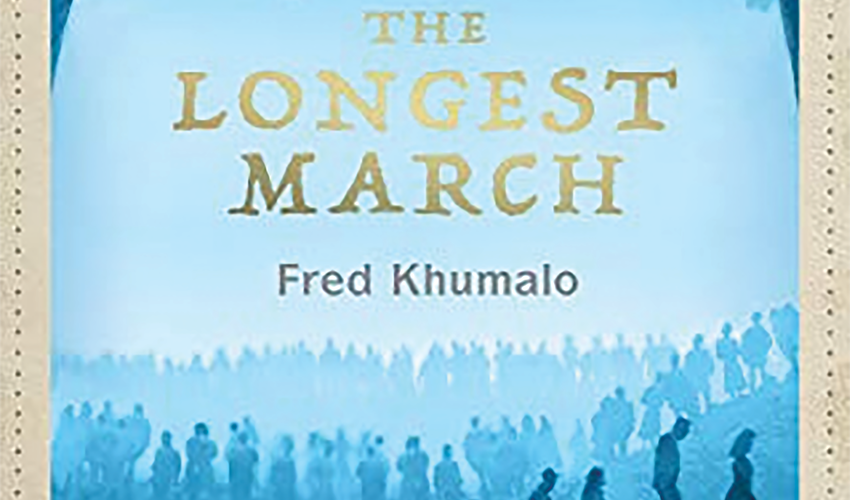
These are the questions that Fred Khumalo’s The Longest March brings to life.
Giving the miners agency
Khumalo’s historical novel gives the marchers names, personalities, relationships and conflicting loyalties.
Through characters such as Nduku, Philippa and Xhawulengweni, he imagines lives beyond the anonymous label of “Native labour”.
These are characters in a novel rooted in a real historical event. Their importance lies in the humanity they bring to people whom conventional accounts too often leave faceless.
They love, quarrel, fear, scheme and make decisions. They have histories before the march and hopes beyond it.
They are not merely a column being moved across the landscape. They are people trying to get home.
This is where The Longest March challenges the old historical prism. African workers become the centre of the story.
They have agency. They choose to walk rather than remain stranded in the compounds.
Marwick and his pony
Special mention must also be made of John Sydney Marwick and his pony.
Marwick was a young, Zulu-speaking representative of the Natal Native Affairs administration in Johannesburg. He was neither a general nor a Randlord. Faced with thousands of stranded workers, he helped organise their passage home.
He negotiated with officials, arranged provisions and sought permission for the column to move through territory increasingly tense with military preparations.
He did not act alone. African organisers were essential to the march, and colleagues also assisted him. Remembering his contribution should help us recover those people, rather than obscure them.
Yet the image of Marwick walking alongside the column, placing exhausted marchers on his pony, deserves its place in the story.
The pony offered relief to people whose strength was failing. Against the scale of the crisis, it was a small act of practical compassion.
It could not undo the injustice that had forced thousands onto the road. But it could carry someone who could no longer walk.
There is something deeply moving about that image: an exhausted marcher, a small pony and the long road home.
By 15 October, the column had reached Hattingspruit in Natal. For many, the journey was still not over. Home lay further ahead.
A story that asks for memory
If conventional histories looked at the Anglo-Boer War through a narrow prism, Khumalo invites us to widen the view.
We were taught in Bantu Education that this was a war between the English and the Dutch: two bulls fighting over a cow called South Africa. We Africans were the grass trampled beneath their feet.
But grass does not speak. People do.
That is why the road matters. It takes us away from the generals’ maps and into the lives of workers whose safety counted for so little when the goldfields fell silent.
The march was unarmed. Its participants could not rely on military protection or the privileges that made escape easier for others. They relied on organisation, endurance and the determination to reach home.
What I love about this work is that it does not ask for pity. It asks for memory.
Khumalo takes an event too easily reduced to a statistic and asks us to imagine the people within it.
The march belongs in the history of African labour in Johannesburg. Long before apartheid became official policy, the city’s wealth already rested on a racial order that valued African labour while giving African lives far too little protection.
The mines needed their strength. When war approached, their journey home became somebody else’s problem.
On this anniversary, we should remember the marchers as people who endured, organised and kept moving.
They helped build the city of gold.
Their lives belong at the centre of its history.
Rapitse Montsho is a South African media expert, veteran cameraman, documentary producer, and board chairperson of Jozi FM