 WeeklySA_Admin
TUSSLE: A clash between African Energy Week in Cape Town and the rescheduled WPC Energy Congress in Riyadh has sparked concern over divided delegations, investment budgets and whether Africa’s growing institutions receive equal respect on the global stage…
By Ajong Mbapndah
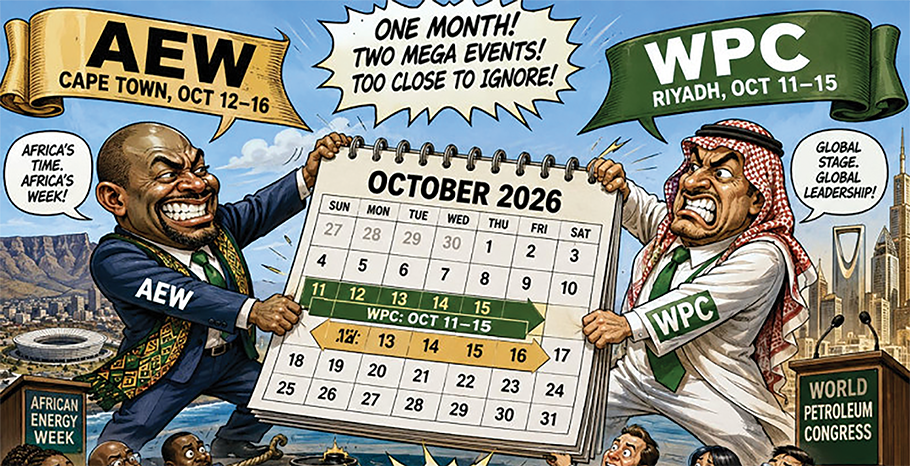
Africa’s flagship energy investment gathering faces an unprecedented battle for delegates, capital and international attention after the WPC Energy Congress was rescheduled to take place almost simultaneously with African Energy Week in October.
The 25th WPC Energy Congress is scheduled for Riyadh, Saudi Arabia, from October 11 to 15, while African Energy Week (AEW): Invest in African Energies will run in Cape Town from October 12 to 16.
The four-day overlap means the two events will compete for many of the same petroleum ministers, national oil company executives, international energy companies, financiers, service providers, investors and media organisations.
It also confronts participating governments and businesses with difficult decisions over where to send their most senior representatives and how to divide sponsorship, exhibition and travel budgets.
Industry observers have questioned why a major international congress was moved into a period already occupied by an established African gathering whose dates had reportedly been publicly communicated during 2025.
Although there is no public evidence that the clash was deliberately engineered, critics argue that its practical consequences cannot be dismissed as a routine scheduling inconvenience.
Ministers and chief executives cannot participate fully in programmes taking place thousands of kilometres apart, while companies with limited resources may have to choose between the international prestige associated with Riyadh and the investment opportunities being promoted in Cape Town.
The scheduling controversy also comes as AEW seeks to strengthen its position as a major marketplace for African energy projects.
Launched in 2021 with about 1,700 delegates, AEW has grown into a gathering attracting governments, national oil companies, independent producers, international majors and financial institutions.
Organisers project that the 2026 edition will attract more than 9,000 attendees, over 300 ministers and VIPs, more than 400 speakers and representatives of at least 1,500 companies.
Those projections, if achieved, would underline the event’s emergence as more than a regional industry conference.
AEW has positioned itself as a platform through which African governments can present exploration blocks, infrastructure projects and investment opportunities directly to prospective partners. Its programme includes deal rooms, farmout discussions, local-content initiatives and engagements between national and international oil companies.
The conference also promotes an African approach to the energy transition—one that combines renewable energy and emerging technologies with continued investment in oil, natural gas, hydropower and nuclear power.
Its supporters argue that Africa cannot follow precisely the same transition path as industrialised economies because the continent must simultaneously confront electricity shortages, unemployment, weak infrastructure and rapidly growing populations.
The dispute therefore touches on more than conference attendance. It has become part of a wider debate about Africa’s ability to build institutions that shape decisions over its own natural resources and development priorities.
Questions are also being asked about whether an equivalent clash would have been accepted without controversy had it affected established gatherings such as ADIPEC, CERAWeek or Gastech.
The situation is particularly sensitive because organisations linked to the two events have previously cooperated.
In 2022, the African Energy Chamber and World Petroleum Council Canada signed a memorandum of understanding to support and promote each other’s conferences, including African Energy Week and the 2023 World Petroleum Congress.
The agreement covered cooperation on delegates, exhibitors, partners, webinars and broader industry dialogue. Johannesburg also hosted the 18th World Petroleum Congress in 2005—the first time the gathering was held in Africa. Against that background, the latest calendar collision has raised questions about whether there was sufficient consultation between the institutions involved.
The African Energy Chamber, which organises AEW, has so far reportedly avoided turning the matter into an open institutional confrontation. Preparations for the Cape Town gathering have continued, with organisers announcing participating government officials, corporate executives and sponsors.
However, the clash presents a particularly delicate leadership test for Nigeria, one of Africa’s largest oil and gas producers and a central participant in both continental and international energy diplomacy.
Nigeria will join Saudi Arabia and Italy as a co-host of the 17th International Energy Forum Ministerial Meeting in Riyadh on October 11, immediately before the main programmes in Cape Town and Riyadh begin.
Abuja is also expected to have a substantial presence at AEW through government officials, regulators and indigenous energy companies.
Nigeria’s position carries added importance because it was chosen to host the Africa Energy Bank, an initiative of the African Petroleum Producers’ Organization and Afreximbank intended to help finance energy projects across the continent.
Nigerian companies expected to participate in the Cape Town event include Oando and Renaissance Africa Energy Company. Renaissance, a Gold Sponsor, is expected to promote a growth strategy involving a reported $15-billion investment drive following its acquisition of former Shell onshore assets.
The Dangote Refinery has meanwhile become a powerful symbol of Africa’s drive to process more of its resources locally instead of exporting crude and importing expensive refined products.
Nigeria must therefore maintain its global relationships while demonstrating support for the African institutions it has helped build.
The strongest response would not necessarily require Abuja to choose one conference over the other. It could instead ensure sufficiently senior representation at both gatherings while using its diplomatic influence to encourage better coordination between international and African institutions.
The controversy unfolds as geopolitical tensions increase the strategic importance of Africa’s energy resources.
Oil and gas discoveries in Namibia, established production in Nigeria and Angola, expanding gas projects in Senegal, Mauritania and Mozambique, and growing refining capacity could all contribute to greater global supply diversification.
Africa also holds critical minerals needed for the energy transition and has substantial renewable-energy potential. Yet the continent continues to face a shortage of investment in electricity generation, transmission networks, pipelines, processing facilities and industrial infrastructure.
For African governments, converting these resources into lasting economic power will require stronger institutions, domestic processing, coordinated policy and access to capital.
That is why the October clash has assumed symbolic importance. It will test whether Africa’s expanding energy platforms are treated as equal participants in the international system or remain vulnerable when their priorities collide with those of more established global centres.
Riyadh has the influence, infrastructure and industry standing to host a major congress. Cape Town equally has the right to convene an African investment gathering without its dates being regarded as easily expendable.
The immediate commercial contest will be measured in delegate numbers, investment announcements and agreements signed. The larger issue, however, is whether the global energy industry’s frequent commitments to partnership and inclusion are reflected in how it treats institutions established by Africans to advance African priorities. –Source: Pan African Visions