 WeeklySA_Admin
IMPUNITY: Auditor-General exposes a deepening “no-consequence culture” as hundreds of billions are misspent, wasted or written off — with officials rarely held to account…
By GroundUp and WSAM Reporters
South Africa has lost at least R417-billion in irregular, fruitless and wasteful expenditure over the past six years — with almost no consequences for those responsible.
Auditor-General Tsakani Maluleke has condemned a growing culture of impunity in government, warning that weak accountability is crippling service delivery and financial performance across national and provincial departments.
According to the Auditor-General’s 2023/24 Public Finance Management Act report, officials implicated in irregular or wasteful spending are seldom disciplined, and recovery of lost funds is the exception rather than the rule.
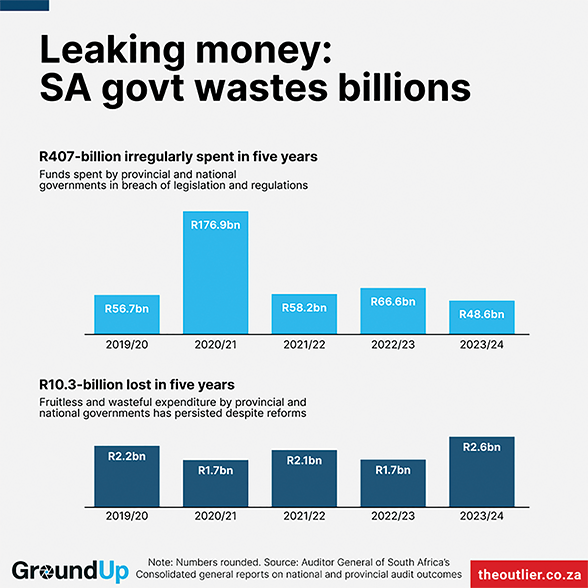
Between 2018 and 2024 alone, national and provincial governments incurred R407-billion in irregular expenditure, with the peak reached in 2020, when R177-billion was flagged.
Major contributors included the National Student Financial Aid Scheme (R77.5-billion) and Transnet (R31.1-billion). Last week, the Special Investigating Unit (SIU) reported that it has returned R1.7 billion to the NSFAS’s purse, which will be allocated to students’ needs at institutions of higher education. This amount is part of the R2 billion that the SIU has so far received from universities, TVET Colleges and unqualified former students.
The funds in question were unallocated from 2016 to 2021. These unallocated funds represent financial resources that were designated for students who qualified for funding but later changed institutions or deregistered.
These funds are retained by the institution for one year, but in this case were kept for more than a year. The existence of unallocated funds can be attributed to inadequate control systems and a lack of reconciliation processes implemented by NSFAS during that period, resulting in a failure to recover these funds from institutions of higher learning.
Irregular expenditure refers to breaches of procurement and financial regulations — often involving flawed tender processes, inflated pricing or poor contract management — even where goods or services were eventually delivered.
In most cases, government entities failed to recover, condone or properly investigate the expenditure, allowing responsible officials to remain in office.
In addition, R10.3-billion was recorded as fruitless and wasteful expenditure — money spent with little or no value returned to the public.
Top offenders in 2023/24 included Transnet, which lost R600-million to overpayments, penalties and cancellation costs; the Gauteng Department of Human Settlements, which spent nearly R500-million on abandoned housing feasibility studies; and the Free State Development Corporation, which overpaid R270-million for Special Economic Zone assets.
The Auditor-General cautions that the true cost of corruption is likely far higher, as many irregular contracts are excluded from wasteful-expenditure figures, audits remain incomplete, and corrupt deals are often uncovered years later.
The amount of money the government actually wastes on corrupt contracts and deals is likely much higher than the amount of fruitless and wasteful expenditure found by the auditor general each year.
In many cases, irregular contracts will still result in value for the government, so these are not always included in fruitless and wasteful expenditure.
There is also general lack of transparency within government entities, which often makes it difficult to quantify actual financial losses. Many entities have qualified audits and billions of rand worth of contracts cannot be audited by the Auditor-General because documents are incomplete.
Meanwhile, President Cyril Ramaphosa has promised a hardline stance against wasteful expenditure, poor financial management, and service delivery failures in South African councils, recently describing the failure of municipalities to spend infrastructure budgets as “treason against the people of South Africa”.
As of 2025–2026, his administration is focusing on stricter accountability and structural reforms to rein in spending.
In May 2025, it was announced that a dedicated committee between The Presidency and National Treasury would be established to identify and eliminate wasteful, inefficient, and underperforming spending programmes.
Ramaphosa highlighted that many municipalities fail to use their infrastructure grants (e.g., for water and roads), with 88 municipalities recently failing to spend at least 10% of their Municipal Infrastructure Grant.
The government is engaging directly with these municipalities to address root causes like poor planning and weak capacity.
Late 2025, the president unveiled an ANC action plan targeting municipal reforms to improve service delivery and maintain infrastructure, with a focus on fixing audit failures within a three-month deadline.
He has called for the state to reclaim functions previously outsourced to private contractors to curb overpricing and corruption.
Corrupt deals are often exposed years after the fact. GroundUp has for example uncovered hundreds of millions of rand of theft of Lottery money which has not been included in the Auditor-General’s reports. – GroundUp