 WeeklySA_Admin
MILESTONE: A defiant stage born in the shadows of apartheid – and only days after the June 16 Soweto student uprising – turns 50, like the landmark protests, reflecting a legacy where art challenged power, united divided audiences, and continues to tell the country’s evolving story…
By Kate Bartlett
JOHANNESBURG, South Africa — When it first started in the 1970s, South Africa’s Market Theatre staged plays considered to be so subversive that it became a regular target of the apartheid government’s zealous censors.
Even the fact that its audiences were made up of Black and white South Africans mingling together was unheard of in a city where the law separated areas and people by race.
The theatre, established in an old fruit and vegetable market in central Johannesburg, was born at a pivotal time in “the Struggle” — the fight against the apartheid government. It opened its doors just days after the 1976 Soweto uprising changed the country forever.
During apartheid, the stage became a
battlefield — where storytelling defied censorship, and a
divided nation briefly became one audience…
Youth took to the streets to protest schools teaching in the Afrikaans language and the ensuing government crackdown saw hundreds killed.
“So, we opened our doors three days after that event,” says the theatre’s current artistic director Greg Homann. “The Market Theatre has been forged in those days of June 16 and now has really carried the weight of telling the national story of South Africa all the way through the dark years of apartheid.”
This year, the theatre, where legendary South Africans like actor John Kani and playwright Athol Fugard made their names, is celebrating its 50th anniversary, coinciding with the 50th anniversary commemoration of the June 1976 Soweto student uprising which inspired its birth.
In that half century it produced plays of international renown, including “Woza Albert,” “Sophiatown,” and “Sizwe Banzi is Dead,” and the hit musical “Sarafina” — about the Soweto uprising.
“Sarafina,” written by jazz musician Hugh Masekela, went on to Broadway and became a Hollywood movie starring Whoopie Goldberg.
But many initially doubted it would survive. Tony-award-winning actor John Kani said he was stunned when the theatre’s founders Barney Simon and Mannie Manim first told him their vision.
“I thought these two whities were nuts, it’s not going to work, and they said to me and Athol Fugard that it’s going to be open to all. I said what are you talking about, it’s ‘75, ‘76” Kani recalled in a 2014 interview.
But despite his initial reservations, Kani said, “My entire career fell into place on this stage.”
Still, there were times when it was touch and go. The theatre “was often raided. Actors were sometimes in some kind of danger,” Homann says.
And often, apartheid government censors turned up.
“They would then go onto stage and they would start doing their censorship in front of the audience,” he continues. “And it almost became like a second act of the production where the censorship was actively part of the work.”
‘No Black, no white’
Then there was the fact it was a place where all races could mix, with the theatre’s directors cleverly finding loopholes to circumvent the law.
“At one point, our bar was sold for one rand, so, you know, the equivalent of 50 American cents, so that it was privately owned,” says Homann.
Being privately owned meant that audience members of colour “could stand in that space legally,” he explains.
“But if they stepped one meter into the foyer they were illegal by apartheid laws.”
While the theatre’s work helped spread the message of the anti-apartheid movement at home and abroad, some white audience members were triggered.
“Quite a number of times I’ve seen them whites. You know, they get up,” recalls director Arthur Molepo, a theatre veteran who has been involved with the Market since its inception.
“You see a man grabbing a woman and just walking out during the play, meaning they were angry, of course, or they’re not agreeing or believing what we’re saying,” said Molepo.
Still, he remembers the early years of the market as a heady time.
“There was no black, there was no white. We were just a whole group, a whole bunch. So we were making things, making theatre,” he says.
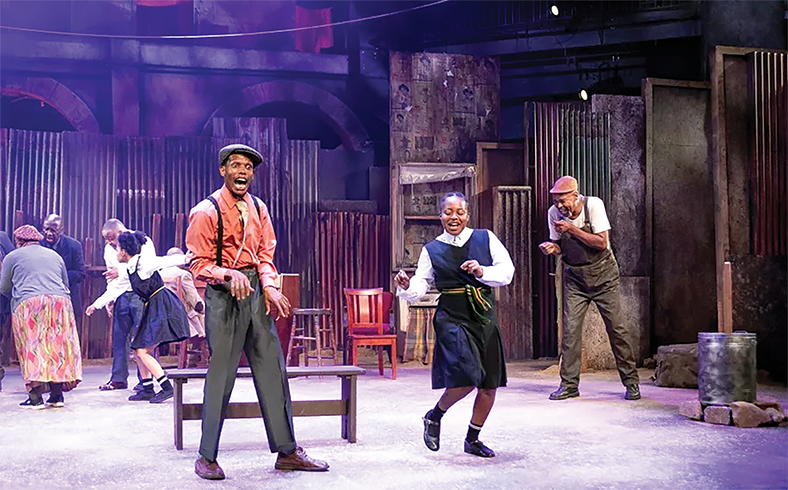
From the applause and standing ovation it was clear the subject matter still resonated, even with what appeared to be a mainly Gen Z and millennial audience who never knew life under apartheid.
The story follows a Black family’s struggles in the first half of the twentieth century and ultimately ends with their forced removal from their home under the white government’s racial segregation laws.
Gabisile Tshabalala, 35, played the lead role in Marabi, but she grew up in a free South Africa and doesn’t remember apartheid.
However, the actress says: “Theatre is extremely important for young South Africans….especially as Black people…we get to tell our stories.”
And the theatre isn’t content to rest on its historic laurels.
It “tells the South African story,” says Homann. “Whatever that might be of its day.”
“So during the ‘80s, that was the story of the fight against apartheid. More recently, it’s the challenges of a young democracy.”
Issues like access to education, corruption, and gender-based violence are all being tackled on stage as the Market turns 50, with South Africans hoping for many more years of thought-provoking theatre. – NPR