 WeeklySA_Admin
OPERATIONS: How this development could end up making things worse in the West African region, warns political analyst Saheed Babajide Owonikoko…
By Saheed Babajide Owonikoko
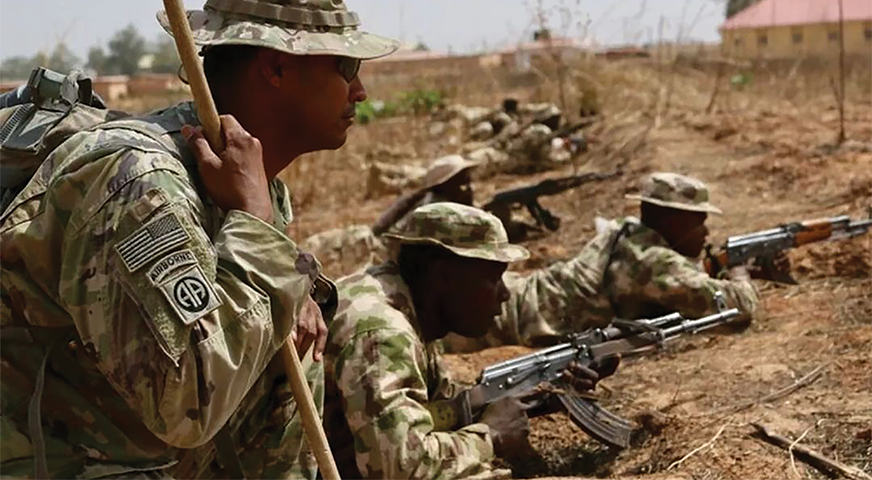
The recent deployment of US soldiers in Nigeria to assist the west African country in its counterterrorism campaign could worsen Nigeria’s insecurity.
It might be perceived as a sign of weakness; deepen religious divisions; widen the rift between the Economic Community of West African State (Ecowas) and the breakaway Alliance of Sahel States (AES); provoke terrorist attacks; and hinder the development of Nigeria’s armed forces.
Since Nigeria’s 1999 transition to civil rule, insecurity has worsened in the country’s northern regions. In 2024, 9 662 people were killed nationwide, 86% of them in the north. In 2025, violent deaths rose to 11,968, with northern Nigeria still the most affected.
The first batch of US soldiers was deployed barely two months after the US bombed militants in Nigeria’s north-west on Christmas Day 2025.
Foreign boots on Nigerian soil may project strength abroad — but at home,
they risk deepening insecurity rather than defeating it…
The director of defence information at Nigeria’s defence headquarters said the US troops’ presence would give Nigerian troops access to specialised technical capabilities. This would strengthen Nigeria’s ability to deter terrorist threats and enhance the protection of vulnerable communities across the country.
This is not the first time foreign boots have been brought into Nigeria since its independence in 1960. Foreign soldiers were deployed to fight the Nigerian Civil War, and to re-professionalise the Nigerian Armed Forces.
The edge you’ve been looking for. Receive daily expert analysis.
Between December 2014 and April 2015, Nigeria is said to have hired a private military company called Specialised Tasks, Training, Equipment and Protection (STTEP) International, involving 100 to 250 South African ex-soldiers, for a direct combat role against insurgents in Maiduguri. The government denied this.
Now is the first time US soldiers will be deployed in a combat-related operation as part of Nigeria’s counterterrorism efforts. Among members of the public, there are divided opinions over this.
As a security scholar who researches Nigeria’s security crises, I have serious concerns that the deployment of US soldiers in Nigeria, regardless of their number, may exacerbate insecurity rather than improving it.
Why it may backfire
The armed forces of any country are an emblem of sovereignty. Foreigners in a combat operation against terrorism in another country may be framed domestically as a loss of control over security.
The US has long sought to station its Africa Command (Africom) in Nigeria. Nigeria resisted this, largely due to the sovereignty issue, regional politics in Ecowas and other strategic calculations. Since the US Christmas Day bombing, President Bola Tinubu has come under heavy criticism for not being able to truly act as commander-in-chief while a foreign power handles the security.
What is more, President Donald Trump has widened existing religious divisions across Nigeria by:
• framing Nigeria’s security challenge as persecution of Christians;
• declaring Nigeria a country of particular concern; and
• threatening to deploy the US military to Nigeria unilaterally to defend Christians.
Given this context, US boots on the ground in Nigeria may feed into several conspiracy narratives. One is the perception that the US is seeking access to Nigeria’s critical mineral resources.
It could reinforce the Alliance for Sahelian States-Ecowas crisis, deepening the security conundrum in the Sahel. Nigeria would likely be the most affected. After the coups in Mali, Niger and Burkina Faso, and Ecowas efforts to force the coupists to return power to civilians, the Alliance of Sahel States formed and disengaged with western powers. Animosity developed between the two regional groupings.
The Alliance of Sahel States countries, which used to be allies of France and the US, have now shifted to Russia and China. Niger’s junta ordered the withdrawal of over 1 000 foreign military personnel and closure of US facilities, including a drone base in Agadez.
Russia currently has at least 1 500 foreign troops, tagged as the African Corps (previously Wagner), fighting in Mali alone.
The deployment of US troops to Nigeria, given the context of fracture within Ecowas and the shift in foreign alliances, could lead to an escalation of insecurity in the region.
Thirdly, the US is the global arrowhead of westernisation that most Islamist terrorist organisations usually select as the target of attacks. Boko Haram attacks in Nigeria and the support it gets from foreign terrorist organisations like al-Qaeda and ISIS are due largely to the perception that Nigeria is a proxy for the US.
With US soldiers in Nigeria, Nigeria’s value as a target for terrorist organisations may increase. There are already signs that terrorist attacks are escalating in Nigeria since the Christmas Day bombing.
Even with US troops deployed to Nigeria’s north-east, terrorist attacks have become more daring. On March 5, Islamic State West Africa Province attacked military bases in Borno State. Several high-ranking military officers were killed and arms and ammunition were carted away.
If US forces are attacked, Trump is more likely to deploy more soldiers.
This was the case in Somalia in May 2017. Trump expanded US military operations in Somalia after a US Navy Seal was killed by al-Shabaab.
Even if the presence of the US soldiers in Nigeria is to help Nigerian Armed Forces in operational capacities such as intelligence, surveillance and reconnaissance, logistics and air power manoeuvres, heavy reliance on the US could weaken the long-term development of the Nigerian Armed Forces.
What to do
US support is key to Nigeria’s improved capability to address its security challenge, but this should not take the form of US military boots on the ground in Nigeria. It can come in the form of training support and supply of precision equipment. That would help to address critical shortages that affect Nigeria’s ability to deal with insecurity. – The Conversation
Comment
SA’s Unfinished Reckoning
The testimony emerging from the current inquiry into stalled apartheid-era prosecutions forces South Africa to confront an uncomfortable, long-circulating truth: that justice may have been quietly negotiated away.
For years, it has been suggested — often in hushed tones, sometimes in open accusation — that former apartheid-era security operatives retained leverage over the democratic state. Whether through real evidence or the threat of fabricated claims, the implication has been clear: push too hard for prosecutions, and the political consequences could be destabilising. Now, under oath, those suspicions are finding renewed life.
If indeed the pursuit of justice was tempered by fear — fear of political fallout, fear of reputational damage, fear of reopening wounds — then South Africa must ask itself a difficult question: was accountability ever truly on the table?
At the centre of this dilemma lies the governing ANC, whose liberation legacy is intertwined with the moral authority of the democratic project. Yet, as the years have passed, that authority has been tested by an apparent reluctance to pursue apartheid-era prosecutions with consistency and resolve. Was this hesitation strategic, even necessary, in the fragile early years of democracy? Or has it hardened into a pattern of political expedience that now undermines the very foundations of justice?
The current inquiry presents an opportunity — perhaps the last credible one — to break this cycle. But it will require something that has thus far been in short supply: political will.
Can today’s leadership rise above the calculations of the past? Can they confront not only the crimes of apartheid, but the compromises of the democratic era that followed? Or will the same forces that stalled justice before — fear, factionalism, and self-preservation — once again prevail?
Noble compromise?
There is a growing sense that South Africa may be heading toward a familiar resolution: no prosecution, but settlement. No accountability, but accommodation. Reparations, expanded and reframed, may yet emerge as the pragmatic way out of this impasse — a means of acknowledging harm without reopening politically dangerous cases. For victims, this may offer material recognition. For the state, it may provide closure without confrontation.
But it will also raise a haunting question.
If justice is ultimately substituted with compensation, what does that say about the original promise of the Truth and Reconciliation Commission?
Was the TRC, as many believed, a noble compromise in service of peace? Or, more troublingly, was it from the outset a veiled instrument of managed accountability — a process that prioritised stability over justice, and closure over consequence?
These are not merely historical questions. They go to the heart of South Africa’s democratic identity. Because if justice can be deferred, diluted, or traded, then the moral contract between state and citizen is fundamentally altered.
And once that line is crossed, it becomes far harder to draw it again.