
 WeeklySA_Admin
SCRUTINY: A new wave of church activism claims to defend religious freedom, but history warns what happens when faith mobilises to protect power instead of the abused…
By Moss Ntlha
There has been a recent surge in spirited activism by church leaders and congregants, driven by what is presented as legitimate concern over state regulation of religion.
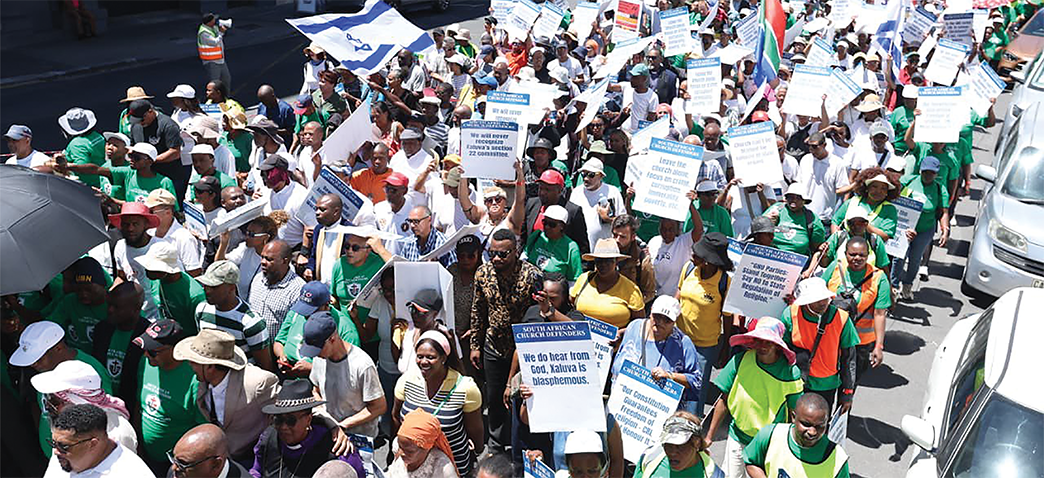
A new formation, calling itself Church Defenders, has emerged to mobilise church groupings across the country, with plans to march on the Union Buildings and in Cape Town against what they perceive as a threat to religious freedom.
Their chief adversary appears to be the CRL Rights Commission, a Chapter 9 institution that began asking difficult but necessary questions about serious abuses taking place within church spaces. One would have expected churches to welcome such scrutiny, to collaborate openly in confronting abuse and restoring the integrity of their sacred spaces. Instead, the opposite has occurred.
Church Defenders have formed a defensive laager around their institutions—and by extension, around those who wield power within them. Known abusers of religious authority have found refuge behind the rallying cry of “Defend the church against state control”. In doing so, institutional preservation has been prioritised over pastoral responsibility and justice for victims.
Every movement needs an ideology to legitimise itself. For Church Defenders, that ideological scaffolding has been supplied by Freedom of Religion South Africa (ForSA), a legal NGO launched by Joshua Generation church and led by Michael Swain, alongside Phillip Rosenthal, a vocal proponent of ultra-conservative evangelical politics through his ChristianViewNetwork platform.
Together, they define the problem, determine the theological and legal framing, and prescribe the strategy—largely without accountability to those in whose name they claim to speak. Their conclusions are then handed down to congregants, many of whom are simply relieved that someone “who loves Jesus” has done the thinking for them.
The consequence is devastating: the church’s central pastoral task—walking alongside victims of abuse and confronting the misuse of religious power—is outsourced to NGOs located in the leafy suburbs, far removed from the lived realities of the vulnerable.
This crisis must be understood in its broader context. Over 70% of churches on the African continent—particularly within evangelical, Pentecostal and charismatic traditions—have no formal theological training.
Given that Africa is now the global centre of Christianity, it is catastrophic that theological reflection on suffering, power and pastoral responsibility is effectively outsourced to white-led NGOs that make little effort to inhabit the social and economic realities of those they claim to represent.
The parallels with the 1980s are striking. At the height of resistance to apartheid, a white-led counter-revolutionary movement known as the Church Alliance of South Africa (CASA), under Pastor Poen Badenhorst, claimed to represent Pentecostal and charismatic Christianity.
CASA positioned itself against the South African Council of Churches and Concerned Evangelicals, resisting peaceful efforts to dismantle apartheid.
Behind its religious rhetoric lay a familiar alliance between religion, power and racial supremacy. The formula was simple: defend power, sacrifice its victims, and sanctify the process in the name of Jesus.
History shows that it was those who suffered under apartheid who saw most clearly. They broke ranks with CASA, reminding us that the hurting often possess sharper moral vision than the beneficiaries of institutional privilege. This remains the source of Christianity’s prophetic renewal. Naming white privilege is not racism; it is fidelity to the gospel, which Jesus declared to be good news to the poor.
To their credit, churches that benefited from apartheid later confessed their complicity before the Truth and Reconciliation Commission and pledged never again to defend institutional injustice. They committed themselves to helping build a more caring and just society.
Why, then, are these same churches repeating the errors of their forebears—rallying to defend institutional power against ecclesiastical victims whom the CRL seeks to protect? Why do they now defend apartheid in Israel after confessing their sin of defending apartheid in South Africa?
Christian Zionism—a toxic fusion of political Zionism, racial supremacy and corrupted Christian theology—is a Western construct with no foundation in the New Testament. Nor does political Zionism belong within Judaism, where it has deeply wounded prophetic traditions and silenced Jewish voices critical of occupation and injustice.
Once again, the attempt to capture the voice of the church is unmistakable. It is no coincidence that Israeli flags appear prominently at Church Defender marches, or that their posters boldly declare: Hands off the Church! Hands off Israel!
This unfolds as the new US ambassador to South Africa, Leo Bozell, openly vows to pressure South Africa into withdrawing its ICJ case against Israel.
A principled state might well question whether such a diplomat should be welcomed at all, given his stated intention to interfere in sovereign foreign policy.
Is it any wonder, then, that sections of the church are proving to be willing allies in a broader campaign that legitimises the colonisation and oppression of Palestinians? From Bozell’s political ecosystem, American evangelicals have long empowered efforts to erase Palestinian presence altogether.
The question that remains is unavoidable: is this mobilisation about defending religious freedom—or about defending power, privilege and impunity, once again wrapped in the language of faith?
* Rev Moss Ntlha is the general secretary of The Evangelical Alliance of SA (TEASA)
Comment
Warnings replace action at local govt level
South Africa’s local government crisis is no longer looming — it is here. Across the country, municipalities are failing at the most basic level, unable to provide reliable water, maintain roads, or keep street lights working. For millions of residents, especially in townships and rural areas, service delivery protests have become a permanent feature of daily life.
At the heart of the crisis lies a toxic mix of weak administration, political indifference, and financial collapse. Municipalities are struggling to meet their obligations, largely because they are not collecting enough revenue to sustain their operations.
Frontline of public trust
National Treasury’s latest figures paint a dire picture: municipalities are owed more than R416 billion by households, businesses, and government departments, with households accounting for over 70% of the debt. Billions have already been written off as bad debt — money that will never be recovered.
Households have been fingered as the largest contributors to the debt, accounting for approximately 71 percent of the total outstanding account. Government departments and entities also contributed significantly to the arrears.
President Cyril Ramaphosa has repeatedly warned ANC councillors that failure to perform could result in dismissal. His message to nearly 5 000 councillors at a national roll-call meeting was blunt: councillors are the party’s foot soldiers and the frontline of public trust. Yet, despite these warnings, many councils continue to slide toward collapse, while councillors remain absent, unresponsive, and disconnected from the people they were elected to serve.
Enough is enough
Residents’ pleas for help — for water, electricity, passable roads, and functioning infrastructure — are too often met with silence. Ward meetings are ignored. Accountability is evaded. Promises are recycled, while conditions on the ground steadily deteriorate. Protests by residents in various townships and even in rural areas, over lack of delivery of basic services, are a daily norm with councillors always promising but still failing to address these issues. Enough talk. Enough threats. Communities are exhausted by councillors who draw salaries without delivering services or showing up for the people they represent. Those who lack the time, energy, or commitment to serve should do the honourable thing and step aside.
If national leadership is serious about fixing local government, it must move beyond podium warnings. Unannounced visits to struggling municipalities — especially townships and rural areas — would expose the reality officials prefer to avoid. South Africans do not need more speeches. They need functioning councils, accountable leadership, and visible action.
Local government is collapsing in plain sight. The question is no longer whether warnings have been issued — but whether consequences will finally follow.