 WeeklySA_Admin
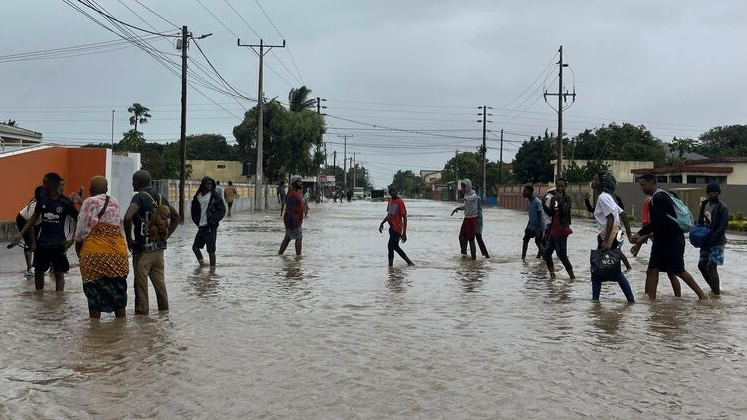
DESTRUCTION: Weeks of heavy rainfall across southern Africa have affected several countries, with Mozambique bearing the brunt of the floods, which have killed and displaced thousands of people…
By Nicholas Mwangi
Mozambique is grappling with one of its worst flood disasters in recent years after weeks of heavy rainfall, compounded by emergency dam water releases, left vast parts of the country submerged, killing several people and affecting hundreds of thousands.
The National Institute for Disaster Management (INGD) reported that, since October last year, flooding, triggered by persistent rains, has affected approximately 812 000 people across the country.
Rising water levels have destroyed homes, schools, health centres and key road networks, severely disrupting livelihoods and access to essential services, with the loss of infrastructure at USD 644 million. The provinces of Maputo, Gaza, Inhambane, Sofala and Zambézia have been the hardest hit, with widespread damage to infrastructure and agricultural land.
Although, in recent days, weather conditions have shifted, offering some relief to flood-affected areas. Uzna Malunga, based in Mozambique, told Peoples Dispatch that intense heat and sunshine over the past week have helped speed up recovery efforts.
“Since last week, the whole country has been experiencing very strong heat and intense sunshine. Under normal circumstances we would be complaining about it, but right now we are grateful because it’s helping to dry out the country faster,” she said.
She noted that access along major transport corridors have largely been restored, easing movement between provinces and supporting repair work.
“As of this week, the main roads have largely been restored. People are now able to move from one province to another, and we can see massive construction taking place on roads and highways,” Uzna added.
Despite the scale of the disaster, only a fraction of affected people are housed in formal accommodation centres. As of January 2026, 97 accommodation centres were hosting 100 153 individuals, representing 21 361 households.
Despite the scale of the disaster, those accommodated in official centres account for only about 16% of the total affected population. Also, 353 schools have been affected since January 7, as well as four bridges and 1 336 kilometres of road.
Uzna said much of the emergency response has been driven by communities themselves, amid political tensions that have hampered coordinated action.
“Most of the response has been mobilised by the population itself, since politicians transformed this crisis into an opportunity to attack each other,” she said.
Local communities converted schools, churches, and public pavilions into shelters for displaced families. As a result, the start of the school year has been delayed in several areas.
“The school period was announced to start later this year because many people are still sheltered in school buildings,” Uzna explained.
Displacement of thousands
Humanitarian agencies say that many displaced families are sheltering with relatives, in community buildings, or in spontaneous settlements that are not systematically monitored. Of the population currently hosted in accommodation centres, 25% are men, 38% women and 37% children, highlighting the impact on women and children.
The United Nations Children’s Fund (UNICEF) reported that preliminary government data indicate more than 513 000 people have been affected, over half of them children. UNICEF further noted that over 50 000 people have been forced to flee their homes and are currently sheltering in 62 temporary centres, many of which are overcrowded and lack adequate water, sanitation, and health services.
Food production has also been severely affected, according to La Via Campesina in Mozambique. In the country alone, nearly 60 000 hectares of cultivated land and more than 58 000 head of cattle and poultry have been permanently lost to flooding, affecting at least 83 000 peasant producers. This loss is expected to deepen food insecurity and increase the need for food assistance.
Mozambique is highly vulnerable to climate-related disasters, including floods, cyclones, and droughts, due to its long coastline, and major river basins. The current floods come as climate scientists warn that extreme rainfall events in southern Africa are becoming more frequent and severe, placing increasing pressure on already fragile infrastructure and disaster-response systems.
Beyond emergency shelter, communities have also taken the lead in providing support through informal networks.
“We self-organised fundraising efforts and support systems to help those affected,” Uzna said. While conditions have improved in some areas, concerns remain as the rainy season is not yet over.
“We know there is still more rain to come, so preparations are being made to endure what lies ahead,” she added. Authorities and humanitarian partners continue to carry out rescue operations, assess damage and scale up assistance. – People’s Despatch
MIRROR Briefs
GIGABA TO FACE THE MUSIC
The high-profile corruption case involving former Minister of Public Enterprises, Malusi Gigaba and several former top executives of Transnet has been postponed to 19 February.
Gigaba, former Transnet Group Chief Financial Officer Anoj Singh, former Group Chief Executive Officer Brian Molefe , former Chief Executive Officer Siyabonga Gama and former Chief Procurement Officer Thamsanqa Jiyane, appeared in the Palm Ridge Specialised Commercial Crime Court on Friday.
They face a string of charges including fraud, corruption and breaches of both the Public Finance Management Act and the Companies Act. Their case was postponed to allow the matter to be enrolled and be heard in the Gauteng High Court in Johannesburg.
Investigating Directorate Against Corruption (IDAC) spokesperson, Henry Mamothame, said the State confirmed on record that notices of trial and indictments had been served on all the accused.
“These indictments relate to the period during which Transnet embarked on the acquisition of locomotives to expand and modernise the country’s rail infrastructure,” Mamothame said. During this process, tender procedures were allegedly flouted and three contracts for the supply of 95, 100, and 1,064 locomotives were irregularly awarded, resulting in losses amounting to billions of rands for Transnet.
The State alleges that Gigaba accepted undisclosed amounts of cash from members of the Gupta family while serving as Minister of Public Enterprises. – Lehlohonolo Lehana.
AMAPANYAZA NOW PEACE OFFICERS
The Crime Prevention Wardens (CPWs) – popularly known as amaPanyaza – have been formally declared as Peace Officers in terms of Section 334 of the Criminal Procedure Act.
This was announced by the Minister of Justice and Constitutional Development, Mmamoloko Kubayi, during a joint media briefing with Police Minister Professor Firoz Cachalia and Gauteng Premier Panyaza Lesufi.
The wardens were disbanded last year following an investigation by the Public Protector (PP), which found that the CPWs’ establishment, appointment and deployment were not underpinned by an appropriate legislative framework and directed remedial actions to be taken.
Briefing the media, Kubayi assured that all the remedial actions directed by the PP had been acted upon.
“Government has worked collaboratively across spheres to address the legal deficiencies identified and to align the process with the applicable legislative framework. In this regard, over 9 000 wardens will be declared Peace Officers.
“The Minister of Justice and Constitutional Development has Gazetted and declared the Gauteng traffic wardens as Peace Officers and therefore making them lawful to operate.”
The CPWs will receive specialised and accredited training, and then absorbed by the Community Safety Department in Gauteng.
The Peace Officers may only exercise powers within a “specified jurisdiction, in relation to defined offences, and strictly within the scope set out in the declaration published in the Government Gazette. – SAnews
NEW WITNESS TO TESTIFY IN-CAMERA
KwaZulu-Natal Hawks head Lesetja Senona has wrapped up his testimony before the Madlanga Commission of Inquiry, which is probing allegations of political interference and corruption within law enforcement.
The new witness was expected to take the stand on Friday. However the commission postponed the hearings to Tuesday following a dispute by the witness legal team over preparation time and the procedure.
The new witness is a member attached to Organised Crime in Gauteng, who reports to suspended deputy national police commissioner, Shadrack Sibiya. He was previously implicated in money dealings which involved one of South Africa’s feared gangsters.
During the proceedings, his lawyer Hartley Ngoato, told the commission that his client had received more than 4,000 documents from the commission and had not had adequate time to review the documents. The witness also requested to testify in-camera.
The request was granted that the witness would not be identified, and would take the stand on Tuesday and testify in – camera.
Meanwhile, Acting Police Minister Firoz Cachalia has recommended placing the implicated officers in the commission’s interim report on precautionary suspension.
In its interim report, the commission has found prima facie evidence of wrongdoing against five senior SAPS members. – Lehlohonolo Lehana.
JUDGE PRESIDENT OFF THE HOOK
Eastern Cape Judge President, Selby Mbenenge escaped impeachment after the Judicial Conduct Tribunal found him not guilty of gross misconduct.
The complainant, Andiswa Mengo, had accused Mbenenge of sexual harassment and had “flirted” with him in “deeply sexual WhatsApp conversations”. She contended that the attention she received from Mbenenge was unwanted.
The complaint, initially lodged with the Office of the Chief Justice and later reviewed by the Judicial Complaint Committee (JCC), alleged sexual harassment by Mbenenge.
The JCC, on September 14, 2023, recommended a full investigation by a Tribunal, citing a prima facie case that, if substantiated, could lead to a finding of gross misconduct.
The Tribunal, comprising retired Judge President, B.M. Ngoepe, retired Judge C. Pretorius and Adv. M.G. Mashaba SC conducted the hearing. The tribunal ruled that Mbenenge’s actions including a flirtatious relationship with a court secretary, violated the judicial code of conduct, but were not serious enough to justify impeachment.
Mengo was found to have given false testimony. While the Tribunal found no evidence of gross misconduct, gross incompetence or gross incapacity, it did determine that Mbenenge was guilty of misconduct because he initiated and subsequently conducted a flirtatious relationship with Mengo at a place of work and during working hours. – Lehlohonolo Lehana.